

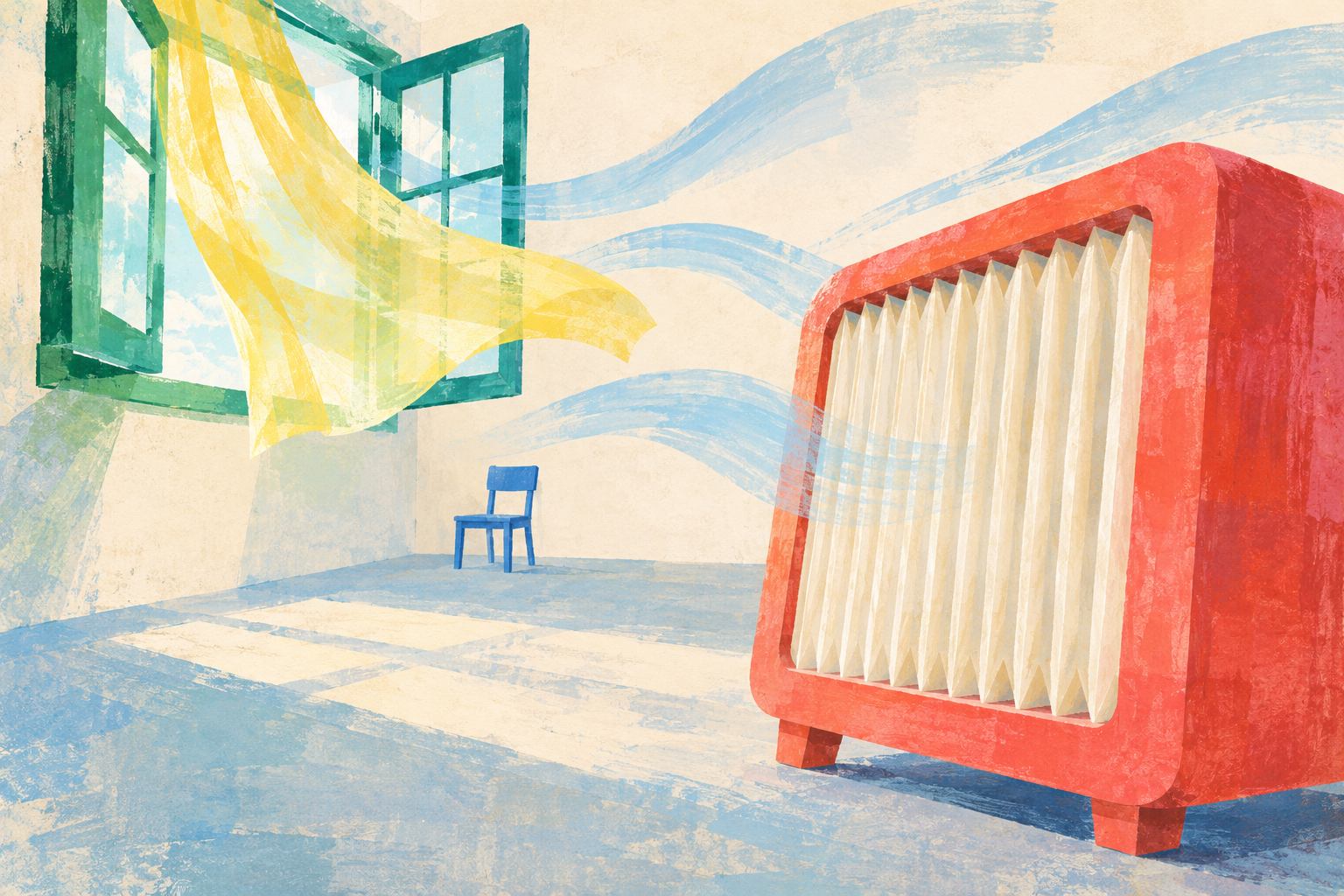
An open sea-green window, a billowing yellow curtain, and a coral air cleaner suggest the care behind a shared learning space. Original AI-generated editorial painting.
A practical way to improve shared rooms, choose suitable equipment, and keep the work going after the purchase.
By Arbab Naseebullah Kasi, Chief Executive Officer - CEO, Feel Worldwide Foundation Inc.
Illustrative scene: An evening class is about to begin in a borrowed community room. The chairs are ready. The projector works. Someone has brought extra pens. In the corner, a portable air cleaner is switched off because its highest setting makes conversation difficult.
The organizer remembers the receipt but cannot find the replacement-filter details. Nobody knows whether the building's ventilation runs after office hours.
This is an invented example, but it raises a useful planning question: who is responsible for the air in a room once people arrive?
Organizations put understandable care into the things participants can see. We check the entrance, prepare materials, and arrange a welcoming space. Indoor air deserves a place in that preparation too.
The practical goal is to reduce avoidable exposures and keep improvements working during real activities. No device or simple number can guarantee that a gathering is free of infection or other air-quality risks. A thoughtful plan can still make the room better prepared.
Start with the room as it is actually used
Before buying anything, walk through the room with the person responsible for the building. Bring the actual schedule, expected attendance, and a description of the activities.
A room used for two people answering emails is different from the same room hosting a crowded evening workshop. A building system that runs during the working day may have a different schedule after hours. Questions about the real use of the space belong near the beginning of the conversation.
Ask which systems supply outdoor air, which recirculate air, and who can explain their operation. Find out when equipment was last checked and where concerns should be reported. Record uncertainties rather than filling them with optimistic assumptions.
The U.S. Environmental Protection Agency's guidance for schools, offices, and commercial buildings recommends combining ventilation, filtration, and other appropriate measures. It also recognizes that building capabilities vary and professional help may be needed. EPA guidance for public indoor spaces.
A small organization does not need to turn its programme coordinator into a ventilation engineer. It needs a reliable route to someone qualified to assess the building, and a clear agreement about what the organization itself will manage.
Give each improvement a clear job
Three useful questions make a complicated subject more manageable.
First, can we reduce a pollutant at its source? Second, can appropriate outdoor air enter and indoor air leave? Third, can suitable filtration remove particles from the air?
These approaches do different work. A particle filter cannot replace every other measure. EPA explains that source control and clean outdoor-air ventilation are central to indoor air quality, with filtration providing a useful supplement. Filters cannot remove every pollutant, and an air cleaner does not fix the moisture problem that causes mold. EPA guide to air cleaners.
That distinction helps prevent a common purchasing mistake: asking a new machine to solve an old building problem.
If there is a recurring leak, report it through the building's maintenance process. If a room has a persistent air-quality concern, investigate the concern rather than covering it with fragrance or assuming a filter has resolved it.
Window opening also needs judgment. Outdoor conditions, weather, security, accessibility, and the building's design matter. Agree with the building manager when windows are appropriate and what to do when they are not. A simple instruction such as “always open everything” is too blunt for a shared facility.
For permanent changes to mechanical systems, get competent advice. The programme team can describe the problem and the activities; the responsible professional should assess technical changes.
Choose equipment for the room and the setting people will use
A product label can look reassuring while leaving practical questions unanswered.
For particle removal, EPA advises choosing a portable air cleaner with a clean air delivery rate, or CADR, suitable for the room. Its consumer sizing chart assumes an eight-foot ceiling, so room height also matters. Higher fan speeds generally filter more air than lower speeds. EPA equipment-selection guidance.
The implication for a learning space is straightforward: check performance at a setting people can tolerate during teaching.
Ask to hear a proposed unit while someone speaks at an ordinary volume. Consider people who use hearing aids, those following an unfamiliar language, and anyone who finds background noise difficult. A machine that is routinely turned off needs a different plan.
Before purchasing, ask the supplier or facilities professional:
What particle-cleaning performance will this unit provide at the intended operating setting?
Does the sizing account for the actual room and any connected open space?
Where can it stand without obstructing movement, access, or airflow?
What replacement filters does it need, how much do they cost, and are they available locally?
Who will handle a fault, a missing part, or a change in the room's use?
Avoid equipment that intentionally produces ozone. EPA identifies ozone as a lung irritant and cautions against ozone-generating devices in its public-building guidance. A claim that a product is powerful, innovative, or “hospital grade” should not substitute for relevant evidence and competent selection. EPA air-treatment cautions.
These questions make a donation more useful too. An offered machine may need a suitable placement, replacement parts, training, and an operating budget before it can serve anyone.
Use numbers with their limits attached
Numbers can help a team ask better questions. They become less useful when treated as certificates of safety.
CDC recommends aiming, when possible, for five or more clean-air changes per hour to help reduce viral particles. Outdoor-air ventilation and equivalent air changes from suitable air cleaning can contribute to that total. CDC describes five as a rough guide, rather than a universal rule, and explicitly says it does not guarantee completely safe air. More crowded spaces or higher-risk occupants may need a different level of protection. CDC guidance on clean-air changes.
An equivalent air change from filtration does not mean a roomful of fresh outdoor air has entered. It describes a cleaning contribution for a particular contaminant. The distinction matters when someone is choosing between ventilation and a device that only filters particles.
Ask a qualified person to explain the proposed target, the information used, and the limits of the estimate. Keep the explanation with the room plan so a later volunteer does not have to reconstruct it.
Carbon dioxide readings need similar care. CDC says CO₂ monitoring can provide information about ventilation, but a reading cannot tell you who is infectious, how much virus they are producing, or whether virus near a source is being adequately removed. Sensor placement and maintenance matter. CDC ventilation questions and answers.
ASHRAE also cautions that indoor CO₂ is not a general indicator of indoor air quality. Other pollutants do not necessarily follow the same pattern. ASHRAE position on indoor carbon dioxide.
If monitoring is used, agree beforehand who will interpret the results and what action a concerning pattern will trigger. Avoid placing a display on the wall and leaving participants to guess what its colors promise.
Make responsibility visible
Once the technical choices are made, turn them into a short operating plan.
Name a person responsible for the plan and a backup who can use it. Separate tasks the programme team can perform from work reserved for building staff or qualified contractors. A volunteer should never feel expected to improvise electrical repairs or alter a ventilation system.
The plan can fit on one page:
The room and activities covered.
The approved equipment, settings, and operating schedule.
The person responsible for routine checks.
The maintenance instructions and replacement-filter information.
The contact for faults or unresolved concerns.
The alternative arrangement if the room cannot be used as planned.
The date for reviewing the plan.
Keep the manufacturer's instructions available as well. A short local checklist should point to them, not invent a competing maintenance schedule.
Consider what happens when the regular organizer is away. Can a substitute find the equipment and understand the controls? Can they report a fault without searching through someone's personal messages? Is there authority to move or postpone an activity when a serious concern cannot be resolved?
Those arrangements are part of making the improvement dependable.
Budget beyond the first box
The purchase price is only the beginning of the resource decision.
Illustrative budget: Suppose a community group is considering an air cleaner priced at $300 and plans for two replacement filters at $45 each during the first year, based on its selected model's instructions and expected conditions. The equipment-and-filter subtotal is $390. Electricity, staff time, delivery, taxes, and any professional assessment remain additional costs.
These are invented figures, not market prices or a recommended replacement interval. Their purpose is to show why a $300 equipment grant may not cover a full year of use.
Before accepting restricted funding or donated equipment, clarify what happens after the initial contribution. A donor may be willing to support a maintenance period, a professional assessment, or suitable replacement parts if the organization explains the need.
For a funder, a helpful question is: “What will keep this working for the people who use the room?”
For the organization, the answer should include ownership of the work and a realistic way to pay for it.
Try a manageable first month
A small organization can begin with one regularly used room.
During the first week, gather the room's schedule, usual attendance, existing equipment information, and questions for the building manager. Include the evening or weekend organizer if activities happen outside normal hours.
During the second week, agree on the initial improvements and any assessment needed. Record the expected costs and who can authorize them. Decide what must be resolved before a particular activity goes ahead.
During the third week, test the operating arrangements in the way the room will really be used. Listen for equipment noise. Check that placement preserves access. Ask the person opening the room to follow the instructions without coaching.
During the fourth week, review what happened. Was equipment operating when intended? Were concerns passed to the right person? Did anyone repeatedly lower the setting or unplug the unit? Are replacement parts ordered through an actual process?
This is an illustrative implementation sequence, not a technical certification or a reason to delay urgent repairs.
Keep the evaluation proportionate. Equipment operating time, maintenance completion, and resolved faults can tell you whether your plan is being followed. They do not, by themselves, establish how many infections were prevented or prove that learning improved.
A more complete way to welcome people
A learner should not need specialist knowledge to ask whether a room has an air-quality plan. A volunteer should not have to absorb a new technical responsibility simply because nobody else was assigned.
Organizations can explain the measures they use, the limits they recognize, and how people can raise a concern. They can make reasonable participation arrangements without demanding that someone publicly disclose private health information.
This is a practical leadership task: ask informed questions, obtain the right help, fund the ordinary work, and check that the plan survives a busy week.
The next improvement may be modest. It could be confirming the evening ventilation schedule, choosing equipment people will actually use, or making sure a replacement filter has an owner and a budget.
Each is a concrete way to take the conditions of learning seriously.
If you would like to contribute expertise, resources, or a practical community idea, explore a partnership conversation with Feel Worldwide Foundation. You can also support the Foundation's work through a donation. Proposed activities and contributions are reviewed for suitability, responsibilities, and available capacity.
