

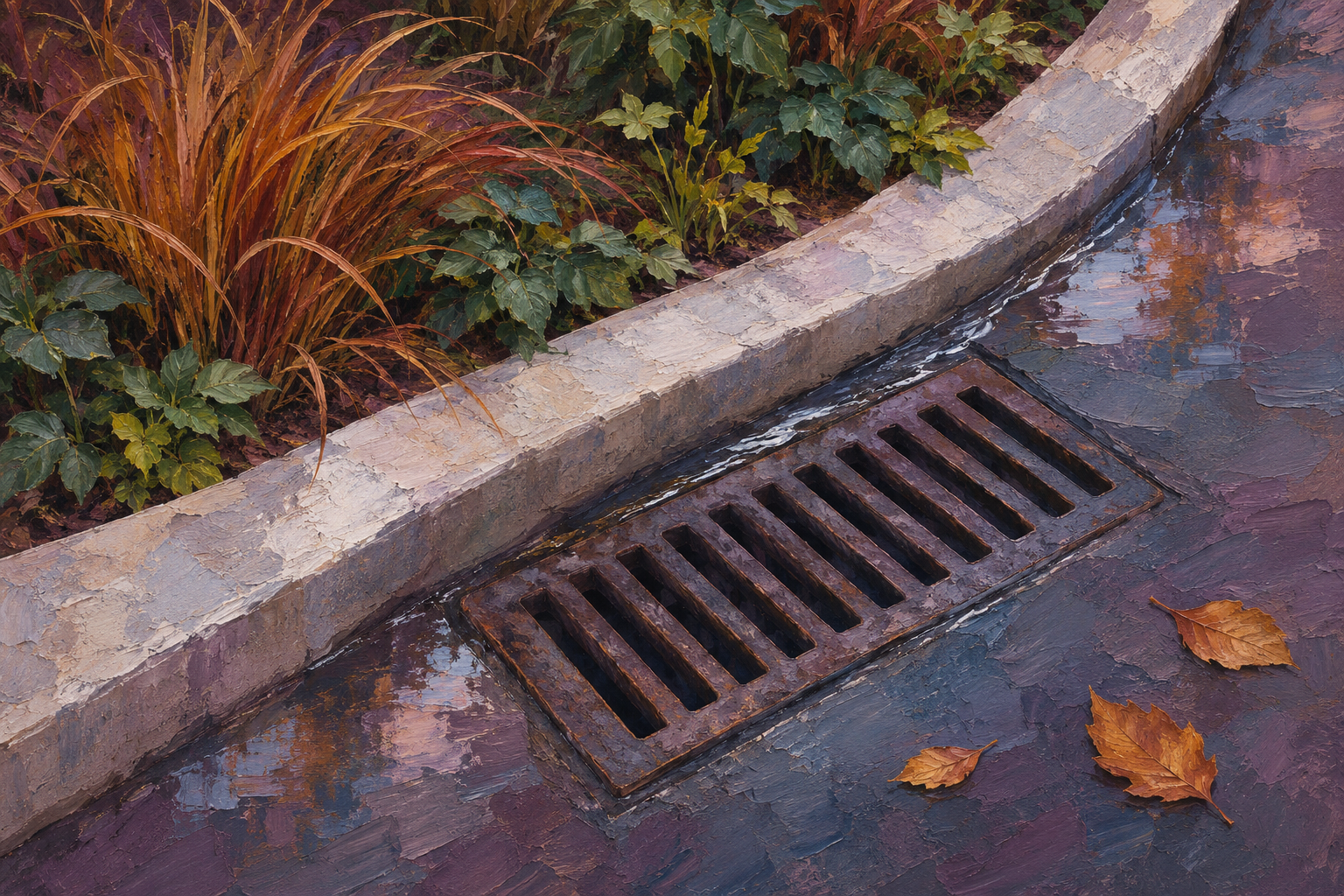
An imagined street drain beside a curved curb and planted verge after gentle rain. This original painting is an editorial illustration, not a drainage design or a photograph of a Foundation project.
Practical maintenance and clear reporting can strengthen flood readiness when communities respect the limits of every system
By Arbab Naseebullah Kasi, Chief Executive Officer - CEO, Feel Worldwide Foundation Inc.
Illustration: An imagined street drain beside a curved curb and planted verge after gentle rain. This original painting is an editorial illustration, not a drainage design or a photograph of a Foundation project.
For most of the year, a street drain asks for little attention. We step over its grate, pass it on the way to work, or park nearby. Then rain arrives, leaves gather at the curb, and an ordinary piece of infrastructure becomes much easier to notice.
The useful moment to notice it is earlier.
Well before a storm, a community can learn who maintains its drains, how to report a recurring problem and which small actions are safe. It can also ask harder questions about pipes, runoff and the places where water collects. Those questions matter because a clear grate is only one part of a functioning drainage system.
This is work for residents, property managers and public agencies together, with different responsibilities. Residents can provide observations. Trained crews maintain infrastructure. Engineers investigate capacity and design changes. Emergency services handle immediate danger. A good local approach makes those boundaries easy to understand.
Follow the water beyond the grate
A catch basin receives runoff from the street and connects it to a drainage network. A blockage at the surface can stop water entering. Trouble may also lie farther along the route, where a pipe is obstructed, an outlet is constrained or the system has more water than it can carry.
EPA explains that municipal separate storm sewer systems often discharge runoff into local waterways without treatment. In a combined sewer system, stormwater and wastewater share pipes; wet-weather flows can overwhelm capacity and produce overflows containing untreated or partially treated sewage. Knowing which system serves an area helps explain why both drainage and pollution prevention matter.
Street drainage is a different service from supplying safe drinking water. A drain carrying water away does not make that water clean, and it says nothing about whether a household's drinking supply is safe. Never pour paint, oil, wash water or other waste into a street inlet. Use the disposal arrangements specified by the local authority.
The same distinction matters when looking for solutions. A drain at the lowest corner of a street may be where a problem becomes visible, without being the place where the problem began. Clearing that corner repeatedly cannot substitute for investigating the wider flow of water.
Keep routine care within safe boundaries
Some municipalities invite residents to help keep the surface of drains free of ordinary leaves and litter. Others have different arrangements. Check the local program first rather than assuming that public infrastructure is available for informal repair.
New York City's Adopt-a-Catch Basin pilot, described for East Greenpoint in Brooklyn, makes a useful distinction. Volunteers clear debris from the grate. Cleaning the inside belongs to the Department of Environmental Protection, which uses specialized equipment. Participants receive guidance, and the program asks them to report observations. Its clearing guide directs people to work from the sidewalk and stay out of the roadway.
Bothell, Washington, makes the limits explicit in its Adopt-a-Drain guidance. Do not lift the grate. Stay out of the street. Leave needles, chemicals and other dangerous materials alone and report them to the city. These are useful safety boundaries even where the local volunteer arrangements differ.
If an approved local program permits surface clearing, do it only in safe, dry conditions, in daylight, from a secure position away from traffic. Use the program's recommended tools and protective equipment. Collect ordinary debris for appropriate disposal rather than pushing it through the openings. If access is unsafe, report the issue instead.
Never enter a drain, manhole, culvert or other confined space. Do not reach into the system, lift covers, improvise barriers in the road or try to clear an inlet while floodwater is moving toward it. Do not send children into the street to help. A volunteer activity must never become an improvised rescue or engineering job.
People who cannot safely undertake physical work still have an important role. A clear report, a translated explanation of the local reporting process or a reminder to a property manager can be useful contributions. Participation should not depend on strength, mobility or willingness to accept risk.
Make a report that someone can use
“The street floods” describes a serious concern, but a maintenance team needs enough detail to find and assess it. From a safe place, record the location, the nearest intersection, the side of the street and any visible identifying number. Describe what you actually observed and when.
Useful distinctions include a grate covered with leaves, a damaged or missing cover, water remaining after rain has stopped, or recurring ponding despite a clear surface. A photograph can help when it can be taken without approaching traffic or floodwater. Nobody should enter water to measure its depth or obtain a better image.
NYC311's catch basin reporting page distinguishes blocked basins, structural problems and missing covers. It also points to separate routes for dumping, odors and street flooding unrelated to a clogged basin. Other communities organize their services differently. Find the correct local route in advance, including the emergency route for immediate danger.
An illustrative report might read: “The grate at the northeast corner of [intersection] appears clear from the sidewalk. Water remained across the curb ramp at [time] after the rain stopped. The same location was reported under reference [number] on [date]. Please assess the recurring drainage problem.” This is a template, not a record of an actual event.
Keep the reference number and any response. If the problem returns, explain that it recurred rather than simply submitting the same description without history. Ask whether the matter has been referred for an engineering investigation when routine maintenance has not resolved it.
For public agencies, closing the communication loop is part of the service. Residents should be able to learn whether a blockage was removed, an inspection found another cause, or a larger repair is pending. “Closed” is more useful when it comes with an understandable explanation.
Read maintenance numbers for what they show
In testimony dated October 22, 2025, NYC DEP reported that 98 percent of more than 87,500 catch basins inspected in fiscal year 2025 were functional. It described a data-informed inspection schedule introduced in 2023 and additional cleaning trucks. The same testimony reported 3.47 inches of rainfall in one hour at Central Park during Hurricane Ida on September 1, 2021.
These figures answer different questions. The first is an agency-reported measure of the basins inspected in a particular fiscal year. It is not a finding that 98 percent of all streets were protected, nor proof that maintenance caused a particular reduction in flood losses. The rainfall figure describes one measuring location and event, not uniform rainfall across the city.
Both belong in a serious discussion. Maintenance helps available infrastructure do its job. Intense rainfall can still exceed what the wider system can manage. A neighborhood should not have to choose between requesting reliable maintenance and asking whether its infrastructure needs improvement.
A useful local review can consider inspection coverage, time to resolve urgent defects, recurring problems and locations still awaiting assessment. It should also describe the conditions under which performance was observed. A dry season and a season of intense storms do not provide interchangeable tests.
Give water more places to go before it reaches the street
Green infrastructure can manage some rainfall closer to where it falls. EPA describes approaches using plants, soil and permeable surfaces to store, infiltrate or return water to the atmosphere. Properly designed measures can complement pipes and other conventional infrastructure. They do not remove the need for those systems. See EPA's overview of green infrastructure.
A rain garden, planted drainage feature or permeable surface may be appropriate in one location and unsuitable in another. The important question is what the site can safely accommodate. According to EPA's design guidance, poorly draining soils may require designs that do not depend on infiltration. Groundwater, contamination, vegetation and maintenance access also require attention. Local design standards and qualified professional advice matter.
Before a school, business or neighborhood association funds a project, ask where its water will come from, where excess water will go and who owns the land. Check permissions, utilities and responsibilities with the appropriate authority. Do not disconnect downspouts, excavate public land, alter a ditch or redirect runoff toward neighboring properties on the strength of a general article.
The design should explain what happens when its capacity is exceeded. EPA's flood mitigation guidance points to hydrologic and hydraulic modeling to help communities select combinations of green and conventional infrastructure. That kind of assessment supports a realistic proposal. A photograph of a successful rain garden somewhere else does not establish how a new site will perform.
The value of a proposal also depends on everyday use. Will pedestrians retain an accessible route? Can maintenance crews reach the site? Does the plan preserve the entrance a shop needs for deliveries? Asking these questions early can prevent a well-intended improvement from creating another problem.
Fund the care that follows construction
A new planting is easy to photograph. A maintenance budget is harder to celebrate, but it helps determine whether the project will still function years later.
EPA's installation and maintenance guidance calls for written maintenance arrangements, responsible parties, inspection schedules, trained personnel and funding. It also notes that different installations behave differently: some are designed to retain water, while water remaining in others can indicate a problem. Residents need an explanation of what normal operation should look like at their particular site.
For any proposed project, ask for a named owner and a realistic plan for routine work, specialist repairs and replacement. Confirm who will remove sediment, inspect inlets and respond when vegetation fails. Establish how a concern becomes a work order and how completion will be checked.
Community organizations can help residents understand those arrangements, but volunteers should not quietly become the replacement for a missing public maintenance service. If the only answer to an essential task is “someone will probably do it,” the plan is unfinished.
Make the records simple enough to keep using. A modest register with locations, observations, responsible teams, dates and unresolved issues can be more useful than an ambitious system nobody updates. The purpose is to support action and learning, not to produce an impressive count of entries.
Prepare for the storm that maintenance cannot solve
Even a well-maintained neighborhood needs a flood plan. Before severe weather, know safer routes, plan how household members will communicate and consider the needs of anyone who may require assistance. The National Weather Service's preparation guidance recommends an emergency kit, advance planning for evacuation and knowing how to reach higher ground.
Once flooding begins, stop thinking about drain care. Follow official instructions and move away from danger. The National Weather Service advises people to avoid walking or driving through floodwater, obey evacuation orders and stay out of rooms where water may be in contact with electrical outlets or submerged cords. Report immediate threats through the local emergency service.
The presence of a familiar drain can create false reassurance. Water may conceal a missing cover, damaged pavement or other hazards. A person standing at a window may see the grate they normally maintain, but that does not make it safe to approach during a storm.
Afterward, wait until authorities say conditions are safe before checking what happened. A report about recurrence can guide further investigation. It should never come at the cost of entering contaminated water or an unsafe structure.
Make responsibility visible on an ordinary day
The practical starting point can be small: identify the responsible service, save its reporting route and understand the limits of any volunteer role. Property managers can review their own approved maintenance arrangements. Community groups can ask how unresolved drainage problems are prioritized and how residents will hear back.
For officials and funders, the question extends beyond how many assets were installed. Who will care for them? What evidence will show that maintenance occurred? Which recurring problems need a different kind of intervention? How will people with less time, limited internet access or language barriers be heard?
There is no promise here that a tidy gutter will prevent every flood. There is a practical opportunity to reduce avoidable blockages, improve reporting and make better decisions about the infrastructure people depend on. The drain at the end of the street deserves attention before the street fills with water.
Organizations interested in discussing a defined community-resilience collaboration with Feel Worldwide Foundation Inc. can submit a partnership inquiry. Describe the location, local authority involvement, proposed contribution and maintenance responsibilities so that scope and feasibility can be considered. An inquiry is not a commitment to provide engineering services, funding or a drainage project.
To support the Foundation's broader mission, visit the donation page and review the available giving options and terms. This article does not establish a dedicated stormwater fund or promise that a gift will finance the activities discussed here.
