

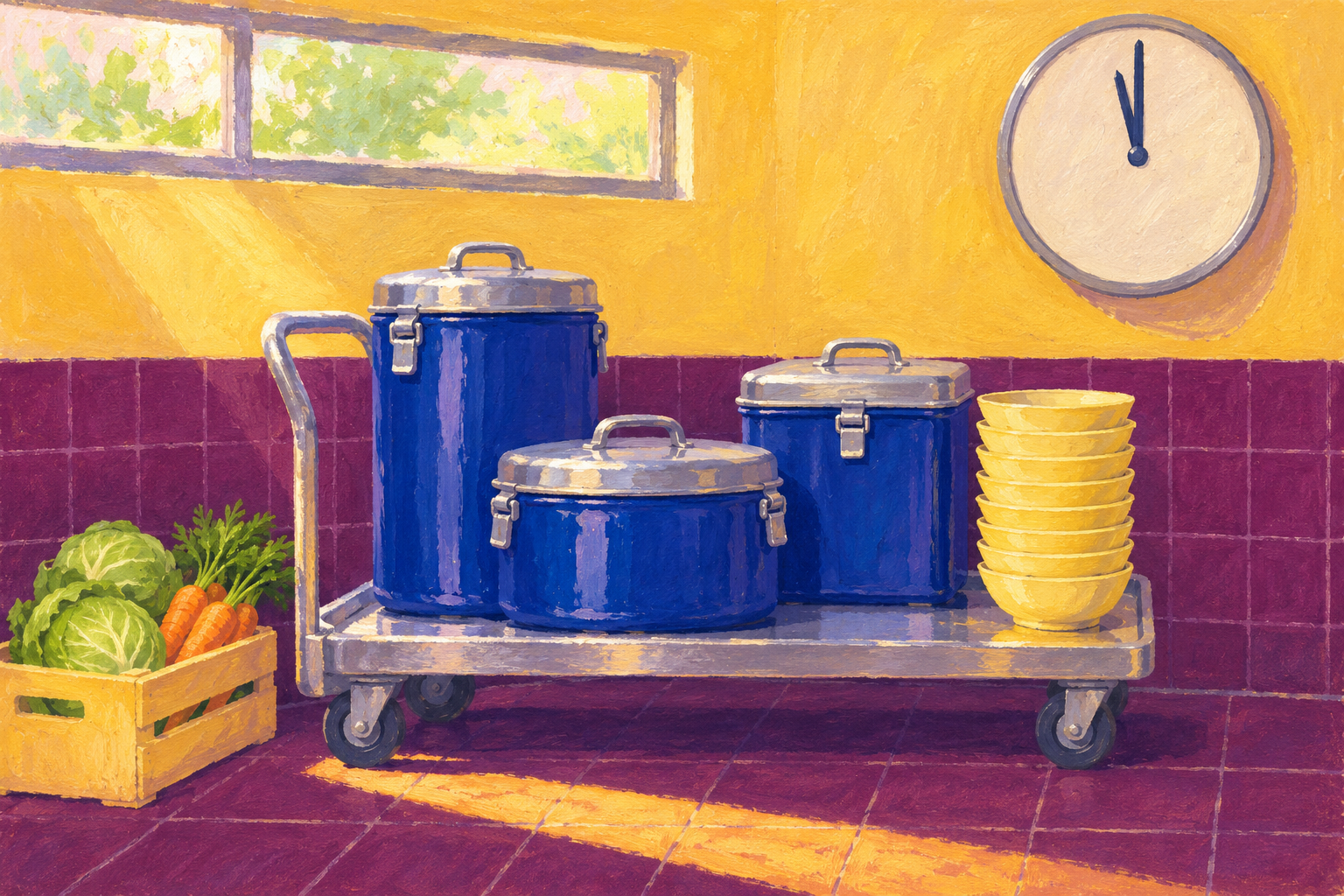
Blue meal carriers, stacked bowls and fresh produce await the school lunch service. Original editorial painting about the preparation behind dependable school meals.
Make nutritious food dependable and welcoming for every child who needs it
By Arbab Naseebullah Kasi, Chief Executive Officer - CEO, Feel Worldwide Foundation Inc.
Before a child takes the first bite, many adults have already made decisions about that meal. Someone approved the budget, selected a supplier, planned the menu and arranged the delivery. Someone decided how a family would apply, where children would queue and how much time they would have to eat.
Those decisions can make lunch an ordinary, reassuring part of school. They can also leave a child eligible for food but unable or unwilling to receive it.
School meals deserve attention as a daily public service. Their value includes access to nutritious food and relief for family budgets. Their success depends on much more than announcing a program or counting the meals leaving a kitchen. The food has to arrive, suit the children who will eat it and be offered without humiliation.
For school leaders, public agencies, community organizations and potential partners, the practical task is to build a service children and families can trust. That requires careful evidence, dependable operations and the willingness to listen when the planned meal and the lunchtime experience do not match.
A large commitment with a very local test
The World Food Programme's State of School Feeding Worldwide 2024, released in September 2025, reported that at least 466 million children received school meals through government-led programs. That was nearly 80 million more than in 2020. WFP also reported global funding of US$84 billion in 2024, with 99 percent coming from national budgets. These are global coverage and financing estimates, not a measure of meal quality at every school. WFP's report announcement explains the figures and links them to the biennial report.
The scale is encouraging. It also makes everyday delivery worth examining closely. A national policy reaches a child through a particular school, kitchen and lunchtime routine. An increase in coverage can coexist with shortages, inaccessible dining spaces or menus that some children cannot use.
Ask a more precise question than whether a school has a meal program: on an ordinary Tuesday, can a child obtain an appropriate meal, eat it comfortably and return to class without having been singled out?
That question draws attention to the last few practical steps. An application left incomplete, a missing allergy substitution or a queue that consumes the lunch break can interrupt access even when the funding and the intention are sound.
Be precise about what the evidence shows
Nutrition, participation and academic achievement are different outcomes. A program may improve one without producing a measurable change in another. Combining them into a single promise makes evaluation less useful and public communication less credible.
USDA's nationally representative School Nutrition and Meal Cost Study collected data in the 2014–2015 school year. Its menu analysis covered 1,207 schools. School lunches served had an average Healthy Eating Index score of 81.5 out of 100, compared with 57.9 in the earlier 2009–2010 study. The index measures alignment with dietary guidance. The comparison is evidence of improved nutritional quality across those study periods; it does not establish what every child ate or what any particular lunch did to a test score. USDA's nutritional characteristics summary sets out the methods and findings.
The same study's student research included 2,165 students and interviews with 1,850 parents or guardians. Many food-group and nutrient differences between the lunches of participants and matched nonparticipants did not persist across the full day's intake. This is a useful reminder to distinguish the quality of the school meal from the quality of a child's entire diet. USDA's participation and dietary intake summary reports those results.
A separate USDA experiment offers an especially clear lesson about academic claims. In a three-year pilot beginning in 2000–2001, elementary schools in six districts were randomly assigned to universal free breakfast or the regular means-tested breakfast program. There were 79 treatment schools and 74 control schools. Participation in treatment schools rose from 19 percent at baseline to 36 percent in the first year, but universal availability did not improve academic outcomes beyond those seen in the comparison schools. This was a test of expanding free access where breakfast already existed, not a test of feeding children versus giving them no breakfast. The evaluation's executive summary makes that scope explicit.
These findings do not settle every question in every country. They show why the claim should match the study. Children should not have to demonstrate a rise in examination scores to justify access to a decent meal. Nutrition and dignified access are worthwhile public purposes in their own right.
Remove the embarrassment from getting lunch
A meal service communicates who belongs. Separate queues, public discussion of unpaid balances or a visibly inferior substitute can make a child carry information about family finances into the dining room.
The design goal should be an ordinary experience. Where eligibility rules apply, explain them clearly, offer help with applications and protect household information. Review the whole process from the child's perspective, including payment systems, staff language and the handling of mistakes. A family should be able to ask a question without its child becoming the subject of one.
Research with students helps explain why these details matter. A California qualitative study used 17 virtual focus groups with 67 middle and high school students from nine regions in June and July 2022. Participants appreciated the accessibility, simpler payment process and reduced stigma of universal meals during the federal pandemic waivers. They also raised concerns about food quality and quantity. These are accounts of student experience from a specific sample and period, not a national estimate or a controlled measure of the policy's effects. The 2024 study records both the benefits and the concerns.
Universal provision can simplify the experience of receiving food. Targeted programs also need deliberate safeguards for dignity. In either model, adults remain responsible for making the service respectful. A funding formula cannot do that work by itself.
Give students a private, accessible way to report a problem. Tell them what happened after they raised it. Complaints about portion size, a repeated missing option or unkind treatment should reach someone with authority to make a change.
Let the menu reflect the people eating it
A nutritionally planned meal still has to be recognizable and acceptable to the child. Cultural fit includes familiar ingredients and preparations, religious requirements and the way a meal is served. It also requires enough choice to avoid treating a whole community as if everyone in it eats the same food.
Ask families and students before making assumptions. Use translated information where needed. Include children who rarely take a school meal, because a survey of current diners alone may miss the reasons others stay away. Explain the nutritional and budget constraints honestly, then invite practical suggestions within them.
Allergies and medically necessary diets require a separate, competent process. Religious needs, sensory sensitivities, disabilities and assistance with eating also deserve attention. A generic alternative is not automatically appropriate for everyone. Schools should work with qualified staff, families and relevant professionals to establish safe arrangements without making children publicly explain private needs.
Consider an illustrative school reviewing a bean dish that many students decline. Staff might discover that children recognize the ingredients but dislike the texture, or that the name on the menu gives families too little information. A small, voluntary tasting with two preparation methods could help identify a workable change. This is an example of a decision process, not a report of a Foundation activity or a guaranteed result.
Listening also means examining the setting. In a qualitative evaluation of universal free meals in two London secondary schools, researchers interviewed 20 parents, 28 students and eight staff from the participating schools, alongside four staff from other schools. Participants supported the approach but identified barriers including kitchen and dining capacity, meal choice and queues. The authors called for larger studies of longer-term outcomes. The 2023 evaluation offers implementation lessons, not proof that the same design will work everywhere.
An improved recipe will achieve little for a child who reaches the front of the queue just as the break ends. Food, time and the physical environment need to be planned together.
Make local purchasing workable for suppliers
School meals can create demand that local farms and food businesses are able to plan around. FAO describes sustainable public food procurement as connecting institutional demand with smallholder farmers and smaller enterprises, in pursuit of social, economic and environmental goals. Its procurement guidance includes resources on home-grown school feeding.
The opportunity depends on the purchasing arrangements. A small producer may grow excellent food yet be unable to finance months of deliveries before receiving payment. A contract may be too large, too complicated or too unpredictable for a local business to accept responsibly.
Start with the menu and actual supply capacity. Agree on quantities, quality requirements, delivery windows and permitted substitutions. Explain how suppliers will be selected and inspected. Where procurement rules allow, consider contract sizes that smaller businesses can fulfill, or transparent arrangements through producer groups. Local preference should sit alongside food safety, nutritional quality, fair competition and value for money.
Payment deserves particular attention. WFP's evaluation of Malawi's Healthy Future Home-Grown School Feeding Project, covering 2020 to 2023, recommended measures to address delayed school payments and the resulting cash-flow problems for farmers. That is a documented operational concern in one program, not a statement about all local procurement. The evaluation summary provides the context.
A school system should know who approves an invoice, how an error is resolved and when the supplier can expect payment. Calling a supplier a partner while leaving it to absorb unpredictable financing costs weakens the relationship.
Plan for seasonal availability and disrupted harvests as well. Local sourcing can be valuable without requiring every ingredient to come from nearby. A sensible contingency protects the meal service and avoids promises that farmers cannot safely make.
Pay for the work that makes meals dependable
The cost of a meal includes more than its ingredients. Kitchens need trained staff, appropriate equipment, safe water, cleaning supplies, storage, energy and maintenance. Delivery systems need vehicles or other reliable transport, clear responsibilities and procedures for delays. Each setting will have different requirements, but none can operate indefinitely on goodwill alone.
Staff should know what to do when a shipment fails inspection, a refrigerator breaks or the number of children arriving exceeds the forecast. Substitutions need to remain safe and suitable. The person making that decision needs the authority and information to act before lunchtime, rather than after a complaint reaches the office.
Keep the daily records practical: planned service, actual service, significant shortages, safety issues and the action taken. Use the information to solve repeated problems. Collecting a form every day has little value if no one notices that the same school loses its delivery twice a month.
Continuity also requires honest communication with families. School-day meals do not automatically cover weekends, holidays or closures. Explain the calendar, any separate support that is actually available and how families can find it. Do not imply that an unconfirmed alternative exists.
For potential donors and partners, the less visible needs may be the most useful place to start. Before offering equipment, ask whether it fits the kitchen, whether anyone can maintain it and whether installation and operating costs are funded. Before supporting additional meals, confirm the capacity to prepare and serve them safely.
Judge the service by what children can rely on
A useful review combines numbers with experience. Count how many children are reached, but also check how consistently the planned service happens and who remains excluded. Review nutritional quality with qualified professionals. Ask about taste, portions, waiting time, respect and the usability of alternatives.
A small set of questions can keep the review grounded:
Were appropriate meals available on every planned service day, including for children needing agreed alternatives?
Could children obtain and eat them without unreasonable delay or embarrassment?
What did students and families say needed to change, and what response followed?
Were staff equipped to do the work and suppliers paid within agreed terms?
Do the reported outcomes reflect what was measured, over the period and population actually studied?
Protect children's privacy when collecting this information. A school can learn about barriers without publishing names, household finances or medical details. Use results to improve the service rather than to reward the most flattering report.
School meals feed more than the school day because the decisions behind them reach into family budgets, local livelihoods and children's experience of belonging. Those wider possibilities begin with a modest promise kept repeatedly: suitable food will be there, and receiving it will be ordinary.
Schools, nutrition professionals, community organizations and responsible suppliers interested in exploring a practical collaboration with Feel Worldwide Foundation Inc. can submit a partnership inquiry. Describe the local need, proposed contribution and delivery responsibilities so that fit, capacity and scope can be considered before commitments are made.
To support the Foundation's broader charitable mission, you can make a donation. Any designated support should follow the purpose and terms of the specific fund; this article does not announce an existing Foundation school-meal program or promise a number of meals per gift.
