

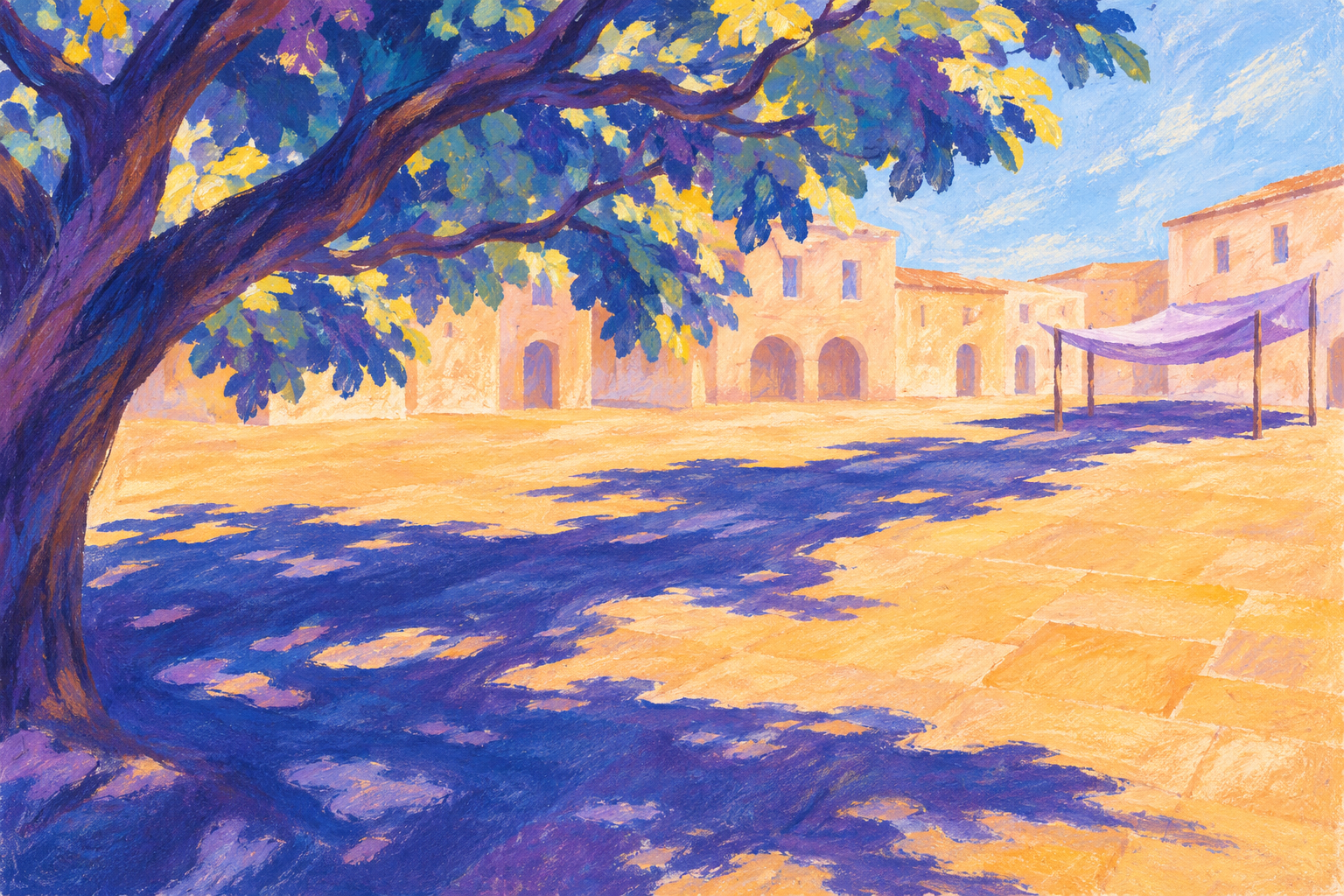
A ribbon of tree shade crosses a sunlit square toward a fabric canopy, connecting places of relief along an everyday route.
Bring useful shade to the routes and waiting places people depend on
By Arbab Naseebullah Kasi, Chief Executive Officer - CEO, Feel Worldwide Foundation Inc..
Imagine a community centre with a shaded garden behind it and an exposed entrance at the front. The garden looks inviting in photographs. But on a hot afternoon, the people waiting for the doors to open are standing beside a bare wall, outside the reach of every tree.
The site has shade. The service does not.
That distinction matters when we plan neighbourhood improvements. A canopy somewhere on a property is not the same as relief where people must spend time. The practical question is whether someone can reach useful shade while continuing the journey or activity that brought them there.
For a person waiting for a bus, collecting a child or lining up for a community service, moving into a cooler place may mean losing their place, missing their transport or abandoning the task. Their exposure is partly shaped by a design decision made long before they arrived.
Shade deserves a place in those decisions from the beginning. It should be considered alongside the location of entrances, walking routes and waiting areas, rather than added only if money remains at the end.
Start with the conditions at ground level
A street can look attractive on a plan and feel difficult to cross in the afternoon. Trees may be concentrated around the edge of a development while the routes connecting its buildings remain exposed. A shelter may cast its shadow behind the place where people actually stand.
The U.S. Environmental Protection Agency explains that buildings, roads and other hard surfaces absorb and release heat differently from natural landscapes. It also distinguishes surface temperature from air temperature. A hot pavement reading and a weather-station reading describe different things; they should not be presented as interchangeable evidence. EPA explanation of heat islands.
For a community organisation, this is a reason to be precise rather than a reason to postpone action until it can commission a sophisticated study. Start by identifying where people wait, when they wait and whether shade reaches those locations.
A photograph taken at opening time can reveal something that a general tree count cannot. So can a short conversation with a regular bus passenger who knows which side of the shelter is usable after lunch.
Neither observation proves that a location is safe in extreme heat. They help identify a design problem that deserves proper assessment.
Give priority to places people cannot easily avoid
An attractive shaded corner may be pleasant without addressing the most pressing need. Priorities should reflect how people use a place, including the choices they do not have.
Begin with unavoidable waiting and essential journeys. Consider the stop serving a clinic, the entrance to a food distribution service, the school pickup area, or the path between affordable housing and public transport. Ask where a person cannot simply leave and return at a cooler hour.
Phoenix provides a concrete planning example. Its City Council adopted the Shade Phoenix Plan in November 2024. The city's description focuses on residents most vulnerable to heat and places where people spend time outdoors, including journeys to work, bus stops and local parks. That is a useful example of choosing locations around people's exposure rather than treating additional shade as decoration. It is a policy approach, not proof that every planned improvement has already been completed. City of Phoenix tree and shade programmes.
A local priority list should also consider how long people remain at each location, whether an alternative exists and whether the shaded area is accessible. A distant park does little for someone who must stay within sight of an arriving vehicle.
Residents can help identify these details. Ask about the actual journey, not only whether they would like more trees. Where does the walk become uncomfortable? Where do they stop? Which opening hours leave them waiting outside?
Choose trees and structures for the place they must serve
Trees offer more than a shadow. The EPA describes how vegetation reduces heat through both shade and evapotranspiration, the movement and evaporation of water through plants and surrounding soil. Those processes help explain why tree cover belongs in community heat planning. EPA guidance on trees and vegetation.
But the choice need not be limited to either planting or building. An existing healthy tree may provide valuable cover that should be preserved. A well-designed structure may address an immediate gap while new trees grow. Some sites will need both.
In a 2016 field study at Arizona State University's Tempe campus, researchers combined weather observations with surveys of 1,284 people. Shade improved reported thermal comfort in every season except winter, and the researchers found no significant difference in perceived comfort between the tree shade and photovoltaic canopy shade they studied. The finding comes from a particular hot, dry setting. It does not establish that all trees and all structures perform equally in every climate. Middel and colleagues' shade study.
The useful lesson is to examine performance in context. A tree requires suitable growing conditions and continuing care. A structure needs appropriate design, installation and upkeep. Local climate, water availability, utilities, access and the shape of the site all belong in the decision.
Qualified local advice is particularly important for species selection, structural safety and approvals. A promising idea on a sketch is not an installation plan.
Check the hour as carefully as the location
A roof above a waiting area does not guarantee that the waiting area will be shaded when people use it. The sun's position changes through the day and across seasons. A design that works at noon may leave an afternoon queue exposed.
Before committing to a solution, name the hours it needs to serve. A school entrance and an evening market may require different arrangements even if their available space looks similar.
Assess the footprint of the shadow at those times. Consider the accessible approach as well as the destination. There is little value in creating a shaded waiting area that a wheelchair user cannot enter without crossing an obstructed route.
Capacity matters too. A small patch that accommodates two people may be inadequate for a regularly crowded stop. People should not have to compete for relief or leave someone else standing in the sun because the design counted the structure rather than the users.
Sun protection also extends beyond thermal comfort. The Centers for Disease Control and Prevention identifies tree coverage and built shade at places such as bus stops, playgrounds and parks as community strategies for reducing ultraviolet exposure. That is another reason to assess the protection a design provides, not simply its appearance. CDC community sun protection strategies.
Budget for shade that will still be there later
A planting ceremony or installation day is a beginning. The benefit depends on what happens afterward.
For trees, establish who will oversee watering, inspections and appropriate maintenance, with a realistic allowance for local conditions. For a structure, identify responsibility for checking its condition, arranging repairs and replacing worn components. Confirm who owns the land and who has authority to act before a problem occurs.
An organisation should be able to answer a simple question: if the shade becomes unusable next month, who receives the report and who can approve the repair?
This is especially important when a donor funds the initial work but a different organisation inherits the operating costs. A gift can be welcome and still create an unfunded responsibility. Include the receiving organisation in the design and budget before announcing the project.
Existing shade should also enter the discussion. Removing a mature tree and promising several new ones does not necessarily preserve the shade people can use today. The appropriate response depends on tree condition and site safety, but the short-term loss should be considered explicitly rather than hidden inside a planting total.
Try the approach on one everyday journey
Consider an illustrative community centre that wants to improve the route from its nearest bus stop to its entrance. The centre does not own the whole route, so its first task is to establish which parts belong to the transport operator, the municipality and the property owner.
Staff and residents then identify two recurring problems: an exposed wait at the stop and a queue outside the centre before a weekly service begins. These are observations for the example, not findings from a reported project.
The centre can address its own queue by reviewing opening arrangements and assessing an approved shade option. It can bring the bus-stop problem to the responsible agency with photographs, relevant times and a clear description of how the stop is used.
This makes the request more useful than a general appeal for a greener neighbourhood. It identifies the location, the affected activity and the hours when the gap matters. It also separates changes the centre controls from those requiring a partner's decision.
A carefully approved temporary arrangement may help test placement before a permanent installation. Any trial still needs appropriate safety checks, accessibility and permission. Temporary does not mean exempt from responsibility.
After a change, return at the same relevant times. Does the shadow reach the queue? Can people enter and leave comfortably? Has the improvement created another obstruction? Those questions help refine the next investment.
Measure usable relief rather than impressive totals
Counting trees planted or structures installed is useful for tracking work. It is not enough to show what people gained.
A more informative record would include the priority location, the hours when useful shade is available, the waiting area it covers and whether it remains accessible. Add a maintenance contact and a date for checking the site again.
If temperatures are measured, identify what was measured and under what conditions. Do not turn a cooler surface reading into a claim that the surrounding air fell by the same amount. Likewise, a small local project should not claim to have reduced illness unless it has evidence capable of supporting that conclusion.
Shade is also one part of heat protection. CDC guidance includes limiting exposure, taking breaks, using cooler times of day where possible and accessing air-conditioned spaces. A shaded outdoor location should not be advertised as safe in all conditions or treated as a replacement for a broader heat response. CDC heat and health guidance.
The community development question remains practical: can people complete ordinary activities with less avoidable exposure?
A good answer may begin with one entrance, one stop or one stretch of pavement. When shade is placed where the need actually occurs, a design detail becomes a service people can use.
