
Before You Start a New Community Program, Map What Already Exists
A practical asset-mapping method for finding local skills, spaces, groups, services, and relationships before adding something new.
When a community names a serious problem, the instinct to create something new can be immediate. A group may propose a learning center, a food distribution point, a volunteer team, a youth club, or a referral service before anyone has asked what already exists nearby. The urgency may be sincere, but starting from a blank page can duplicate work, overlook trusted local knowledge, and spend scarce time on infrastructure that another organization or resident is already willing to share.
Community asset mapping offers a more grounded starting point. It does not deny unmet needs or suggest that every neighborhood can solve a structural problem with volunteer effort alone. It asks a practical question first: which people, skills, places, groups, services, tools, and relationships are already present, and which of them could responsibly contribute to the next small step? The answer can reveal a faster pilot, a more credible partner, or a reason to redesign the idea before money is committed.
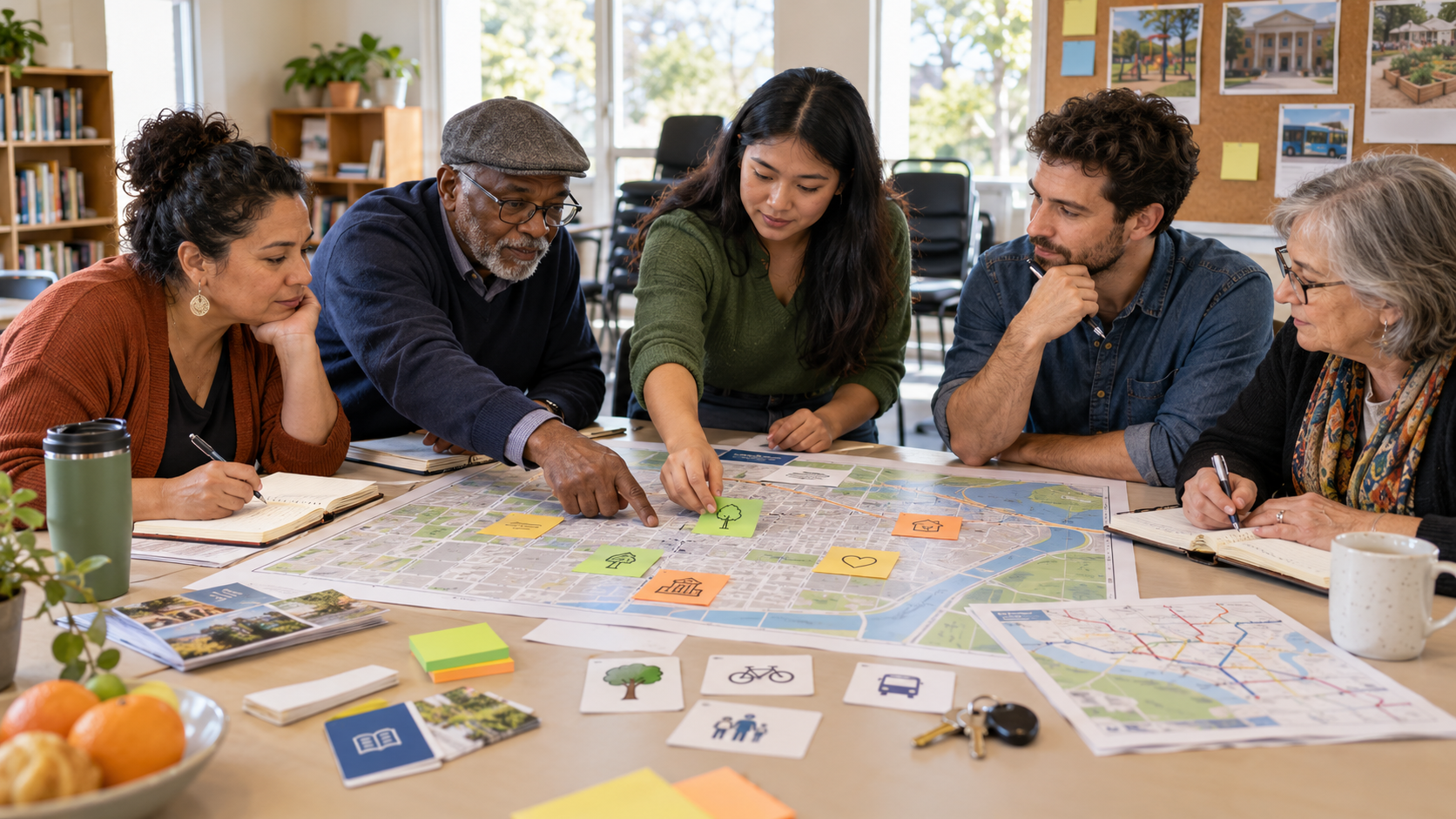
AI-generated illustration of residents mapping existing community assets before planning a new program.
Start with capacity, not only deficiency
A needs assessment and an asset map answer different questions. A needs assessment examines what is missing, unequal, unsafe, or difficult to access. An asset map examines what people can already reach, use, contribute, or connect. A responsible plan needs both. Looking only at needs can reduce a community to a list of problems. Looking only at assets can minimize real hardship or excuse institutions from obligations they still need to meet.
Current public guidance supports combining these views. The U.S. Centers for Disease Control and Prevention describes a community health assessment as a picture that includes both needs and the resources available to improve conditions. Its guidance also emphasizes broad, diverse engagement, shared ownership, transparency, and information from multiple sources. Although this framework is written for public health, the planning lesson is widely useful: evidence about problems should sit beside evidence about local capacity.
The World Health Organization’s 2026 community mapping toolkit similarly emphasizes understanding existing local resources, capacities, and structures, using meaningful participation to shape responses that fit the context. The toolkit focuses on health emergencies, so it should not be treated as a universal formula for every local project. Its central discipline still applies: people closest to a place should help identify what exists and how it can be used.
Look through five practical lenses
A useful asset map is broader than a directory of organizations. Begin with people and skills. Residents may know how to teach, translate, repair equipment, organize transport, care for children, prepare food safely, communicate online, or navigate a public system. These abilities often remain invisible because they are not attached to a formal title. Ask what people know, what they enjoy contributing, and under what conditions they would consider taking part.
Next, identify associations and informal groups. Parent circles, tenant groups, sports clubs, cultural associations, faith communities, alumni networks, mutual-aid groups, and neighborhood chats may already hold trust and communication channels. An informal group is not automatically available for a project, but it may understand local routines and concerns better than a new outside committee.
Third, map institutions and existing services. Schools, libraries, clinics, local government offices, nonprofit organizations, training providers, shelters, and community centers may offer programs, staff knowledge, referral pathways, or meeting space. The University of Kansas Community Tool Box provides a community capacity inventory that prompts planners to look across associations, institutions, community organizations, and the private sector, then ask about relationships, volunteers, resources, and interest in future work.
Fourth, record physical and digital assets. These may include an accessible room, a shaded outdoor area, a projector, shared tools, public internet, a noticeboard, a community radio program, a bus route, or a commonly used messaging channel. Record the conditions that matter. A building is not a usable asset if it is unavailable at the needed time, inaccessible to intended participants, unsafe, or unaffordable.
Finally, map relationships and connectors. Some people regularly bridge groups that do not otherwise communicate. A school secretary may know families, transport providers, and youth leaders. A shopkeeper may hear which services residents cannot reach. A librarian may connect learners with public computers and local tutors. These relationships can help a project listen and coordinate, but they should not be used to pressure anyone or bypass consent.
Test whether an asset is actually available
An asset on paper is only a possibility. Before building a plan around it, confirm five things: access, willingness, fit, capacity, and conditions. Who controls access? Has the person or organization agreed to participate? Does the asset meet the actual need? Is there enough time, space, staffing, or equipment? What costs, permissions, safeguarding rules, insurance requirements, accessibility needs, or limits apply?
This confirmation prevents a common planning mistake. A team sees a school hall and records “free venue,” even though the hall is booked, has no evening custodian, and cannot be used without formal approval. Another team lists a bilingual resident as a translator without asking whether that person has time, wants the role, or is comfortable handling sensitive information. Respectful mapping distinguishes “exists” from “available,” and “available” from “appropriate.”
Keep personal information protected. A working map does not need private phone numbers, immigration details, health information, or names of vulnerable residents. Record a public contact channel or an agreed point of contact. Ask permission before sharing a person’s skills, availability, or relationship network with a wider group. The goal is coordinated action, not a public catalogue of people who can be called without consent.
A fictional example: the homework-space idea
Consider a fictional neighborhood where several parents say that children need a quiet place to complete homework and use the internet. The first proposal is to rent a storefront and create a new learning center. The idea sounds useful, but the group has no budget, staff, equipment, or operating plan.
Before fundraising, the residents conduct a small asset map. They learn that the library has an accessible meeting room available on Tuesday and Thursday afternoons. A retired teacher is willing to help twice a month, not every week. Two high school students want supervised volunteer experience. A local business can print twenty worksheets per week. Parents already use a group chat, and the public bus stops near the library, although its final evening service leaves earlier than expected.
The map changes the first step. Instead of promising a permanent center, the group proposes a clearly labeled four-session pilot at the library. The librarian confirms room rules and internet access. One adult coordinator agrees to be present at every session. The student volunteers receive defined roles, and the group limits registration to the room’s safe capacity. Parents review the time against the bus schedule. After four sessions, the group will examine attendance, completed learning tasks, participant feedback, volunteer workload, and unresolved access barriers before deciding what should come next.
This fictional example does not prove that a library-based program will work everywhere. It shows how an asset map can turn a large assumption into a smaller, testable arrangement built around confirmed local capacity.
Run a 45-minute asset walk
Choose one precise community question, such as “How might ten adults practice basic online job applications?” or “How could older residents receive reliable information during a severe-weather closure?” Avoid a question so broad that every local issue enters the same conversation.
Bring three to eight people who know the area in different ways. Include people affected by the issue, not only organizational representatives. On a sheet of paper, create five sections for people and skills, associations, institutions and services, physical or digital assets, and relationships. Spend five minutes on each section. Ask participants to name what exists without assigning it to the project yet.
Use the remaining time to circle three promising assets and test each one against access, willingness, fit, capacity, and conditions. Mark any assumption that still needs confirmation. Then choose one small action for the next seven days, such as requesting room availability, asking a resident group whether it wants to advise, verifying a bus schedule, or inviting two potential partners to review the map. Name one owner and one review date.
Let the map change the idea
Asset mapping is not complete when the paper is full. Its value appears when the information changes a decision. The map may show that a new service is unnecessary because an existing provider needs better referrals. It may reveal that the proposed location creates an access barrier. It may identify a trusted group that should lead while the original organization provides support. It may also confirm a genuine gap that requires new funding or infrastructure.
Do not measure the exercise by the number of assets listed. Measure it by whether the team avoided duplication, involved people with relevant knowledge, confirmed real availability, and designed a more realistic first test. Update the map when contact details, schedules, capacity, or community priorities change. A useful map is a living planning tool, not a one-time display.
Feel Worldwide Foundation Inc.’s Community Engagement, Volunteerism & Local Action pathway emphasizes participation, trust, shared ownership, and practical local collaboration. Before proposing your next community program, reserve 45 minutes to ask what the neighborhood already has. The strongest first step may be a new connection between existing strengths.
