

Thoughtful outdoor lighting can support evening access while respecting neighbours, wildlife and the sky above us
By Arbab Naseebullah Kasi, Chief Executive Officer - CEO, Feel Worldwide Foundation Inc.
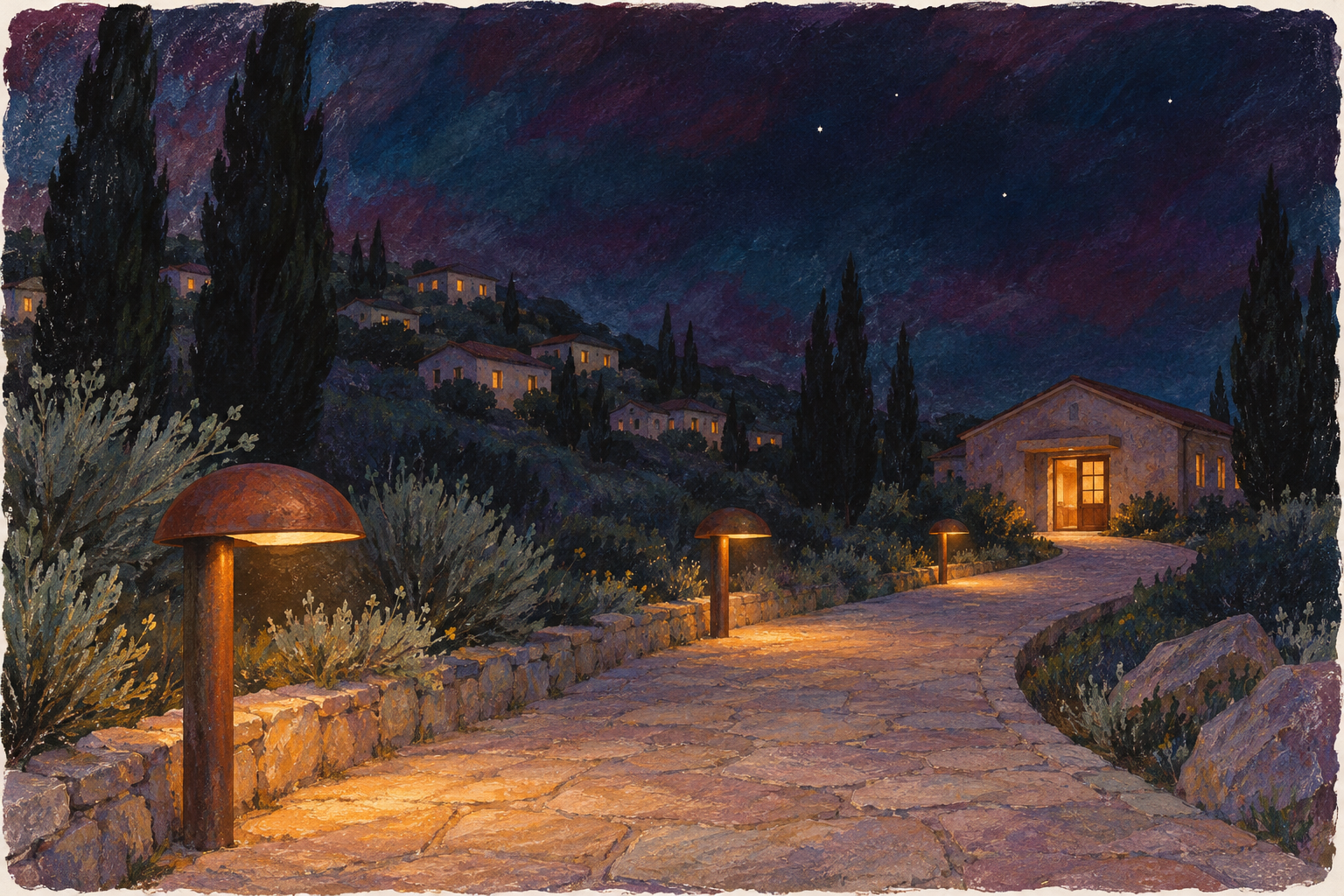
Warm pools of light guide an imagined village path while the sky remains dark. Original AI-generated painting created for this article.
The evening class finishes at eight. Inside the community centre, the room has been welcoming and easy to use. Outside, a powerful lamp shines across the entrance, while the turn toward the bus stop disappears into shadow.
A participant pauses at the doorway. The building is brightly lit, but the next part of the journey is difficult to read.
This is an imagined scene. It captures a question that deserves attention wherever communities gather after sunset: does the lighting help people do what they came to do?
For a small nonprofit, a neighbourhood association or a local business, the instinctive response to a dark area may be to install a stronger light. Sometimes additional lighting is needed. Sometimes the existing light is pointed in the wrong direction, creates uncomfortable glare or leaves a critical part of the route untreated.
The useful starting point is the person's journey. Where do they arrive? What must they see? Where do they wait? How do they leave? Those questions can turn a purchase of equipment into a thoughtful improvement in access.
Begin with the task and the place
Write down what the light needs to make possible before choosing a fixture.
At a community building, that might include finding the entrance, seeing the edge of a step, using an accessible path, reading a notice or identifying a waiting area. A public-road crossing has different requirements from a garden path. A late-night transport stop has different operating hours from a courtyard that closes at dusk.
The Federal Highway Administration identifies lighting as a proven road-safety countermeasure. Its guidance considers visibility along roadways and at locations such as intersections and pedestrian crossings, with attention to the people using them. That is support for appropriate lighting in a specific setting, rather than a reason to illuminate every outdoor surface. FHWA lighting guidance
For a community project, prepare a simple description of the site and its uses. Mark entrances, paths, changes in level, waiting places and nearby homes. Identify which spaces remain open after dark and who owns the lights serving them.
This early work can reveal that the problem crosses a property boundary. The centre may control its doorway light, while the council or utility controls the street beyond it. A useful plan names the responsible parties instead of assuming one organisation can fix the whole route alone.
The scenes, planning exercises and calculations in this article are illustrative. They do not describe a particular community or a Feel Worldwide Foundation project.
Visit after dark and listen carefully
A daytime site inspection can miss the very conditions the project is meant to improve.
Arrange a safe evening visit with the property manager and people who use the place. Invite different perspectives, including older residents, people with visual or mobility impairments, staff who close the building and neighbours whose windows face it. Offer another way to contribute for anyone who cannot attend.
Ask concrete questions. Where do you slow down? Which sign is difficult to read? Does a lamp make you look away? Is the route clear when you approach from the other direction?
Record the location and the task, rather than simply noting that somebody wants “more light.” A request may concern a broken fixture, a confusing entrance or a bright source in the person's line of sight. Each calls for a different response.
Take reports of feeling unsafe seriously, while distinguishing them from measured visibility and recorded incidents. They provide different kinds of information. A resident's discomfort deserves attention without being presented as proof that a particular lighting change will prevent crime.
Keep the visit within safe, accessible areas. Nobody needs to stand in traffic, climb a pole or enter an isolated place to contribute. Public-road concerns should go to the responsible road authority for assessment.
Pay attention to glare
A light can be very noticeable without making its surroundings easy to see.
The U.S. Department of Energy distinguishes disability glare, which limits the ability to see, from discomfort glare, which causes irritation or discomfort. Its explanation also identifies the light source's intensity, size, position and surrounding darkness as relevant considerations. DOE explanation of outdoor glare
Return to the imagined community centre. The bright lamp may attract attention to the building while making it uncomfortable to look toward the gate. Replacing it with an even stronger version could leave the original difficulty unresolved.
A qualified lighting professional can assess the distribution of light, mounting position and shielding, together with the levels needed for the activity. Ask them to explain the proposed improvement in terms a resident can understand: what will become easier to see, from where, and at what times?
Avoid treating a photograph as a complete assessment. Camera settings can change the apparent brightness of a scene. Record residents' observations and use appropriate professional measurements where the design requires them.
Existing equipment also needs care. Texas Department of Transportation guidance warns that adding a glare shield changes a fixture's light distribution and should be analysed to ensure roadway lighting remains acceptable. A seemingly simple adjustment can affect more than the unwanted beam. TxDOT guidance on glare and fixture modification
Protect the route as a whole
An inviting doorway is only one part of an evening visit.
Follow the authorised route from arrival to departure. Include the accessible entrance rather than checking only the most prominent door. Consider where someone waits for a ride, turns toward a bus stop or needs to distinguish the edge of a path.
At road crossings, fixture placement requires particular expertise. FHWA guidance explains that lighting should help drivers identify pedestrians through positive contrast and that careful positioning avoids a silhouette effect. Lighting the pavement alone does not answer every visibility question. FHWA crosswalk visibility guidance
For the community centre, the practical outcome might be a coordinated request: repair a failed path light on the property, ask the road authority to review the crossing and clarify the route to the stop. The final design would depend on the actual site.
Look for problems that lighting cannot repair. An uneven surface, inaccessible gate, obstructed sightline or missing crossing may need its own action. Give each issue an owner and a next step so that a new lamp does not become the answer to every concern.
Keep useful darkness in the plan
Neighbours should not have to choose between a usable path and a bedroom filled with unwanted light.
DarkSky International and the Illuminating Engineering Society jointly developed five principles for responsible outdoor lighting. They call for light with a clear purpose, directed where needed, no brighter than necessary, controlled for the times it is needed and warmer in colour where possible. These are useful questions to bring to a design discussion. Five Principles for Responsible Outdoor Lighting
Ask the designer to show where light will fall beyond the intended area. Include neighbouring windows, gardens, trees and any sensitive habitat in that conversation. Seek local ecological advice where the setting warrants it.
The Department of Energy notes that artificial light at night can disrupt ecosystems and increase sky brightness. It also cautions that efficient light sources can still waste energy when lighting is unnecessary, excessive, misdirected or mistimed. Choosing an LED is therefore one decision within a larger plan. DOE guidance on light at night
Colour deserves consideration, but a colour label cannot settle the entire design. Discuss the activity, the surrounding environment and applicable requirements together. A warm-coloured lamp can still be badly positioned or left on for unnecessary hours.
The aim is a place people can use comfortably, with unwanted effects reduced as far as the setting allows.
Match operating hours to real use
An evening timetable should inform the lighting controls.
At our imagined centre, a timer that switches the route off at eight would fail the people leaving an eight o'clock class. Staff may remain later to clean and lock up. A delayed accessible vehicle may extend somebody's wait.
Agree on the operating needs before setting timers or sensors. Test the controls with the people who will encounter them, including someone moving slowly or waiting in one place. Explain who can adjust settings and what happens if a control fails.
The National Park Service recommends timers, motion detectors and dimmers as ways to provide appropriate light when needed and reduce unnecessary effects. Its guidance is written for park settings, so the details should be adapted by competent professionals to a building, street or other local setting. NPS outdoor lighting principles
Required emergency, security and access lighting must remain part of the assessment. Saving electricity should never depend on quietly removing a function people rely on.
Make the energy calculation visible too. Suppose, purely for illustration, six fixtures each use 30 watts and operate for ten hours a day. Together they use 1.8 kilowatt-hours daily. At an assumed electricity price of $0.20 per kilowatt-hour, that is $0.36 a day for their electricity consumption.
This example is not a price estimate or a recommended design. Actual bills depend on the equipment, controls, operating hours and tariff. Its purpose is to make the assumptions understandable so that competing proposals can be compared honestly.
Budget for the years after installation
A project can look complete on opening night and become unreliable when nobody knows who handles a fault.
Before purchasing, ask who owns the equipment, who inspects it and who is authorised to repair it. Include access costs, replacement components, cleaning and control adjustments in the discussion. Confirm the warranty and whether suitable parts are available.
Give residents and staff a simple reporting route. A useful report identifies the location, the problem and when it was noticed. It should not require somebody to know the technical name of the fixture.
Keep a short asset record with the installation date, supplier, settings, maintenance contact and any agreed operating schedule. If responsibility changes, the next person should be able to understand what was installed and why.
After work is completed, return after dark. Check the original concerns and ask about new ones. Has unwanted light reached a window? Does the waiting area remain usable? Are controls behaving as expected? A repair or adjustment may be needed even when the equipment is functioning exactly as supplied.
Start with one place people already use
A small organisation does not need to launch a neighbourhood-wide lighting project to make progress.
Choose one entrance and its connected route. Over the next month, an illustrative sequence could be:
Speak with users and neighbours, and establish who owns the site and equipment.
Complete a safe evening review and describe the specific visibility and access problems.
Obtain appropriate technical advice, permissions and a proposal that includes maintenance.
Review the installed result with users and document any changes still needed.
Keep the measures close to the purpose. Track whether reported faults were resolved, whether users can identify the route and whether neighbours report unwanted spill. Record energy use where reliable data are available. A short local review can guide improvements, but it cannot establish that lighting caused a change in crime or crashes.
There is something quietly generous about a place that helps people leave as thoughtfully as it welcomes them in. A visible turn, a readable entrance and a comfortable waiting area can communicate that the evening journey was considered.
We can give outdoor lighting a clear job, check that it does that job and leave the rest of the night room to remain itself.
