
Before You Set the Date, Ask Whose Schedule the Community Activity Fits
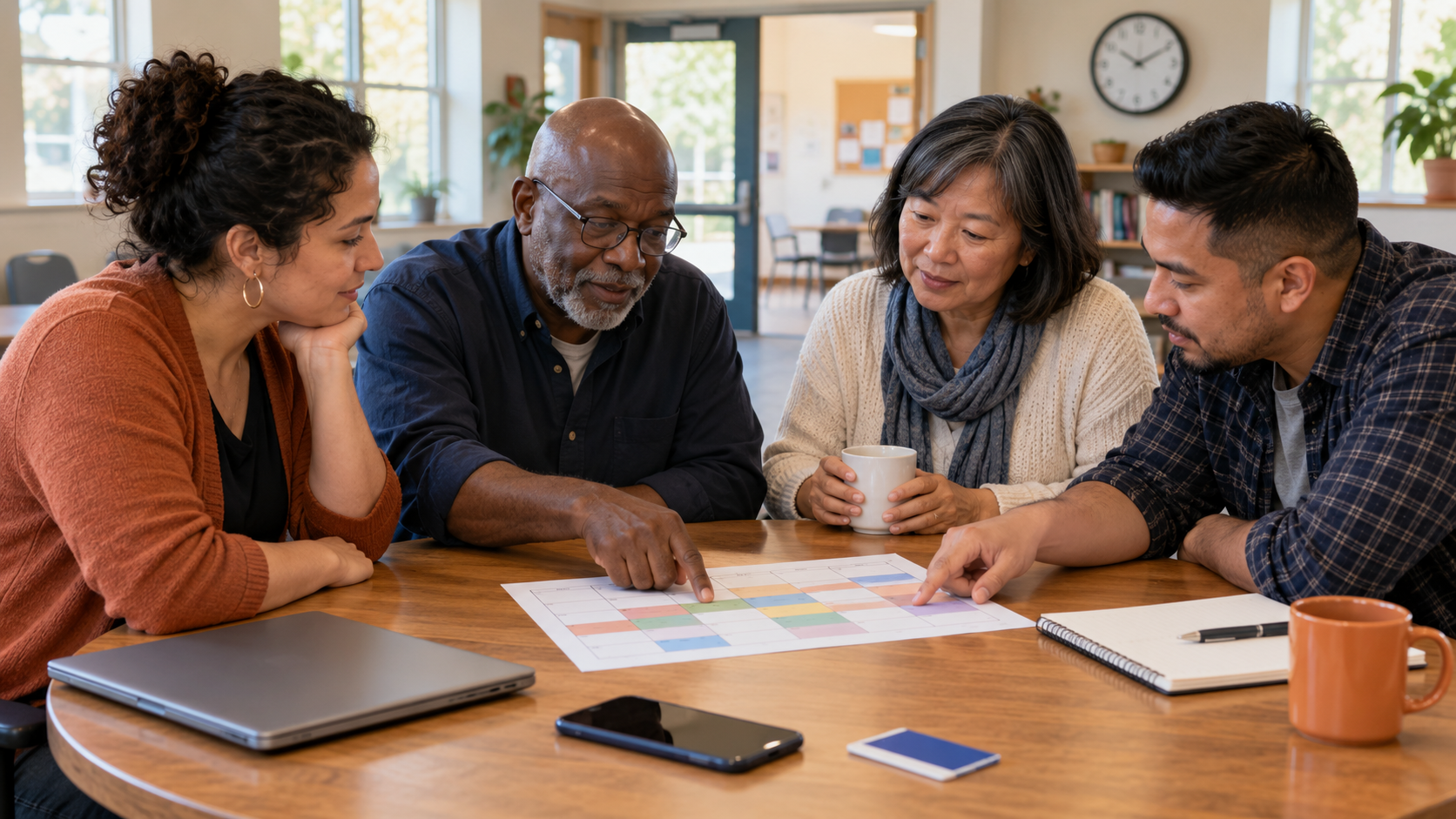
AI-generated illustration of residents and an organizer comparing workable times for a community activity.
A practical access check for timing, transport, caregiving, disability needs, and backup ways to participate.
A community activity can be useful, free, and warmly promoted, yet still be difficult for the intended participants to attend. A workshop scheduled at 9 a.m. may conflict with a night shift. An evening meeting may end after the last practical bus home. A caregiver may need more notice than the organizer expected. A person who uses mobility support may find that the advertised room is accessible while the route from the entrance is not. When attendance is low, it is easy to conclude that people were not interested. Sometimes the real problem began when the schedule was designed.
The goal is not to find one time that is perfect for everyone. That is rarely possible. The goal is to make the choices visible, learn which barriers matter most, and provide another realistic way to contribute when one shared time excludes people whose participation matters.
Start with the people, not the calendar
Before comparing dates, write down whose participation is necessary for the activity to be useful and legitimate. A neighborhood safety discussion may need residents from several streets, people who travel at different hours, older adults, young people, and local workers. A skills workshop may need learners with different work, care, transport, language, or disability access needs. Naming these groups does not mean assuming that everyone in a group has the same schedule. It tells the organizer whom to ask and whose absence should trigger another look at the plan.
The U.S. Department of Transportation advises public agencies to avoid one-size-fits-all engagement and to seek broad and early representation from people affected by a decision. Its guidance is written for transportation planning, not every community activity, but the principle transfers carefully: participation design should begin before a date and format become difficult to change. Source: U.S. Department of Transportation, Promising Practices for Meaningful Public Involvement (https://www.transportation.gov/sites/dot.gov/files/2022-10/Promising%20Practices%20for%20Meaningful%20Public%20Involvement%20in%20Transportation%20Decision-making.pdf).
Ask a few people from the intended group about workable windows rather than presenting one finished plan. A useful question is, "Which of these time windows could you realistically manage, and what would make each difficult?" A selected time may be the least difficult option, not a genuinely accessible one.
Map the whole participation journey
The meeting time is only one part of the schedule. Map what a participant must do before, during, and after the activity. They may need to receive the information, understand the purpose, arrange transport or care, travel, find the entrance, participate in a suitable format, and return home safely. A one-hour session can require three hours of a person's day once travel and preparation are included.
Check five connected areas:
1. Timing: Does the activity conflict with common work, school, worship, meal, medication, or rest times? Is the notice long enough for people who must arrange support?
2. Travel: Can people reach and leave the location at the proposed times? Are public transport schedules, walking conditions, parking, and the return journey realistic?
3. Care responsibilities: Could the timing exclude people responsible for children, older relatives, or others? Can the activity offer a shorter attendance window, suitable childcare, or another safe way to contribute?
4. Access and communication: Is the full route accessible? Are interpretation, captioning, quiet space, readable materials, and advance information available when needed?
5. Technology: If there is a remote option, does it require expensive data, a large screen, strong connectivity, or software that people cannot reasonably use?
The Centers for Disease Control and Prevention includes accessible locations, transportation support, childcare, translation, and appropriate incentives among practical considerations for community engagement. Source: CDC, Building Community Commitment for Safe, Stable, Nurturing Relationships and Environments (https://www.cdc.gov/child-abuse-neglect/communication-resources/efc-building-community-commitment.pdf). These supports will not be necessary or feasible in every activity, but they are useful prompts. The organizer should identify which barriers are relevant, communicate honestly about what can be provided, and avoid advertising access features that have not been confirmed.
Offer a real alternative, not a token option
If no single time works for everyone, choose at least one additional route that can influence the activity. This might be a second shorter session, a phone conversation, a paper response collected at a familiar location, an accessible online form, or a trusted representative gathering input. An alternative is meaningful only if the team explains how the contribution will be used and reviews it before the relevant decision is final.
The U.S. Environmental Protection Agency describes public meetings as one method within a broader participation process and recommends selecting a meeting format for a clear purpose. Source: U.S. EPA, Public Participation Guide: Public Meetings (https://www.epa.gov/international-cooperation/public-participation-guide-public-meetings). Although the guide is aimed at environmental decision-making, its planning lesson is widely useful. One event should not be treated as the entire participation process when another method could reach people who cannot attend.
A phone number with defined call times may be more accessible than a video meeting. A short paper prompt may work better than a long survey. The best alternative is one the intended participants can use and the organizer can responsibly review.
Confirm the plan before people reorganize their lives
Once the format is chosen, send a clear confirmation. Include the purpose, start and finish times, location, full access details, cost if any, what participants should bring, how to request a reasonable accommodation, and how to use the alternative participation route. If arrangements may change, say when the final confirmation will arrive.
Clarity protects people's time. A vague invitation can require several messages before someone can decide whether attending is possible. Organizers may not have the resources to solve every barrier, but they can make the current plan easy to evaluate.
After the activity, record more than the number of people who came. Note which groups or perspectives were missing, what access requests arose, which alternative routes were used, and what participants said about the timing. Do not collect sensitive personal details that are not needed. The purpose is to improve the next design choice, not to create a profile of individual participants.
A fictional example: a neighborhood preparedness session
Consider a fictional teaching example. A volunteer team plans a neighborhood emergency-preparedness session for Saturday at 9 a.m. The community room is free, so the team assumes the time is convenient. Before publishing the notice, they ask six residents about two possible windows. A night-shift worker says the morning session begins during their sleep period. A parent can attend only if the session ends before a child's appointment. A resident who relies on the bus explains that the route runs less often on weekends. Another resident needs step-free access and wants to know which entrance to use.
The team cannot create a perfect schedule, but it can improve the design. It moves the main session to late Saturday morning, limits it to sixty minutes, confirms the accessible entrance, and includes the relevant bus arrival and departure times in the notice. The team also offers two short phone windows during the following week for residents who cannot attend. One volunteer uses the same three questions in every conversation and brings the responses to the planning group before it finalizes the neighborhood contact plan.
The team records who participated in person, who used the phone option, and which perspectives remain missing. Low participation from one apartment building leads the volunteers to ask a resident there which communication route would be more workable next time. The example does not claim that every barrier disappeared. It shows that the team treated schedule design as part of access rather than as a neutral administrative choice.
Try a twenty-minute schedule access check
Take one sheet of paper and draw three columns: people, barriers, and options. Spend four minutes naming the people or perspectives whose participation matters. Spend four minutes mapping the journey from receiving the invitation to returning home. Spend four minutes identifying the two barriers most likely to prevent participation. Spend four minutes choosing one main time and one realistic alternative route. Use the final four minutes to write the confirmation details and the question you will ask afterward to learn whether the design worked.
Read the plan from a participant's point of view. Can they tell what the activity is for, how long the full trip may take, what access support is confirmed, and how to contribute if the main time does not work? If not, improve the plan before promoting it widely.
Designing around real schedules does not mean promising unlimited flexibility. It means recognizing that time, transport, care, disability access, and technology shape who can participate. This practical attention to access, shared responsibility, and local decision-making connects directly with Feel Worldwide Foundation Inc.'s Community Engagement, Volunteerism & Local Action (https://www.feelworldwidefoundation.org/programs/community-engagement-volunteerism-local-action) pathway.
Before setting the date for your next community activity, speak with a small, varied group of intended participants. Map the full participation journey, choose one barrier you can reduce, and create one backup route that can genuinely affect the work. Then review who still could not participate and use that information in the next plan.
Community groups, volunteers, educators, and local organizations interested in thoughtful participation and practical local action are welcome to connect with Feel Worldwide Foundation Inc. (https://www.feelworldwidefoundation.org/connectwithus). Share the activity you are planning and the practical contribution a potential collaboration could bring.
