
Balochistan Youth Empowerment
Balochistan Youth Empowerment: From Skills to Dignified Income, Locally
A ready-to-implement, district-specific venture pathway that turns learning into earnings in Quetta, Kech (Turbat), Gwadar, and Khuzdar, then scales across all Balochistan.
Balochistan Youth Empowerment
Assumptions (so we can be specific and practical):
This article targets youth ages 16 to 29 across Balochistan, with a deliberate focus on young women, rural youth, and underemployed graduates. It assumes you want an action-first model that works even with low budgets and limited connectivity, and that you want to align with existing public systems like TVET and youth programs rather than reinvent them. (BTEVTA)
Interactivity prompt: Write this sentence now: “In the next 90 days, I will help ___ youth in ___ district earn their first ___ PKR through ___.”
2) Big Promise
Within 90 days, a “Skills to Earnings” youth hub in one Balochistan district can realistically:
Place 30 to 80 youth into paid work, apprenticeships, or paid micro-contracts.
Launch 10 to 25 micro-enterprises with real customers and documented revenue.
Build a repeatable pipeline by partnering with existing training systems and local employers. (BTEVTA)
This is not a motivational campaign. It is a delivery system that converts effort into verifiable outcomes.
Quick check: If a skeptic asked, “Show me proof in 14 days,” what would you show: employer letters, paid invoices, signed apprenticeships, or customer orders?
3) Problem to Opportunity
Balochistan’s youth challenge is not a lack of talent. It is a conversion problem: effort does not reliably convert into employability, earnings, or trusted market access.
Three root causes show up repeatedly:
Skills without market linkage
Training exists, but too often youth finish without a clear next step into paid work. The fix is to reverse the flow: start from employer demand and paid tasks, then train only what is needed. National and provincial TVET structures can be used as feeders if linked to real hiring and contracts. (BTEVTA)Low trust and weak proof
Many youth can do the work, but cannot prove it. The opportunity is to create “proof-of-work portfolios” through short paid micro-projects, apprenticeships, and verified references.Access barriers, especially for young women
Mobility, safety, cultural norms, and lack of safe spaces limit participation. The opportunity is to design women-friendly training-to-work pathways: local micro-contracts, home-based production with quality assurance, and trusted community partners.
A youth opportunity system in Balochistan must treat education gaps seriously. UNICEF highlights severe out-of-school exclusion in Balochistan in proportional terms, which means foundational learning and catch-up pathways must be built into empowerment models. (UNICEF)
Pause and choose: Are you solving “unemployment,” “low income,” or “lack of safe opportunity for women”? Pick one as your headline problem, and design everything around it.
4) Stakeholders in paragraphs
Youth and families: Youth want dignity, income, and a future that feels real. Families want safety, social acceptance, and predictable returns on time spent. Any program that cannot explain “how this becomes income” will lose trust quickly.
Local employers and markets: In Quetta’s services economy, Kech’s trade and agriculture base, Gwadar’s logistics and port-related services, and Khuzdar’s transport corridor and mixed economy, employers need reliable entry-level talent and short-contract labor. Employers will cooperate when you reduce hiring risk by screening, training for specific roles, and providing performance guarantees.
Government and public systems: Balochistan has institutional channels for skills and youth programming that can be partnered with rather than duplicated, including B-TEVTA and national skills initiatives like NAVTTC programs and the Prime Minister’s youth platforms. (BTEVTA)
Universities, colleges, and madrassas: These are not just education institutions. They are distribution channels for opportunity. They can host career clinics, entrepreneurship cells, and apprenticeship pipelines.
Donors, CSR, and NGOs: Donors and CSR funders want measurable outcomes and safeguarding. They will fund models that have strong MEAL, cost-per-outcome logic, and transparent governance.
Community leaders and local influencers: In Balochistan, legitimacy is local. Community leaders, women leaders, and respected professionals reduce friction and increase participation, especially for women and rural youth.
Interactivity prompt: Circle your primary stakeholder. Now write what they fear most, in one line. Design your first pilot to reduce that fear.
5) Venture Concept
The Venture: Balochistan Youth Opportunity Hubs (BYOH)
A network of district-based hubs that convert youth potential into income through three integrated tracks:
Skills to Job (roles-based training plus hiring pipeline)
Skills to Micro-Contracts (paid tasks delivered to local institutions and SMEs)
Skills to Micro-Enterprise (small businesses with first customers inside 30 days)
Start with one district hub (example: Quetta), then replicate a “hub-in-a-box” model in Turbat (Kech), Gwadar, and Khuzdar, using pop-up delivery in partner spaces (colleges, training centers, community buildings).
Why this fits Balochistan
Balochistan’s geography and access realities demand a model that works with:
Low bandwidth and hybrid delivery
Pop-up centers and mobile trainers
High trust, local partnerships
Fast proof through paid work, not just certificates
Minimum Viable Offer (MVO)
You do not start with a big center. You start with one paid outcome:
Employer-Ready Sprint (14 days)
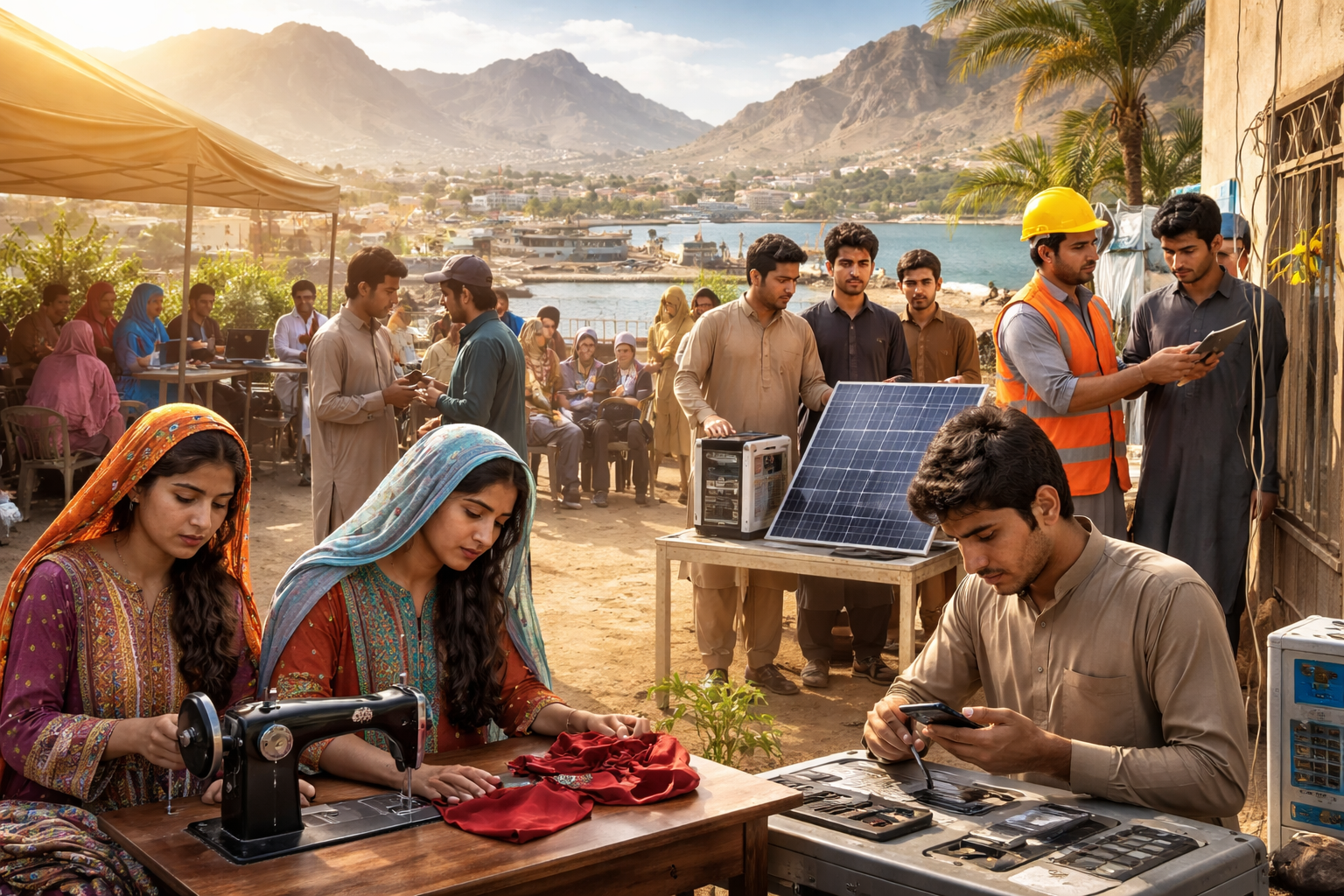
Roles-based preparation for 2 to 3 roles (example: office assistant, retail sales, solar technician helper, basic IT support).Paid Micro-Contract Pack (30 days)
Youth teams deliver paid services: school digitization support, basic bookkeeping for shops, social media setup for SMEs, water conservation campaigns, or inventory management.Micro-Enterprise Launch Pack (30 days)
Youth launch small offers like phone repair pickup, women-led home catering, tailoring with quality checks, water delivery coordination, livestock feed supply, or freelance design.
If you have 2 hours this week do this: List 20 businesses in your area and write the one task each would happily pay someone to do.
6) Business Model and Revenue Logic
BYOH is a hybrid social enterprise that earns revenue while remaining mission-locked.
Placement and hiring fees (B2B)
Local employers pay a modest fee for screened candidates, replacement guarantees, and onboarding support.Training contracts (B2G and B2NGO)
Deliver training outcomes through partnerships with TVET and youth initiatives already operating nationally and provincially, aligning your hub as an implementation partner. (NAVTTC)Micro-contract margin (service delivery)
Youth teams deliver services to institutions and SMEs. The hub takes a transparent coordination margin (example: 10 to 20 percent) to cover supervision, quality, and safeguarding.Affordable learner fees with scholarships
Charge small fees where feasible, with need-based support funded by CSR and donors.Digital opportunity brokerage
Use the Digital Youth Hub and other job linkages as channels, while charging employers and projects for verified matching and performance tracking. (PMYP)
Quick check: Which revenue stream can work in 30 days in your district: employer fees, micro-contracts, or a training contract?
7) Validation and Testing
Validation must be fast, local, and measurable.
What to validate first (in this order)
Demand: Are employers or institutions willing to commit to interviews, apprenticeships, or paid tasks?
Delivery: Can youth reliably deliver quality within 7 days?
Trust: Will families allow participation, especially for young women, if safety and legitimacy are strong?
The 14-Day Test Plan (required)
Day 1 to 2: Target roles
Pick 2 roles and 2 micro-contract services based on local demand.
Day 3 to 5: 20 stakeholder interviews
10 employers or shop owners
5 community or education leaders
5 youth and parents (include young women’s families)
Day 6 to 7: Get commitments
Secure in writing:
5 employers agree to interviews or apprenticeships
2 institutions agree to a paid micro-contract pilot
Day 8 to 10: Run a mini-sprint
Train 15 to 25 youth on only what is needed for the selected roles and services.
Day 11 to 14: Deliver proof
Conduct interviews or place apprentices
Deliver one paid micro-contract output
Produce “proof-of-work” portfolios for every participant
Minimum success metrics for the test:
10 youth complete portfolios
5 employer interviews happen
1 paid contract is delivered or invoiced
30 percent of youth earn some income within 14 days
What would make a skeptic say yes? Decide your single strongest proof: paid invoice, signed apprenticeship letter, or employer testimonial.
8) Operations and Delivery
Delivery system that works in Balochistan
Hub core team
A hub manager, trainer lead, placement officer, and community mobilizer. Add a part-time MEAL lead early to keep integrity and evidence strong.
Partner facilities first
Run the first cohorts in partner spaces: B-TEVTA centers, colleges, community halls, or NGO facilities, then expand to a dedicated hub after revenue and proof. (BTEVTA)
Safe participation design
Women-only cohorts and women trainers where possible
Local scheduling aligned to family realities
Clear safeguarding, grievance, and referral pathways
Transport support or neighborhood-based pop-ups
Quality assurance
Standard checklists for every service delivered
Supervisor sign-off for micro-contract work
Employer feedback loops within 72 hours of placement
Interactivity prompt: If you had to cut your program to only 3 activities that create income fastest, what are they?
9) Go to Market and Growth
Go-to-market for Quetta, Turbat, Gwadar, and Khuzdar
Quetta: services and administration
Target hospitals, schools, pharmacies, retail chains, call centers, clinics, and government-adjacent service providers.Kech (Turbat): trade, agriculture, and small services
Target cold storage, agri-input shops, transport coordination, mobile repair, local retail, and women-led home enterprises.Gwadar: logistics and services growth
Target warehousing support, procurement assistance, basic IT and documentation roles, hospitality, and micro-services around logistics supply chains.Khuzdar: corridor economy and mixed livelihoods
Target transport services, construction support roles, small manufacturing, retail, and vocational trades.
Growth strategy
Anchor partners
Secure 3 anchors per district: one public system partner, one employer cluster, one community legitimacy partner.Referral loops
Youth referrals plus employer referrals become your lowest-cost growth channel.Proof marketing
Publish outcomes monthly: placements, earnings, retention, women participation, completed contracts.
If you have a budget do this: Fund 50 paid apprenticeships as a district “first wave,” tied to retention bonuses after 60 days.
10) Legal, Registration, Compliance (informational only, tailor by location, state what to verify)
Informational only. Verify with a qualified professional and the relevant authorities before acting.
In Pakistan and Balochistan, common structures include:
For-profit route
Sole proprietorship, partnership, or private limited company registration through SECP pathways where applicable, plus tax registration with FBR. (Verify your exact entity type and filing requirements.) (SECP)Nonprofit route
If you want donor eligibility and mission lock, a common option is a Section 42 not-for-profit company under the Companies Act framework regulated by SECP, with specific licensing procedures and compliance steps. (SECP)Provincial sales tax on services
If you are providing taxable services in Balochistan, you may need registration and compliance with the Balochistan Revenue Authority (BRA) and its e-registration and filing systems. Verify applicability to your service category. (BRA)Safeguarding and data handling
If you work with minors (under 18) or vulnerable youth, implement safeguarding policies, consent, incident reporting, and secure handling of identity documents.
Verification checklist (fast):
Which registrations apply to your chosen legal form
Whether your services trigger BRA sales tax obligations
Employment contracts, apprenticeship agreements, and insurance considerations
Any district-level permits for a physical center
11) Finance and Funding
Lean startup budget logic (start small, prove, then grow)
Cost drivers in Balochistan-friendly models:
Trainers and supervision
Mobility and safe access for women
Tools for trades (solar kits, basic IT, repair kits)
Stipends for internships or apprenticeships
Monitoring and verification
Funding stack that matches reality
CSR and local industry partnerships
Position the hub as a workforce and community stability investment.Government-aligned programs
Align cohorts with national and provincial youth and skills initiatives and platforms, including NAVTTC training pathways and youth opportunity portals. (NAVTTC)Donors and NGOs
Sell the MEAL discipline: cost per placement, cost per sustained income outcome, women participation, and safety.Earned revenue first
Even small micro-contract margins build independence and credibility.
Interactivity prompt: Decide your first funding ask: “Sponsor 25 apprenticeships in ___ district with a 60-day retention bonus and monthly reporting.”
12) Team and Leadership
A hub succeeds or fails on leadership integrity and execution discipline.
Core roles to start:
Hub Lead (community legitimacy plus operations)
Employer Partnerships Lead (sales mindset, local network)
Training and Quality Lead (hands-on delivery)
Women’s Participation Lead (safe access, family engagement)
MEAL and Accountability Lead (data, learning, transparency)
Leadership principles that matter in Balochistan:
Do what you said you would do
Show proof monthly
Protect participants
Never inflate outcomes
Put local voices in governance
If you are solo do this: Recruit a volunteer advisory circle of 5 trusted local stakeholders and meet biweekly with a fixed agenda.
13) Measurement and Learning (include MEAL for social ventures)
What to measure (and why)
Access: who participates, by gender, district, and vulnerability
Completion: who finishes and why dropouts happen
Outcomes: jobs, paid apprenticeships, earnings, contracts delivered
Retention: still earning after 30 and 60 days
Safety and dignity: incidents, grievances, and resolution time
MEAL framework (Monitoring, Evaluation, Accountability, Learning)
Monitoring: Weekly cohort dashboards (simple, not fancy)
Evaluation: Compare outcomes across cohorts and districts every 90 days
Accountability: Grievance channels, safeguarding, transparent selection criteria
Learning: Monthly “what changed” reviews and program adjustments
Suggested outcome targets for the first 90 days:
40 percent of participants earn income within 30 days
25 percent increase in average monthly income among earners after 60 days
At least 35 percent women participation in districts where feasible, with safety-first design
Quick check: If you could only track 3 numbers, track: placements, earnings, and retention.
14) Risks and Mitigation
Security and mobility constraints
Mitigation: local pop-up delivery, daylight schedules, community legitimacy partners, flexible cohorts.Low employer follow-through
Mitigation: written commitments, small trial apprenticeships, replacement guarantees, and employer feedback within 72 hours.Women’s participation barriers
Mitigation: women-only cohorts, women trainers, family engagement sessions, safe venues.Quality failures in micro-contract work
Mitigation: supervision checklists, sign-off gates, and small contracts first.Corruption perception or unfair selection claims
Mitigation: transparent criteria, public lists, grievance process, and third-party community observers.Data integrity risk
Mitigation: verify outcomes with employer calls, invoices, and attendance evidence, and publish methodology.
Interactivity prompt: Name the risk you fear most. Now write one prevention step you will implement before cohort 1 starts.
15) 90 Day Execution Plan
Phase 1 (Days 1 to 10): Set the foundation
Pick District and Roles
Choose one district and 2 job roles plus 2 micro-contract services.Recruit Anchor Partners
Secure 3 anchor partners: facility partner, employer cluster, community legitimacy partner.Build the Proof System
Create portfolio templates, attendance rules, safeguarding rules, and verification calls.
Phase 2 (Days 11 to 30): Run the first cohort and deliver proof
Cohort 1 Sprint
Train 15 to 25 youth in a roles-based sprint and finalize portfolios.Interviews and Apprenticeships
Run employer interview day and place apprentices immediately.Micro-Contract Delivery
Deliver at least one paid service to an institution or SME and document it.
Phase 3 (Days 31 to 60): Turn outcomes into a repeatable pipeline
Cohort 2 With Improvements
Repeat with adjustments based on retention and employer feedback.Women-Focused Track Launch
Run a women-only cohort with safe access design and family engagement.Employer Membership Offer
Introduce an employer membership for ongoing talent pipeline.
Phase 4 (Days 61 to 90): Stabilize and prepare replication
District Outcome Report
Publish a transparent report: placements, earnings, retention, stories, and lessons.Replication Kit
Create a hub-in-a-box kit: curriculum, checklists, contracts, MEAL tools.Second District Activation
Start pop-up delivery in a second district using the same kit.
If you have 2 hours this week do this: Book 10 employer meetings and ask one question: “If I trained 10 youth for your exact needs, what would you hire them to do?”
16) Interactivity prompts throughout
Here are four moments to make this article actionable for readers and partners:
Pause and choose: Which district is your pilot: Quetta, Turbat (Kech), Gwadar, or Khuzdar?
Decide your first test: Employer interviews first, or a paid micro-contract first?
Write this sentence now: “We will place ___ youth into paid work in ___ days by partnering with ___ employers.”
What would make a skeptic say yes: A paid invoice, or a 60-day retention report?
Fast Start Path
Today: Pick one district and one youth segment (women, graduates, out-of-school youth, or underemployed).
Within 48 hours: Get 5 employer commitments for interviews or apprenticeships.
Within 7 days: Secure one paid micro-contract from a school, clinic, shop cluster, or NGO.
Within 14 days: Deliver your first verified outcomes and publish them.
Pick your path moment
Choose one path for your first 90 days. Do not mix all four at the start.
Path A: Jobs First
Fastest for income proof. Best where employers exist and hiring is active.Path B: Micro-Contracts First
Best where formal hiring is limited but institutions need services.Path C: Women-Led Home Enterprise First
Best where mobility constraints are high and trust-building is essential.Path D: Youth Tech and Freelance First
Best where connectivity and basic digital skills can be supported reliably, using verified proof-of-work.
17) Call to action
If you want to co-design and implement a real youth empowerment delivery model in Balochistan that is measurable, integrity-first, and built for local realities, I invite you to reach out to Arbab Naseebullah Kasi to collaborate and learn together. Bring your district focus, your constraints, and your best local partners, and we will shape a pilot that produces verified outcomes in 14 days and a scalable system in 90 days.
18) Required Ending Block
[Partnership & Collaboration Invitation (FWF)
If you are a government stakeholder, investor, operator, contractor, community leader, university, NGO, or donor, and you want a practical, measurable, integrity-first model for mining-led entrepreneurship and economic development in Balochistan, I welcome direct outreach. I am ready to share the playbooks, implementation templates, training architecture, MEAL tools, and partnership design options behind this concept, and to help convene serious stakeholders who want real outcomes.
Feel Worldwide Foundation Inc. welcomes collaboration with stakeholders who wish to explore, pilot, or scale the opportunities outlined above. Website: https://www.feelworldwidefoundation.org/
Contact: info@feelworldwidefoundation.org
Founder & CEO: Arbab Naseebullah Kasi - akasi@feelworldwidefoundation.org
An interactive, action-first concept article proposed by Arbab Naseebullah Kasi for discussion, learning, and partnership building.
This article is provided strictly for informational and discussion purposes only. It presents a conceptual idea and a potential proposed plan. It is not legal advice, financial advice, investment advice, tax advice, regulatory advice, or professional consulting advice, and it should not be relied upon as a basis for decisions, transactions, or actions.
All concepts, recommendations, and statements herein are proposed solely by Arbab Naseebullah Kasi in his personal capacity, informed by his professional knowledge, practical field experience across Balochistan and Pakistan, and more than two decades of involvement in U.S.-based projects and programs across multiple sectors and industries, as well as professional networks and stakeholder connections in both regions. These proposals remain conceptual and are not representations of any official position by any institution.
Nothing herein creates or implies any partnership, endorsement, affiliation, sponsorship, contract, commitment, obligation, or agency relationship with Feel Worldwide Foundation Inc. (FWF) or the University of Massachusetts Amherst (UMass Amherst), unless and until expressly confirmed through a separate written agreement signed by authorized representatives of the relevant parties.
To the fullest extent permitted by applicable law, Arbab Naseebullah Kasi, Feel Worldwide Foundation Inc. (FWF), and the University of Massachusetts Amherst (UMass Amherst) disclaim any and all responsibility and liability for any claims, demands, complaints, objections, losses, damages, costs, or expenses of any kind, whether direct or indirect, that may arise from or relate to this article or to any reliance on, use of, or action taken based on it. No claims or objections may be asserted against Arbab Naseebullah Kasi, FWF, or UMass Amherst based on this article or its contents.]
Share this article
For Instagram, Snapchat or another app, copy the link and paste it there.
