
Balochistan Five Priority CAP
Balochistan Five Priority CAP
A coalition delivery plan that turns five urgent needs into visible wins within 90 days, and durable systems within 12 months
Balochistan Five Priority
1) The Big Promise
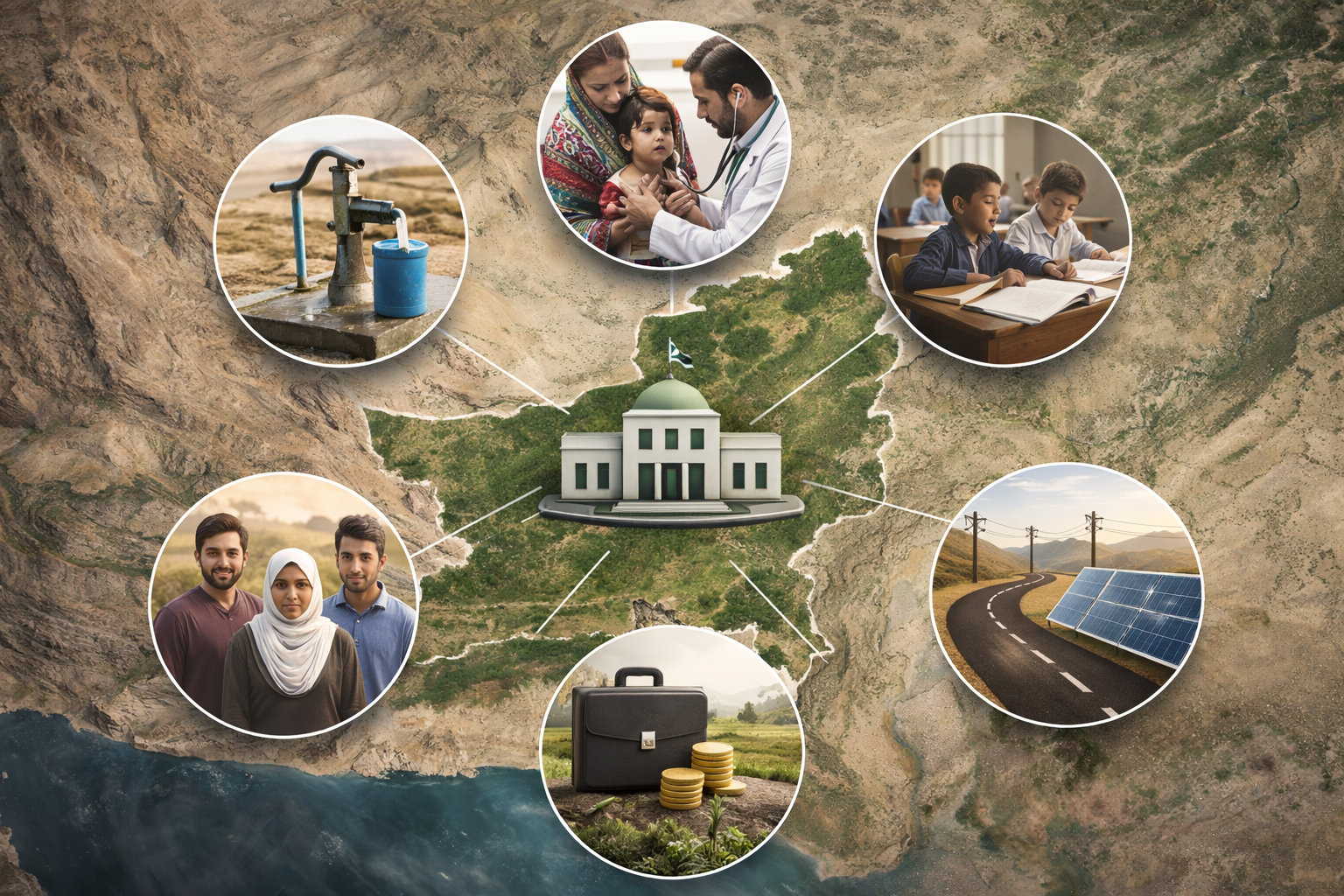
Within 90 days, Balochistan can deliver measurable improvements in five areas that communities repeatedly name as urgent needs: water security, primary health and nutrition, education and youth skills, livelihoods and MSME growth, and resilient infrastructure plus clean energy access. This CAP is built to work in mixed settings: urban neighborhoods, remote rural villages, coastal communities, and conflict affected districts.
The core promise is simple: faster service delivery, stronger local ownership, and transparent results through one integrated delivery backbone that supports all five priorities.
Mode selected: Coalition Plan (with service delivery plus economic development plus resilience).
2) Community Snapshot and Asset Map
Balochistan is large, diverse, and logistically difficult. Distance, terrain, and patchy infrastructure raise the cost of delivering basic services. Communities face repeated shocks: drought, price volatility, displacement, and climate extremes. Trust can be fragile when services are delayed or uneven.
Assets already exist and should be activated, not replaced: district administrations, line departments, BHUs and RHCs, Lady Health Workers, teachers and school management committees, local elders and jirga level dispute resolution customs, faith and community networks, youth groups, women organizers, local traders, transporters, mobile connectivity where available, universities, technical institutes, and a growing presence of private sector activity in energy, telecom, logistics, and mining linked supply chains.
This CAP assumes you will build on what exists, and fill the gaps with a disciplined delivery system.
3) Problem to Root Cause Translation
The five major issues, translated into fixable system causes
Issue 1: Water insecurity and drought stress
Root causes often include: weak local water governance, poorly maintained schemes, limited groundwater monitoring, energy costs for pumping, water trucking dependency, and lack of household level storage and basic filtration.
Issue 2: Primary healthcare gaps and preventable illness
Root causes often include: staffing gaps, stockouts, weak referral pathways, long travel times, low quality outreach, limited maternal and child nutrition support, and fragmented data.
Issue 3: Education disruption and low skills alignment
Root causes often include: teacher absenteeism and shortages, missing facilities and learning materials, low transition to secondary, limited girls access in some areas, and weak pathways from school to jobs.
Issue 4: Youth unemployment and fragile livelihoods
Root causes often include: limited market linkages, lack of finance and working capital, weak business services, few apprenticeships, low productivity tools, and constraints for women led microenterprise.
Issue 5: Resilience and infrastructure deficits including energy access
Root causes often include: poor maintenance systems, limited local contracting capacity, reactive disaster response, high costs for last mile connectivity, and lack of low cost solar solutions for public services.
The throughline: delivery capacity, maintenance culture, and coordination are the multipliers. Fix those, and each sector improves faster.
4) Stakeholder Map
At the provincial level, you need: Planning and Development, Finance, Local Government, Health, Education, PDMA, Public Health Engineering, Irrigation, Energy, Agriculture and Livestock, Social Welfare, and IT.
At district level, you need: Deputy Commissioner leadership, District Health and Education Officers, PHED field teams, agriculture extension, local government representatives, and police for route safety where required.
Community level stakeholders: union council leaders, community based organizations, women’s groups, youth groups, school management committees, water user groups, and religious leaders who can help with legitimacy and behavior change.
Delivery partners: credible local NGOs, national NGOs with district footprints, UN agencies for technical support, private sector for solar, telecom, logistics, cold chain, and local contractors.
Accountability partners: universities, independent monitors, and respected civil society groups to protect transparency and community trust.
5) Vision, Goal, and SMART Objectives
Vision
Every household can access safe water, basic healthcare, meaningful learning, dignified livelihoods, and resilient services that keep working during shocks.
12 month Goal
Create an integrated district delivery system that produces measurable improvements across the five priorities, with community oversight and transparent reporting.
SMART Objectives (12 months)
Water: Restore or upgrade community water schemes and household level safety so that targeted communities report reduced days without water and improved water quality practices.
Health and nutrition: Reduce stockouts of essential medicines in targeted facilities, improve outreach coverage for maternal and child health, and strengthen referral completion for high risk cases.
Education: Increase regular attendance in targeted schools and improve foundational learning support with teacher coaching and community monitoring.
Livelihoods: Support youth and women through apprenticeships, micro grants, and market linkages so that a defined share of participants report increased income within 6 months of support.
Resilience and energy: Solarize priority public services and introduce routine maintenance systems, while improving community disaster readiness with drills and simple early warning practices.
(Each objective becomes district specific with baselines in the first 3 weeks.)
6) Strategy and Intervention Portfolio
This CAP uses one backbone plus five workstreams. You can scale all five, or start with two and add the rest.
Backbone: District Delivery Unit plus Community Accountability Loop
A small team that plans, procures, tracks, and reports weekly, with community verification.
Workstream A: Water Security Quick Fix plus Maintenance
Rapid repair teams for broken schemes, handpumps, and pipelines.
Water committees trained on fee collection where socially acceptable, maintenance logs, and vendor lists.
Household storage and safe water behavior support, plus low cost chlorination guidance where appropriate.
Workstream B: Primary Care Reliability plus Outreach
Facility “no stockout” sprint for essential medicines, basic diagnostics, and referral transport arrangements.
Strengthen LHW outreach micro plans, and add monthly outreach days with local volunteers.
Maternal nutrition and child growth monitoring with clear referral triggers.
Workstream C: Education Continuity plus Skills Bridge
Teacher coaching circles, attendance monitoring, and simple remediation kits for foundational learning.
Girls access support through community agreements, transport options where feasible, and safe spaces.
Skills bridge: short courses linked to apprenticeships.
Workstream D: Livelihoods and MSME Activation
Apprenticeships with local businesses, mining linked suppliers, construction trades, transport, and agribusiness.
Micro grants tied to coaching and basic bookkeeping.
Market linkage days and buyer introductions for livestock, fisheries, dates, and crafts depending on district economy.
Workstream E: Resilient Infrastructure plus Solar for Services
Solar kits for BHUs, schools, and water pumps where feasible.
Maintenance contracts with local technicians trained and certified.
Community disaster readiness: mapping, drills, and SMS or mosque based alerts where appropriate.
Brief alternatives and tradeoffs
Build new infrastructure vs fix what exists: New builds are visible but slow. Repairs plus maintenance deliver faster and cost less.
Centralized control vs district autonomy: Central control reduces variation but delays action. District autonomy speeds delivery but needs strong accountability.
Cash transfers vs livelihoods: Cash helps quickly but can fade. Livelihoods build durable income but need coaching and market linkages.
7) Theory of Change and Practical Logic Model
If district teams have authority, budgets, and procurement support, and communities can verify delivery openly, then small repairs, reliable supplies, and skills plus livelihoods support will restore trust and reduce hardship.
Inputs include funding, district delivery staff, partner NGOs, local contractors, health and education staff, and community volunteers. Activities include repairs, outreach, teacher coaching, apprenticeships, micro grants, solarization, and disaster drills. Outputs include fixed schemes, stocked facilities, coached teachers, trained youth, supported microenterprises, solarized services, and ready communities. Outcomes are fewer service disruptions, improved care seeking, better attendance and learning continuity, higher incomes for participants, and reduced shock losses. Impact is improved wellbeing and stability through reliable basic services and stronger local economies.
8) Community Engagement and Co Design Plan
Listening sprints
Run 10 day listening sessions in each target district with separate safe sessions for women, youth, and marginalized groups. Capture top 10 service failures and what “good” looks like locally.Community scorecards
Create simple public scorecards: what will be fixed, by when, and who to contact. Post at mosques, schools, BHUs, and union council offices.Co design clinics
Hold weekly co design clinics where district teams, community reps, and implementers solve one bottleneck at a time, like water committee disputes, clinic staffing schedules, or school transport.Feedback and grievance
Use a low tech system: WhatsApp number plus paper forms at facilities, plus monthly open forums. Commit to response within 7 days for non sensitive issues and faster for urgent safety issues.
Safeguard: Never force public disclosure for sensitive complaints. Offer private channels for women and vulnerable groups.
9) Implementation and Operations Design
Delivery architecture
Provincial CAP Secretariat: sets standards, approves district plans, unblocks procurement, and publishes monthly dashboards.
District Delivery Unit (DDU): 6 to 10 person team embedded with DC office, empowered to coordinate across departments.
Field Pods: mobile teams assigned to clusters of union councils, including a water repair pod, a health reliability pod, an education coaching pod, and a livelihoods pod.
Operating rhythm
Daily: field updates and issue escalation.
Weekly: district delivery meeting chaired by DC with published actions and deadlines.
Monthly: provincial review focused on bottlenecks, not speeches.
Data and tools
Use a simple mobile first tracker: each activity has a photo, GPS, date, beneficiary count, and verification signature from a community rep.
10) Governance and Coordination
Provincial Steering Council
Chaired by Planning and Development with Finance, Local Government, Health, Education, PDMA, PHED, and key partners. Approves the CAP, sets policy decisions, and protects continuity across political cycles.District CAP Board
Chaired by the Deputy Commissioner. Members include line department heads, union council reps, women and youth reps, and implementing partners. Meets weekly for the first 90 days, then biweekly.Community Oversight Circles
Per union council cluster, 7 to 11 members including women, youth, and minority representation. They verify delivery, manage scorecards, and host monthly forums.Independent Assurance
A local university or reputable third party conducts quarterly spot checks and publishes findings. This protects trust.
Decision rights: District boards decide local priorities within a fixed menu and budget envelope. Provincial council resolves cross district constraints and reallocates resources based on performance.
11) Budget and Resourcing Logic as Narrative
This CAP works as a blended budget. The big idea is to fund the backbone and then fund the five workstreams with flexibility based on district needs.
Budget components you should plan for:
Delivery backbone costs: district staff, transport, communications, training, and data systems. This is the small engine that makes everything else work.
Repairs and maintenance: water scheme repairs, spare parts, minor civil works, and maintenance contracts. Avoid large new builds early.
Health reliability package: essential medicine buffer, basic diagnostics, cold chain support where needed, outreach day costs, and referral transport arrangements.
Education continuity package: teacher coaching, remediation materials, minor school repairs, and safe attendance support.
Livelihoods package: apprenticeships stipends, micro grants, toolkits, and business coaching delivered by vetted partners.
Solar and resilience package: solar for priority services, technician training, and disaster drills plus simple early warning communications.
Safeguarding and accountability: grievance handling, independent monitoring, audits, and community scorecards.
A practical rule: prioritize spending that creates visible reliability. Communities trust what keeps working.
Cost control rule: require every district activity to have a maintenance plan and a named caretaker before funds are released.
12) Funding and Partnership Strategy with Clear Asks
Public funding asks
Provincial government: authorize district budget envelopes and fast track procurement lanes for small repairs and essential supplies.
District government: provide space, staff time, and operational cover for the DDU.
Donor and UN asks
Co fund the health reliability package, education continuity, and independent monitoring.
Provide technical assistance for MEAL, safeguarding, and climate resilience design.
Private sector asks
Telecoms: data support for trackers and a feedback hotline.
Solar providers: discounted packages and local technician training.
Mining and large contractors: apprenticeships, supplier development, and maintenance co funding in host communities as part of social investment.
Local civil society asks
Implement outreach, community scorecards, and livelihoods coaching with strong safeguarding.
Partnership principle: every partner adopts the same dashboard and verification rules.
13) Measurement, Impact, and Learning System using MEAL Thinking
Measurement should be light, fast, and useful.
Monitoring: weekly activity verification, stockout checks, repair completion, attendance checks, apprenticeship placements, and solar uptime.
Evaluation: quarterly outcome checks using short surveys and facility and school records, plus independent spot checks.
Accountability: public scorecards and grievance response tracking.
Learning: monthly learning review that changes the plan when the evidence says so.
Core indicators to start with: reliability days for water schemes, essential medicine availability, outreach coverage counts, school attendance rates, apprenticeship completion, income change self reports, and solar system uptime.
14) Risks and Mitigation
Security and access constraints
Mitigation: district level route planning, local engagement, flexible scheduling, and remote monitoring where needed.Elite capture and unfair targeting
Mitigation: transparent selection criteria, community oversight circles, and independent verification.Procurement delays and leakage
Mitigation: framework agreements, small works contracting templates, mandatory photo and GPS proof, and audit trails.Staff shortages and absenteeism
Mitigation: micro incentives, supportive supervision, clear rosters, and public accountability scorecards.Community distrust or misinformation
Mitigation: consistent communication, local champions, fast visible wins, and respectful grievance handling.Maintenance failure after repairs
Mitigation: caretaker assignment, spare parts lists, fee rules where acceptable, and maintenance contracts.Gender exclusion and safeguarding failures
Mitigation: separate women’s consultations, female staff presence, confidential reporting, and strict codes of conduct.
15) A Real World Micro Scenario
Amina lives outside Turbat. When her child gets fever at night, the nearest facility is far, the road is rough, and she worries the clinic will not have medicine anyway. So she waits, tries home remedies, and the child worsens. Her husband misses a day of work to travel, paying transport costs they cannot afford.
Under this CAP, the local BHU gets a reliability package: essential medicines buffer, a posted stockout commitment, and a referral plan with a named driver and phone contact. Outreach days bring a nurse and LHW team closer to Amina’s area once a month. Amina sees the posted scorecard and hears the same message from a trusted woman volunteer. Next time, she seeks care earlier. The household loses fewer days to illness, and trust begins to rebuild because the service is consistently there.
16) 90 Day Execution Plan with Weekly Milestones
Fast Start Path (do this first, no debate)
Pick 3 pilot districts and 2 union council clusters per district.
Fund the District Delivery Units.
Launch one visible repair, one health reliability sprint, and one apprenticeship cohort within 14 days.
Pause and pick your path (choose one)
Path A: Water plus Health first if drought and preventable disease are the loudest community priorities.
Path B: Education plus Livelihoods first if youth frustration and unemployment are driving instability.
Path C: Solar plus Resilience first if services keep failing due to energy and climate shocks.
Path D: Balanced pilot one intervention per workstream in a tight geography to prove the model.
Now the weekly milestones for the first 90 days:
Week 1: Launch the backbone
Appoint provincial lead, name district leads, stand up the DDU, and agree on the single dashboard. Select pilot clusters with clear criteria and publish them locally.Week 2: Listening and verification setup
Run listening sprints, form community oversight circles, open the grievance channels, and publish the first public scorecards listing top fixes and dates.Week 3: Baselines and quick procurement lanes
Complete rapid baselines for water functionality, medicine stock status, school attendance, and livelihood needs. Set up framework contracts for spare parts, transport, and small works.Week 4: First visible water wins
Repair the highest pain water points and restore functionality. Train caretaker and water committee on maintenance logs. Publicly close the loop with community verification.Week 5: Health reliability sprint
Implement the essential medicine buffer and stock tracking in priority facilities. Start monthly outreach days with clear schedules and referral contacts.Week 6: Education continuity sprint
Start teacher coaching circles, attendance monitoring, and remedial learning support in targeted schools. Fix small facility barriers that block attendance.Week 7: Livelihoods activation cohort 1
Launch apprenticeships with local businesses and start microenterprise coaching. Approve a first tranche of micro grants tied to coaching milestones.Week 8: Solarize priority services phase 1
Solarize 1 to 3 high impact sites per district, typically a BHU, a school, or a water pump. Train local technicians and set maintenance response times.Week 9: Integration week
Link workstreams so they reinforce each other: health outreach at schools, livelihoods opportunities for maintenance technicians, and water committee support linked to solar pumping where feasible.Week 10: Community scorecard review
Hold open forums and publish results, including what failed and what will be fixed next. Close at least 70 percent of grievances received to date.Week 11: Scale within pilot districts
Expand to additional clusters based on performance. Reallocate resources toward the workstreams showing the strongest reliability gains.Week 12: Independent spot check and corrections
Independent assurance partner validates a sample of activities. District boards implement corrective actions and publish a short public response.Week 13: 90 day results package
Produce a district results brief, update the budget envelope for the next quarter, and sign continuation agreements with partners based on performance and safeguarding compliance.
Next 12 months narrative
Months 4 to 6 focus on expanding coverage to additional union councils, formalizing maintenance systems, and improving supply chain reliability. Months 7 to 9 focus on deeper outcomes: learning improvement, income stability, and stronger referral completion. Months 10 to 12 focus on institutionalization: embedding the DDU model into district planning, establishing long term service maintenance contracting, and securing multi year funding.
17) Reader Interactivity Prompts
Which two districts should be the first pilots, and why those? Name them and I will tailor the plan to their context.
In your view, what is the single most visible service failure that drives distrust where you work? Water, medicine, teacher presence, jobs, or electricity? Pick one.
Do you want the CAP designed for a government led model, an NGO led model, or a public private partnership led model?
What is your realistic starting budget range: small pilot, medium district scale, or multi district scale? I will adapt the resourcing logic accordingly.
18) Call to Action
If you want, I can convert this into district specific implementation packs for 3 pilot districts in Balochistan, including: a one page governance charter, a procurement checklist, a community scorecard template in plain language, and a weekly dashboard format that works offline and online.
If you are ready to move, connect with Arbab to align partners and turn this CAP into an executable coalition agreement and pilot launch.
[Partnership & Collaboration Invitation (FWF)
If you are a government stakeholder, investor, operator, contractor, community leader, university, NGO, or donor, and you want a practical, measurable, integrity-first model for mining-led entrepreneurship and economic development in Balochistan, I welcome direct outreach. I am ready to share the playbooks, implementation templates, training architecture, MEAL tools, and partnership design options behind this concept, and to help convene serious stakeholders who want real outcomes.
Feel Worldwide Foundation Inc. welcomes collaboration with stakeholders who wish to explore, pilot, or scale the opportunities outlined above. Website: https://www.feelworldwidefoundation.org/
Contact: info@feelworldwidefoundation.org
Founder & CEO: Arbab Naseebullah Kasi - akasi@feelworldwidefoundation.org
An interactive, action-first concept article proposed by Arbab Naseebullah Kasi for discussion, learning, and partnership building.
This article is provided strictly for informational and discussion purposes only. It presents a conceptual idea and a potential proposed plan. It is not legal advice, financial advice, investment advice, tax advice, regulatory advice, or professional consulting advice, and it should not be relied upon as a basis for decisions, transactions, or actions.
All concepts, recommendations, and statements herein are proposed solely by Arbab Naseebullah Kasi in his personal capacity, informed by his professional knowledge, practical field experience across Balochistan and Pakistan, and more than two decades of involvement in U.S.-based projects and programs across multiple sectors and industries, as well as professional networks and stakeholder connections in both regions. These proposals remain conceptual and are not representations of any official position by any institution.
Nothing herein creates or implies any partnership, endorsement, affiliation, sponsorship, contract, commitment, obligation, or agency relationship with Feel Worldwide Foundation Inc. (FWF) or the University of Massachusetts Amherst (UMass Amherst), unless and until expressly confirmed through a separate written agreement signed by authorized representatives of the relevant parties.
To the fullest extent permitted by applicable law, Arbab Naseebullah Kasi, Feel Worldwide Foundation Inc. (FWF), and the University of Massachusetts Amherst (UMass Amherst) disclaim any and all responsibility and liability for any claims, demands, complaints, objections, losses, damages, costs, or expenses of any kind, whether direct or indirect, that may arise from or relate to this article or to any reliance on, use of, or action taken based on it. No claims or objections may be asserted against Arbab Naseebullah Kasi, FWF, or UMass Amherst based on this article or its contents.]
Share this article
For Instagram, Snapchat or another app, copy the link and paste it there.
