
Global Community Action Plans (CAP) 2026
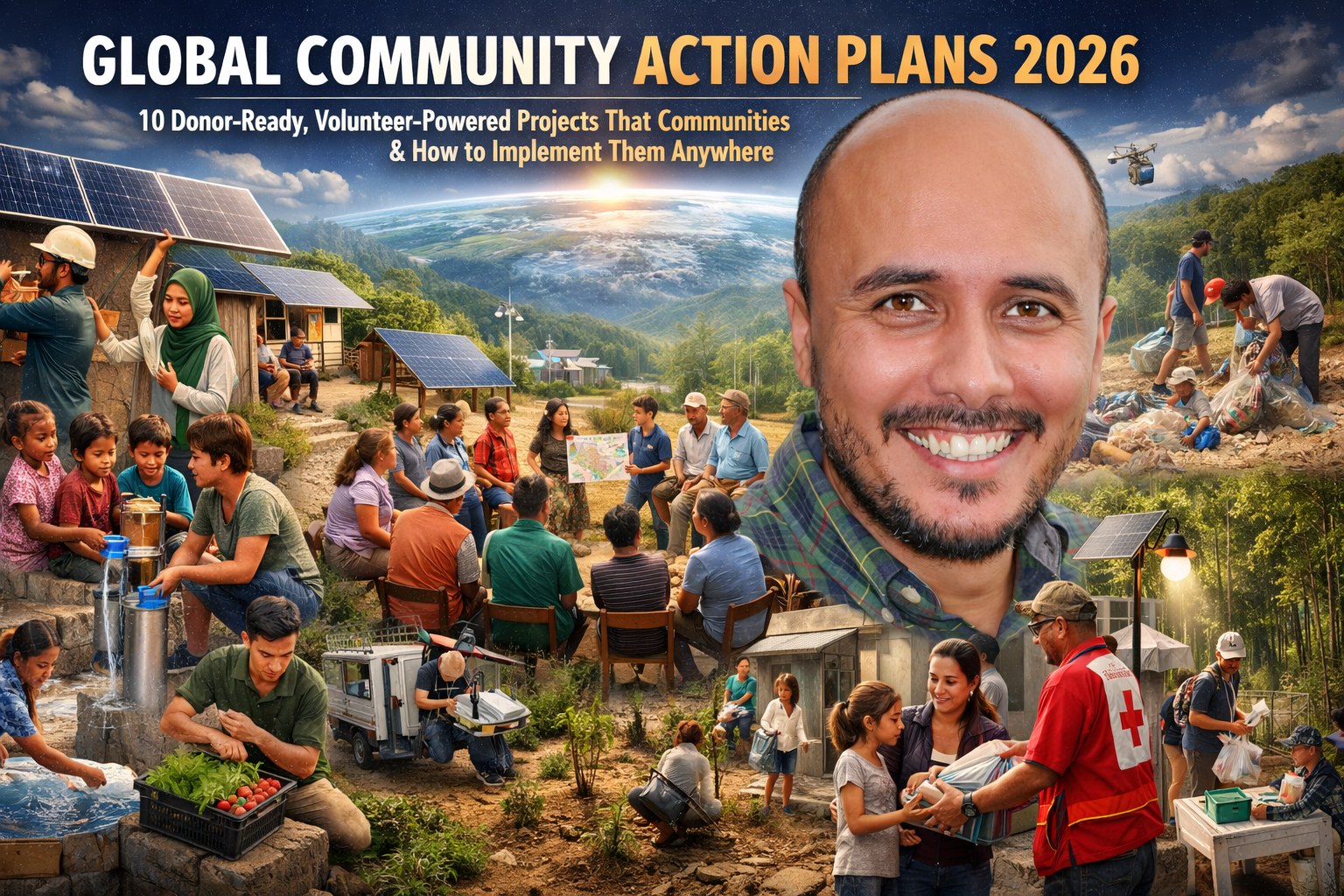
Global Community Action Plans (CAP) 2026: 10 donor-ready, volunteer-powered projects that communities urgently need, and how to implement them anywhere
Global Community Action Plans (CAP) 2026 by Arbab
Purpose
These Community Action Plans (CAPs) are designed to be immediately usable, yet ambitious enough to drive generational change. Each CAP is written so a foundation, municipality, school network, community coalition, or corporate partner can confidently launch a pilot in 30 to 90 days and scale sustainably within 6 to 24 months.
In 2026, communities are dealing with overlapping pressures: rising cost of living, climate shocks, youth unemployment, displacement, mental health strain, and widening inequality. Traditional aid models often move too slowly and measure too little. The CAP approach is different. It treats community change as a disciplined, measurable mission with a clear operating model.
Each CAP is intentionally structured to attract donors, investors, sponsors, volunteers, and public-sector partners because it combines moral clarity with operational realism. These plans translate compassion into execution. The ultimate goals are measurable impact, community ownership, institutional trust, and long-term sustainability that does not collapse when initial funding ends.
To achieve that, every CAP is designed around five non-negotiables that serious partners expect.
First is a clear value proposition: the program must solve a problem people feel every day.
Second is delivery feasibility: it must work with limited budgets, uneven infrastructure, and real human constraints.
Third is accountability: progress must be measurable through simple, verifiable metrics.
Fourth is dignity: participants are partners, not projects.
Fifth is continuity: the program must grow local capacity so results remain after the first grant cycle.
These CAPs are written to be practical blueprints, not abstract theory. They assume real constraints: limited budgets, uneven infrastructure, cultural differences, regulatory complexity, safety risks, and the need for credibility with funders. At the same time, they are designed to unlock human potential at scale through training, systems, partnerships, and trust.
This is program design and educational guidance. It is not legal, medical, tax, or immigration advice.
How to use this playbook
A CAP is most successful when it is treated like a product: it has users, outcomes, quality standards, and feedback loops. Programs fail when they are designed like announcements. Programs succeed when they are designed like systems.
Start by choosing a country or region based on demonstrated need, community readiness, and partner availability rather than convenience or publicity. Readiness matters. A high-need area without local champions can stall. A medium-need area with strong leadership can become a replication model.
Then run a focused pilot that proves outcomes with a small but representative cohort. Early pilots should prioritize learning, trust-building, and refinement over scale. The goal of a pilot is not to look impressive. The goal is to produce proof: evidence that the model works, evidence that it is safe, evidence that people want it, and evidence that the community can help lead it.
After the pilot, scale only what works. Document processes, costs, risks, and outcomes so expansion strengthens quality instead of diluting it. In practice, this means writing down what you did, how much it cost, what skills were required, what went wrong, what you changed, and what improved. This becomes the program’s “replication kit.”
Across all CAPs, the same three design principles apply everywhere.
Community ownership comes first. External funding should accelerate what the community leads, not replace it. Programs that are co-created with communities consistently outperform those imposed from outside because local leaders know where trust lives, where risk hides, and what success must look like to be accepted.
Proof beats promises. Measure outcomes rigorously, publish results transparently, and earn trust from participants, partners, and donors through evidence rather than slogans. A program that can show baseline data, follow-up data, and real stories becomes fundable, scalable, and credible.
Sustainability is not an add-on or a Phase 2 idea. It is designed into the model from day one through local capacity building, diversified funding, realistic operating assumptions, and a plan for how the program keeps running when a grant ends.
A practical way to keep this disciplined is to run every CAP through a simple execution lens.
Who is the target group and how will you recruit them ethically?
What exactly happens in the first week, the first month, and the first three months?
What outcomes will be achieved, and how will they be verified?
What partners are essential, and what partners are optional?
What would make the program unsafe or ineffective, and how will you prevent that?
When those questions have clear answers, the CAP becomes executable.
What “best-in-class” looks like in 2026
A global CAP in 2026 requires a modern operating system that balances humanity with accountability. Best-in-class programs do not rely on charisma or luck. They rely on design.
A clear theory of change is the foundation. It is one concise page that explains how activities lead to outputs, outcomes, and long-term impact. It clarifies the logic so partners and donors can see that your approach is not random.
A safeguarding and ethics framework is mandatory. Written policies and training should protect participants, prevent exploitation, and uphold dignity across cultures. This includes background checks where appropriate, codes of conduct for volunteers, incident reporting, child protection policies, and a clear escalation pathway.
Financial transparency must be simple and audit-ready. Best-in-class does not mean complicated. It means clear budgets, documented approvals, separation of duties where possible, and donor reports that match actual spending. Trust grows when numbers and narratives align.
Data discipline matters more than ever. Collect only what is necessary, store it securely, respect privacy, and use data to improve programs rather than surveil communities. In practical terms, this means defining what data you need, who can access it, and how long you retain it.
A partner ecosystem multiplies impact. Schools, clinics, employers, civic groups, faith networks, and local governments expand trust, expand reach, and reduce cost per beneficiary. A strong CAP is rarely built alone.
A storytelling engine turns impact into momentum. Best-in-class storytelling is not exaggeration. It is clarity. Impact narratives, visuals, community voices, and verified outcomes inspire continued support and attract new partners while protecting participant dignity.
A final best-in-class standard is governance. Programs scale safely when decision-making is clear. That means a community advisory board, transparent selection criteria, a grievance channel, and an annual review process that improves the program rather than defending it.
How countries are selected for each CAP
For each CAP, you will see “high-need implementation clusters.” These examples highlight where the model is particularly relevant because the problem is urgent, the population is large, or the ecosystem is ready for action. They are not limits.
A CAP can be adapted to any country if language, legal compliance, cultural norms, cost assumptions, safeguarding needs, and delivery partners are localized thoughtfully. The strength of the model lies in its adaptability without losing integrity.
To localize a CAP correctly, adjust delivery without changing purpose. Keep the outcomes consistent, but adapt the pathway. For example, in one country the youth employment pathway may prioritize apprenticeships with local employers. In another, it may prioritize remote work readiness and paid projects. In one community, women’s microenterprise may center cooperatives. In another, it may center home-based services with childcare support.
The selection of countries in this playbook should be understood as a starting point for responsible implementation. The best place to start is where need is real, local leadership is ready, and partnerships can be secured.
CAP 1: Global Youth Skills and Digital Employment Accelerator
Executive summary
The Global Youth Skills and Digital Employment Accelerator is a cohort-based pathway that turns youth potential into verified capability and real earnings. It is designed for communities where young people are ready to work but lack the bridges that convert talent into income: tools, mentors, proof of skills, employer access, and safe first opportunities.
This CAP does not market hope. It builds a system. The system produces measurable outcomes: job-ready portfolios, credible credentials, first income through paid projects or placements, and long-term mobility through alumni networks and continuous upskilling.
The need
Youth unemployment and underemployment are among the most destabilizing global challenges. In many regions, formal education no longer translates into income or opportunity. In others, talented youth are blocked by practical barriers: no devices, weak internet connectivity, limited professional communication practice, absence of mentors, limited networks, and no access to employer pipelines.
In 2026, the pressure is sharper because labor markets are changing faster than education systems. AI is reshaping entry-level work, and many starter roles are being redesigned rather than erased. Youth who can work with modern tools, communicate professionally, and prove their capability through portfolios and projects become employable. Youth without those tools and proofs are left behind.
Without intervention, the gap fuels migration pressure, social unrest, cycles of poverty, and enormous lost economic potential. A community can have brilliant youth and still remain economically fragile if there is no bridge from talent to income.
Core objective
Equip young people with future-proof, income-generating skills and connect them directly to real opportunities through local employment, remote work readiness, paid projects, apprenticeships, and ethical entrepreneurship.
This CAP does not promise “jobs.” It promises a reliable pathway that produces employable capability, verified portfolios, and multiple income routes so participants are not dependent on a single employer, a single industry, or a single economy.
Who this program is for
This accelerator is designed for youth who have motivation and potential but need structure, access, and proof.
It supports learners roughly ages 16 to 30 depending on local context and safeguarding policies, including first-generation professionals who lack networks; graduates and near-graduates who are unemployed or underemployed; self-taught talent who need credentials and proof; young women and marginalized groups facing additional access barriers; and displaced youth where legal work pathways exist.
The program is also designed to work with multiple entry levels. Some participants start at basic digital literacy. Others arrive with strong skills but no portfolio, no confidence, and no market access. The accelerator serves both by assessing baseline capability and routing participants into appropriate tracks.
Best-fit locations
High-need clusters include Nigeria, Kenya, South Africa, Ghana, Egypt, Pakistan, India, Bangladesh, the Philippines, Brazil, Colombia, and underserved communities in the United States, Canada, and Europe.
The accelerator works best where at least two conditions are true: a large population of motivated youth; employer demand for skills that can be trained within 8 to 12 weeks; and community partners such as schools, NGOs, faith organizations, youth clubs, workforce agencies, libraries, or municipal offices that can support recruitment and safe space.
What makes this accelerator different
Many youth programs teach skills but do not create earnings. Many job programs push placements but do not build durable capability.
This accelerator is designed as a complete pathway: capability plus proof plus access plus support.
Skills without proof do not get hired.
Proof without access does not get seen.
Access without readiness does not convert.
This CAP delivers all three, in one operating model.
Theory of change
When youth receive role-aligned training, build verified proof of work, and are connected to safe first-income opportunities, they increase employability and earnings. As earnings rise, households stabilize, education outcomes improve, and community resilience strengthens. Alumni then become mentors, facilitators, and local entrepreneurs, creating a self-reinforcing ecosystem that reduces reliance on external funding over time.
Program model
The accelerator runs in cohorts with defined outcomes, weekly accountability, and visible progression. Cohorts can be in-person, hybrid, or remote depending on infrastructure.
The model has three integrated tracks.
The skills track builds capability.
The work track converts capability into income.
The life track builds stability, ethics, and leadership so progress lasts.
The skills track: what we teach and why it works
The skills track starts with a baseline assessment and routes learners into pathways aligned with labor demand. Training is project-based so participants produce proof, not just attendance.
Every participant completes a foundation layer: digital literacy and professional fluency; AI-assisted productivity with ethical guidelines; professional communication and workplace norms; portfolio and proof-building; and workplace reliability skills such as deadline discipline, quality control, and documentation.
Then each cohort offers 3 to 6 role pathways chosen through employer interviews and labor demand scanning. High-demand pathways commonly include customer support and customer success operations, sales development, digital marketing operations, design and video production for social platforms, data analysis and reporting, bookkeeping and admin operations, cybersecurity fundamentals, web development or no-code product building, logistics coordination, and healthcare admin support where appropriate.
Each pathway ends with a portfolio pack: 3 to 6 completed projects that look like real work. Each project includes context, constraints, deliverables, and measurable outcomes so employers can evaluate capability quickly.
The work track: how we convert training into income
The work track is the conversion engine. It ensures training becomes earnings and momentum.
Income pathways include direct employer placement into entry-level roles; internships and apprenticeships that convert into employment; paid projects sourced from local employers, NGOs, small businesses, and municipal needs; freelancing onboarding including profile setup, proposals, portfolio packaging, client communication, invoicing, and dispute prevention; cooperative service businesses where small teams deliver services under a shared brand; and microenterprise launch for participants whose strongest path is local entrepreneurship.
A key feature is the first-income mechanism. This does not mean guaranteed jobs. It means the program is designed so every cohort has a pipeline of paid opportunities: paid projects, internships, cooperative work, or structured client pipelines. That first income is psychologically and economically transformational, and it reduces drop-off.
The life track: what keeps outcomes from collapsing
Many youth programs fail because they ignore the realities that interrupt progress.
The life track includes financial literacy and savings habits; mental health resilience and confidence-building; leadership and ethics including integrity, anti-scam awareness, and responsible AI use; and career ownership including goal setting, feedback culture, personal branding, and long-term learning plans.
What participants graduate with
Graduates leave with proof and pathways.
They graduate with a verified skills portfolio and project artifacts, a professional digital profile and CV package, interview and client readiness training, a role-aligned job readiness credential, a references pathway through mentors and outcome partners, and at least one concrete income pathway such as employment, internship, paid project pipeline, freelance client pipeline, or microenterprise launch plan.
Safeguarding, inclusion, and ethics
This CAP must protect participants, especially minors and vulnerable youth. Best practice includes transparent selection criteria, no pay-to-enter policies, clear codes of conduct for staff and volunteers, incident reporting and referral pathways, safe scheduling and spaces, gender inclusion measures such as targeted recruitment and flexible hours, and accessibility considerations such as offline-capable materials and translations.
Ethical AI is explicitly taught. Participants learn how to use AI as an assistant, how to cite and verify, how to avoid plagiarism and deception, and how to protect sensitive data.
Implementation phases
Phase 1 is community mapping and employer alignment. Start with a demand scan. Interview employers and remote-friendly partners, identify roles they can realistically hire for, and map skill gaps. Secure 5 to 20 outcome partners and define cohort size based on placement capacity.
Phase 2 is cohort launch and training. Run an 8 to 12 week training cycle with weekly assessments and portfolio deliverables. Assign each participant a mentor or coach touchpoint.
Phase 3 is placement and first earnings. Activate the placement engine, match graduates into jobs and internships, assign paid projects, support freelancing onboarding, and provide transition support so early challenges do not cause drop-off.
Phase 4 is alumni network and long-term mobility. Build alumni communities that produce referrals, accountability, and continued learning. Launch advanced tracks for high performers. Invite alumni back as paid assistants or volunteer mentors.
A realistic 90-day pilot blueprint
Weeks 1 and 2 focus on partner alignment, curriculum localization, safeguarding setup, recruitment channels, and device and connectivity planning.
Weeks 3 and 4 focus on cohort selection, baseline assessment, onboarding, and confidence-building.
Weeks 5 to 10 focus on deep training with weekly portfolio deliverables, workplace simulations, and continuous mentor feedback.
Weeks 11 and 12 focus on placement: employer demo day, paid project assignments, internships, and freelancing launches.
The pilot ends only when outcomes are verified and documented in a replication kit.
Staffing and governance
A strong pilot typically needs a program lead, a training lead, a placement lead, and safeguarding oversight. In smaller contexts, roles can be combined, but responsibilities should remain distinct.
Governance should include a community advisory group and an employer advisory loop to ensure the program stays aligned with labor demand and community trust.
Volunteer roles that drive success
Career mentors provide coaching, portfolio review, mock interviews, language practice, and professional norms.
Technical volunteers deliver workshops and live labs in data analysis, design, marketing, coding, cybersecurity, customer success, and operations.
Community volunteers support recruitment, attendance retention, safe spaces, and family engagement.
Employer volunteers provide real assignments, portfolio feedback, and interview loops.
Donor, sponsor, and investor value
Sponsors can fund cohorts, learning labs, devices and connectivity, certification fees, stipends, safeguarding infrastructure, and job placement operations.
Sponsors receive reportable outcomes: completion rates, skills progression, portfolio quality, placement rates and time-to-first-income, earnings growth, retention at 6 and 12 months, employer satisfaction, and repeat hiring.
Sponsor visibility is credible when it is tied to real outcomes: named cohorts, scholarship funds, equipment labs, and employer pathways.
For impact investors and corporate partners, revenue-generating components can be structured ethically through employer-paid training partnerships, paid project marketplaces, and cooperative service businesses that reinvest into future cohorts.
Sustainability
The model blends donor funding with earned revenue so it does not collapse when grants end.
Sustainability mechanisms include employer sponsorship tiers, a paid project marketplace for local businesses, alumni-led enterprises that reinvest a portion into training, and a train-the-trainer pipeline that builds local facilitator capacity.
Success metrics
Core metrics include enrollment-to-graduation, pre and post skill assessments, portfolio completion and quality, placement across jobs, internships, paid projects, and freelancing, time-to-first-income, income uplift at 3 and 6 months, retention at 6 and 12 months, employer satisfaction and repeat hiring, and equity indicators such as participation and outcomes for young women and marginalized groups.
What can go wrong and how to prevent it
Overpromising jobs breaks trust. Prevent it by securing outcome partners before launch and offering multiple income pathways.
Training that does not match labor demand wastes time. Prevent it by interviewing employers, updating pathways each cohort, and requiring portfolio artifacts that reflect real tasks.
Device and connectivity barriers reduce participation. Prevent it through device lending, learning hubs, offline materials, and flexible scheduling.
Drop-off due to life pressures can derail outcomes. Reduce it with stipends where feasible, peer accountability, mentorship, mental health support, and family engagement.
Exploitation and scams, especially in freelancing, can harm participants. Prevent it with safety training, verified platforms, mentor oversight, and clear red-flag education.
Weak documentation undermines credibility. Prevent it with baseline data, weekly deliverable tracking, verified outcomes at graduation, and clear donor reporting.
If executed with discipline, this CAP becomes a community engine: youth talent becomes income, income becomes stability, and stability becomes long-term growth.
CAP 2: Women-Led Microenterprise and Financial Independence Initiative
Executive Summary
The Women-Led Microenterprise and Financial Independence Initiative is a community-rooted economic empowerment model designed to unlock women’s earning power, agency, and leadership through safe, dignified, and scalable entrepreneurship. It recognizes a simple truth: when women control income, entire communities become more stable, resilient, and prosperous.
This CAP is not a microgrant program alone, and it is not a training workshop in isolation. It is a complete economic pathway that combines capital access, practical business capability, protective community structures, and long-term financial confidence. The initiative is intentionally designed to function in high-risk, low-resource, and culturally complex environments while remaining attractive to donors, sponsors, impact investors, and public-sector partners.
The Need
Across the world, women carry a disproportionate share of economic responsibility while facing structural exclusion from capital, formal markets, legal identity systems, and decision-making power.
In many communities, women are primary caregivers, household managers, and informal earners, yet they lack:
Access to startup capital or safe credit
Financial literacy and confidence
Legal identity or business registration pathways
Control over income and assets
Safe market access and mobility
Time and childcare support
Even when women operate businesses, they often remain trapped in subsistence-level activity rather than scalable income generation. Without intervention, this results in persistent poverty, intergenerational inequality, food insecurity, and reduced education outcomes for children.
In 2026, economic shocks, inflation, climate stress, and displacement have made women’s financial resilience more urgent than ever. Supporting women’s entrepreneurship is not only a gender issue. It is an economic stabilization strategy.
Core Objective
Enable women to start, stabilize, formalize, and grow income-generating businesses while strengthening financial confidence, personal safety, leadership, and long-term independence.
This CAP does not push women into risky debt or unrealistic growth expectations. It builds durable, right-sized enterprises that match local markets, cultural realities, and women’s time constraints.
Who This Program Is For
This initiative is designed for women who are economically active or ready to become economically active but face systemic barriers.
It supports:
Low-income and working-class women
Single mothers and women-led households
Rural and peri-urban women
Refugee and displaced women where legal conditions allow
Women transitioning from informal to formal business activity
Survivors of economic abuse seeking independence
The program is flexible across literacy levels, education backgrounds, and business experience. It meets women where they are and builds forward.
Best-Fit Locations
High-need implementation clusters include India, Pakistan, Bangladesh, Nepal, Ethiopia, Kenya, Tanzania, Morocco, Jordan, Peru, rural Latin America, and refugee-hosting communities globally.
The model performs best where:
Women already participate in informal economic activity
Local markets exist for everyday goods and services
Trusted community organizations can support safe recruitment
Cultural adaptation is prioritized over uniform delivery
What Makes This Initiative Different
Many women’s programs fail because they isolate one element of empowerment.
Capital without skills creates debt risk
Skills without capital create frustration
Income without safety creates vulnerability
Business without community creates burnout
This CAP integrates capital, capability, and community into a single operating system.
It is built on four principles:
Safety before scale
Confidence before capital expansion
Income before formalization
Community before isolation
Theory of Change
When women receive small but strategic capital, practical business training, and protective peer structures, they increase income stability. As income stabilizes, women gain confidence, decision-making power, and bargaining power within households and markets. Over time, businesses formalize, savings grow, children remain in school, and women emerge as community economic leaders.
Program Model
The initiative operates through cohorts supported by local partners. Each cohort moves through four integrated pillars.
Pillar 1: Capital Access
Capital is delivered as microgrants or revolving funds, not high-interest loans.
Design principles include:
Transparent eligibility criteria
Simple application processes
Small initial amounts to reduce risk
Clear use-of-funds guidelines
Reinforcement through coaching, not punishment
Capital is often paired with starter kits such as equipment, raw materials, or inventory rather than cash alone.
Pillar 2: Capability Building
Training is practical, visual, and immediately applicable.
Core modules include:
Pricing and cost calculation
Simple bookkeeping and cash flow tracking
Inventory and supplier management
Customer service and trust-building
Digital payments and mobile money
Basic digital selling and promotion
Fraud and scam awareness
Training is delivered in short sessions to respect time constraints and caregiving responsibilities.
Pillar 3: Community and Protection
Women succeed faster and safer when they are not alone.
Community structures include:
Women’s cooperatives
Peer savings and lending groups
Mentorship circles
Safe discussion spaces
Childcare support models
These structures reduce isolation, increase accountability, and provide early warning systems for risk.
Pillar 4: Growth and Formalization
Once income stabilizes, women receive support to grow responsibly.
This includes:
Branding and packaging
Market access partnerships
Cooperative purchasing power
Permit and registration support
Digital records and credit readiness
Formalization is optional and phased. It happens when it benefits the woman, not the system.
High-Performing Business Pathways
The initiative prioritizes businesses with steady demand, low startup risk, and compatibility with women’s schedules.
Common pathways include:
Food processing and agriculture value-add
Tailoring, textiles, and repairs
Childcare and elder care services
Beauty, wellness, and personal care
Home-based catering and baking
Local logistics and last-mile services
Digital microservices and remote work
Small retail and resale
Each pathway is validated locally before inclusion.
Implementation Phases
Phase 1: Safety and Trust Building
Partner with trusted local organizations. Define safeguarding protocols, grievance channels, and consent-based participation. Community trust is non-negotiable.
Phase 2: Selection and Readiness
Use simple, dignity-centered criteria. Assess readiness, household constraints, and support needs.
Phase 3: Launch and Coaching
Provide capital and weekly coaching during the first 90 days when failure risk is highest. Focus on cash flow discipline and confidence.
Phase 4: Scale and Market Integration
Support expansion through partnerships, cooperatives, and formal market access rather than individual risk-taking.
Role of Donors, Sponsors, and Partners
Donors fund seed capital pools, training delivery, safeguarding infrastructure, and childcare support.
Sponsors strengthen market access through procurement commitments, retail partnerships, and supply chain inclusion.
Local governments support registration pathways, facilities, and integration into development plans.
Volunteers provide mentorship, bookkeeping support, and business coaching.
Sustainability Model
Long-term viability is achieved through:
Revolving capital funds
Cooperative purchasing and shared services
Group savings and internal lending
Supplier and buyer partnerships
Gradual cost recovery for advanced services
The goal is decreasing donor dependency over time without compromising safety.
Success Metrics
Business survival at 6 and 12 months
Monthly income growth and stability
Savings rates and emergency resilience
Children’s school attendance and retention
Reduction in financial stress indicators
Women’s decision-making confidence
Participation in community leadership
Risks and Mitigation
Household or community resistance is addressed through community engagement and male ally education.
Misuse of funds is reduced through coaching, peer accountability, and staged capital release.
Overwork and burnout are prevented through realistic growth expectations and childcare support.
Market saturation is mitigated through pathway diversification and cooperative models.
Long-Term Impact
When executed with care and discipline, this CAP produces far more than small businesses.
It produces confident women, resilient households, educated children, and stronger local economies. Over time, women move from survival to leadership, from informal work to respected enterprise, and from exclusion to agency.
This is not charity. It is one of the most powerful economic investments a community can make.
CAP 3: Community Health Access and Preventive Care Network
Executive Summary
The Community Health Access and Preventive Care Network is a scalable, community-anchored health system designed to reduce preventable illness, protect mothers and children, and strengthen mental well-being through early detection, preventive services, and consistent follow-up.
This CAP is built for places where healthcare is available in theory but inaccessible in practice. Distance, cost, stigma, staffing shortages, and weak follow-up systems cause conditions to worsen until they become emergencies. The network flips that pattern. It brings basic services closer to people, connects communities to clinicians through telehealth, and builds local trust through trained community health workers.
This is not a “one-time clinic day.” It is a repeatable system that saves lives by turning prevention into a routine.
This content is educational program design and is not medical advice.
The Need
Preventable illness remains one of the most expensive forms of suffering. When communities lack early screening and basic preventive care, health issues become emergencies, and emergencies become debt, disability, or loss of life.
In 2026, three gaps are especially urgent.
Preventable disease burden. Many conditions that are manageable with early detection, basic medication access, and health education become deadly when care arrives late.
Maternal and child health gaps. Pregnancy complications, newborn risks, malnutrition, and missing immunizations can compound quickly in communities without reliable follow-up.
Mental health strain. Untreated trauma, stress, depression, and anxiety reduce educational outcomes, workplace participation, and family stability.
These gaps reduce life expectancy, weaken productivity, increase healthcare costs, and deepen poverty.
Core Objective
Deliver community-based preventive care using a hybrid model that combines mobile services, telehealth connections, and practical health education.
The purpose is not to replace hospitals or ministries of health. The purpose is to strengthen the front line of health: screening, prevention, referrals, and follow-up.
Who This Program Is For
This CAP prioritizes communities where barriers to care are structural.
It serves:
· Rural and remote populations
· Underserved urban neighborhoods
· Indigenous communities
· Refugee and displaced populations
· Low-income households with limited clinic access
· Mothers, newborns, and children under five
· People managing chronic disease without consistent follow-up
It also supports healthcare systems by reducing avoidable emergencies and improving referral quality.
Best-Fit Locations
High-need clusters include rural sub-Saharan Africa, South Asia, Indigenous communities, refugee settings, and underserved urban neighborhoods worldwide.
The model performs best where:
· basic clinics exist but are hard to access
· community trust needs strengthening
· preventable disease burden is high
· follow-up systems are weak
· digital connectivity exists at least intermittently
What Makes This Network Different
Many health interventions deliver services but fail to sustain outcomes because they lack continuity.
This network is designed around a simple truth.
Care without follow-up is incomplete care.
The network builds continuity through:
· community health workers as trusted connectors
· mobile units that return on a schedule
· telehealth links that bring expertise to the community
· referral tracking so no patient is lost
· education that prevents recurrence
Theory of Change
When community members can access screening and preventive care early, conditions are detected sooner, referral pathways improve, and emergencies decline. When community health workers provide culturally competent education and follow-up, adherence increases and stigma decreases. Over time, maternal outcomes improve, chronic disease complications decline, and health becomes a foundation for education and economic stability.
Program Model
The network operates through four integrated pillars.
Pillar 1: Community Health Workers Plus Digital Support
Community health workers (CHWs) are the trust engine. They are trained to screen, educate, navigate referrals, and follow up.
They use simple digital tools when possible to track visits, referrals, and outcomes.
Key capabilities include:
· basic screening protocols
· symptom triage and escalation
· maternal and child health support
· chronic disease check-ins
· mental health first-line support and referral
· community education and stigma reduction
Pillar 2: Mobile Clinics for Screening and Basic Care
Mobile clinics bring services to communities on a consistent schedule.
Priority services often include:
· blood pressure and diabetes screening
· basic anemia and nutrition assessments
· vaccination support and catch-up
· prenatal and postnatal check-ins
· child growth monitoring
· basic wound care and infection checks
Mobile units are designed to stabilize, detect early, and connect patients to higher-level care when needed.
Pillar 3: Telehealth Connections for Specialist Access
Telehealth expands reach. It connects CHWs and mobile clinicians to remote specialists.
Telehealth can support:
· maternal risk consultations
· pediatric check-ins
· chronic disease management guidance
· mental health counseling referrals
· medication and treatment plan verification
Telehealth works best when it supports local providers, not when it bypasses them.
Pillar 4: Health Education for Prevention and Long-Term Resilience
Education is a clinical intervention. This CAP delivers clear, culturally respectful education focused on prevention.
Core education topics include:
· hygiene and infection prevention
· nutrition and child feeding
· maternal health warning signs
· chronic disease self-management
· medication adherence and safety
· mental health stigma reduction
· safe water, sanitation, and household practices
Education is delivered through small group sessions, school partnerships, community gatherings, and household visits.
Service Priorities by Context
This network can be tailored, but most communities benefit from starting with a high-impact bundle.
A common first bundle includes:
Maternal and child health screening and support.
Vaccination and child growth monitoring.
Diabetes and hypertension screening.
Basic mental health screening and referral.
Nutrition education and anemia detection.
This bundle targets conditions that cause the greatest long-term harm when ignored.
Implementation Phases
Phase 1: Local Health Partner Alignment
Align with clinics, ministries, hospitals, and credible NGOs. Define scope, referral pathways, data-sharing agreements, safeguarding, and clinical supervision.
The network must integrate into local systems to be sustainable and trusted.
Phase 2: Train Community Health Workers
Train CHWs to focus on screening, trust-building, referral navigation, and follow-up.
Training should include:
· standardized screening protocols
· communication and consent
· privacy and data protection
· safeguarding and domestic violence sensitivity
· mental health first-line support
· escalation and emergency recognition
Phase 3: Deploy Mobile and Telehealth Services
Start with high-impact screenings and services based on local disease burden.
Build predictable schedules so communities trust that services will return.
Phase 4: Build Referral and Follow-Up Systems
This is where lives are saved.
Establish a referral loop where:
· every referral is documented
· patients are supported through barriers
· follow-up is confirmed
· outcomes are tracked
If a patient does not complete a referral, the system should detect it and trigger outreach.
Safeguarding, Ethics, and Privacy
This CAP must protect patient dignity and data.
Minimum standards include:
· informed consent practices
· confidentiality and secure data storage
· trauma-informed engagement
· clear referral pathways for abuse or violence
· culturally respectful care
· non-discrimination policies
Donor and Sponsor Value
Sponsors can fund mobile units, screening equipment, telehealth connectivity, training for CHWs, and medication access programs.
Sponsors receive measurable outcomes tied to community health improvement.
Examples include:
· increased screening coverage
· improved follow-up completion
· reduced avoidable emergency visits
· maternal and child health gains
· higher vaccination adherence
Sponsors can also support visibility that is meaningful and ethical: funded mobile clinics, named health hubs, equipment grants, and community education initiatives.
Sustainability
Long-term sustainability comes from integration and cost-efficiency.
The network is designed to integrate with public health systems, community insurance models where feasible, and cost-recovery for those who can pay, while protecting vulnerable populations.
Sustainability options include:
· public-sector integration and CHW recognition
· local facility partnerships and shared staffing
· school-based health partnerships
· low-cost membership models where appropriate
· corporate sponsorship for equipment and connectivity
Success Metrics
· screening coverage and reach
· follow-up completion rate
· maternal outcomes such as prenatal visit completion and safe delivery referrals
· child outcomes including growth monitoring and vaccination adherence
· chronic disease management indicators
· reductions in avoidable emergency care
· community trust indicators such as repeat participation
Risks and Mitigation
Fragmentation and duplication are prevented by aligning with existing health systems and respecting local clinical leadership.
Loss of follow-up is mitigated through referral tracking, CHW outreach, and simple reminder systems.
Staff burnout is reduced by realistic caseloads, supervision, and support.
Privacy risks are mitigated through consent, secure data handling, and minimal data collection.
Long-Term Impact
When executed with discipline, this CAP produces a healthier community that can learn, work, and thrive.
It reduces avoidable suffering, protects mothers and children, stabilizes households, and strengthens trust in local systems.
It turns health from crisis response into community resilience.
CAP 4: Clean Water, Sanitation, and Hygiene (WASH) Resilience Program
Executive Summary
The Clean Water, Sanitation, and Hygiene (WASH) Resilience Program is a high-impact, infrastructure-plus-governance model designed to deliver what communities need most for health, dignity, and economic stability: reliable clean water, safe sanitation, and practical hygiene habits that prevent disease.
This CAP is built on a reality many programs ignore. Installing water points is not the finish line. The finish line is sustained functionality. Communities do not benefit from broken infrastructure, abandoned latrines, or systems with no maintenance pathway.
This program therefore combines three pillars: durable WASH infrastructure, community governance that protects assets, and hygiene education that turns access into health outcomes.
The Need
Unsafe water and inadequate sanitation drive disease, school absenteeism, economic loss, and avoidable death. The burden falls hardest on women and girls.
When clean water is not nearby, women and girls spend hours collecting it, missing school and income opportunities and increasing exposure to exploitation and violence.
When sanitation is unsafe or absent, communities experience higher rates of diarrheal disease, cholera outbreaks, parasitic infections, malnutrition, and stunting.
When hygiene education is not embedded, even improved infrastructure does not fully reduce disease.
In 2026, climate volatility makes WASH resilience more urgent. Drought, flooding, and displacement can break fragile water systems and overwhelm sanitation infrastructure. WASH is not only a health intervention. It is a foundation for education, economic growth, and community stability.
Core Objective
Provide sustainable access to clean water and sanitation, combined with hygiene education and local maintenance capacity.
The program aims to move communities from fragile access to resilient access by ensuring systems remain functional at 12 and 24 months and beyond.
Who This Program Is For
This CAP is designed for communities where WASH gaps have high human and economic costs.
It is especially effective for:
· Rural communities with limited water access
· Informal settlements and slums
· Disaster-prone regions affected by floods or drought
· Schools and clinics without safe WASH
· Refugee and displaced communities
· Communities with repeated waterborne disease outbreaks
Best-Fit Locations
High-need clusters include sub-Saharan Africa, South Asia, disaster-prone regions, and informal settlements in major cities.
The model performs best where:
· water sources exist but are unsafe or unreliable
· sanitation infrastructure is inadequate
· local leadership is willing to govern shared assets
· there is capacity for local maintenance training
What Makes This Program Different
Many WASH interventions focus on installation rather than functionality.
This CAP is designed around one measurable truth.
A water system is successful only when it still works.
The program combines infrastructure with governance and maintenance so communities can protect, repair, and sustain what is installed.
Theory of Change
When communities gain reliable clean water and safe sanitation, and when hygiene behaviors are reinforced through schools and household education, waterborne illness declines. When local governance and maintenance capacity exist, infrastructure remains functional and health benefits persist. Over time, school attendance rises, household productivity improves, women gain time and safety, and communities become more resilient to climate shocks.
Program Model: Infrastructure Plus Governance
This CAP operates through four integrated components.
Component 1: Water Access Solutions
Water access is designed based on local hydrology, population density, climate risk, and maintenance capacity.
Common solutions include:
· filtration systems for households or community points
· boreholes and wells with pumps where feasible
· rainwater harvesting and storage systems
· community taps and standpipes
· small-scale piped systems for clustered communities
The correct solution is the one that can be maintained locally.
Component 2: Sanitation Solutions
Sanitation is designed for safety, dignity, and feasibility.
Common solutions include:
· improved latrines with safe design
· community sanitation blocks for dense settlements
· safe waste management systems and sludge handling pathways
· menstrual hygiene management support in schools
· school-based WASH upgrades, including handwashing stations and safe toilets
Sanitation must include a plan for ongoing cleaning, repairs, and waste management.
Component 3: Hygiene Education and Behavior Reinforcement
Infrastructure alone does not end disease. Behavior change completes the health outcome.
Education focuses on:
· handwashing at critical times
· safe water storage and household hygiene
· food hygiene
· menstrual hygiene management
· early recognition of waterborne illness
Delivery channels include schools, community gatherings, health worker partnerships, and household visits.
Component 4: Local Maintenance and Governance
Sustainability requires community ownership.
The program establishes:
· local maintenance training for basic repairs
· spare parts planning and local supply chains
· a community water committee to oversee fees, repairs, and fairness
· clear accountability and transparent finance tracking
This governance layer prevents breakdown and protects community trust.
Implementation Phases
Phase 1: Site Assessment and Community Agreements
Begin with technical assessments and community alignment.
Key actions include:
· water source testing and feasibility analysis
· sanitation mapping and risk identification
· stakeholder consultations and consent
· community agreement on governance structure and responsibilities
· safeguarding and inclusion planning
Phase 2: Install and Train
Install infrastructure with quality control. Train local technicians and committee members.
Training includes:
· routine maintenance procedures
· basic repairs and troubleshooting
· spare parts and procurement planning
· recordkeeping for maintenance and finances
Phase 3: Hygiene Education and School Integration
Integrate hygiene education into school routines and community programs.
Schools become behavior-change hubs. Children become hygiene ambassadors.
Phase 4: Maintenance, Monitoring, and Repairs
The program includes scheduled monitoring and a repair response system.
Monitoring tracks:
· functionality
· water quality indicators where feasible
· usage levels
· committee finance transparency
· community satisfaction
Safeguarding, Equity, and Dignity
WASH is linked to safety and gender equity.
Minimum standards include:
· community participation in design
· gender-informed placement of water points
· safe sanitation access for women and girls
· menstrual hygiene support
· disability-accessible design where feasible
· non-discriminatory access rules
Donor and Sponsor Value
Sponsors fund installations, maintenance kits, spare parts inventories, hygiene education materials, school WASH upgrades, and long-term monitoring.
Sponsors receive measurable outcomes:
· improved water access reliability
· reduced waterborne illness indicators
· improved school attendance
· increased functionality at 12 and 24 months
· increased safety and time savings for women and girls
Sponsors can support ethical recognition through named installations, school partnerships, and community education initiatives.
Sustainability
Sustainability is designed through local governance and realistic maintenance pathways.
Key mechanisms include:
· small user fees where appropriate and culturally accepted
· transparent fee management through water committees
· local spare-parts supply and technician training
· partnerships with municipal systems where available
· maintenance funds ring-fenced for repairs
The goal is long-term functionality, not one-time construction.
Success Metrics
· water access reliability and uptime
· water quality indicators where feasible
· sanitation usage and cleanliness
· reduction in waterborne illness indicators
· school attendance improvement, especially for girls
· time saved for households collecting water
· functionality rate at 12 and 24 months
Risks and Mitigation
Infrastructure breakdown is mitigated through maintenance training, spare-parts planning, and routine monitoring.
Committee conflict or corruption is mitigated through transparent finance systems, community oversight, and rotating leadership.
Exclusion and inequity are mitigated through inclusive governance rules and gender-informed design.
Climate shocks are mitigated through resilient design choices and diversified water sources where possible.
Long-Term Impact
When executed with discipline, this CAP transforms community life.
Children miss fewer school days. Families spend less on preventable illness. Women and girls gain time, safety, and dignity. Communities become stronger, healthier, and more resilient to climate pressure.
Clean water is not only a resource.
It is the foundation of opportunity.
CAP 5: Climate-Resilient Community Livelihoods Program
Executive Summary
The Climate-Resilient Community Livelihoods Program is a practical economic adaptation model built for a new reality: climate shocks are already reshaping how communities earn, farm, fish, build, and survive. Drought, flooding, heat waves, ecosystem collapse, and disaster displacement are destroying income sources faster than traditional development models can respond.
This CAP moves beyond awareness and into action. It helps communities adapt economically while protecting local ecosystems through climate-smart livelihood pathways, green jobs training, market access systems, and resilience financing.
The program is designed to be implementable, fundable, and scalable. It can launch with targeted pilots in 90 days, demonstrate measurable income stability, and expand through cooperative structures and revenue-generating enterprises.
This content is educational program design and is not legal or financial advice.
The Need
Climate shocks are destroying income sources through drought, flooding, heat, and ecosystem collapse.
When rainfall patterns shift, harvests fail and food prices rise.
When floods hit, homes, inventory, tools, and market access routes are destroyed.
When heat intensifies, labor capacity declines and chronic health burdens increase.
When ecosystems collapse, fisheries decline, forests disappear, soils degrade, and tourism loses stability.
The result is not only environmental damage. It is economic destabilization. Families fall into debt, migration pressure rises, and community cohesion weakens.
In 2026, the most urgent gap is this: many communities know climate risk is real, but they lack a concrete livelihood transition plan that protects income.
Core Objective
Help communities adapt economically while protecting local ecosystems through climate-smart livelihoods.
The objective is to replace fragile income pathways with resilient ones, and to ensure communities can withstand shocks without falling into poverty.
This CAP prioritizes solutions that are practical, locally maintainable, and connected to real markets.
Who This Program Is For
This program is designed for communities whose livelihoods are climate exposed.
It supports:
· Smallholder farmers and agricultural workers
· Coastal fishing communities
· Informal workers and microentrepreneurs exposed to climate disruption
· Women-led livelihoods in climate-stressed regions
· Youth seeking green skills and local job pathways
· Disaster-affected communities rebuilding income
· Indigenous communities protecting land-based livelihoods
This CAP is especially powerful when combined with existing community structures such as cooperatives, local councils, farmer associations, and women’s savings groups.
Best-Fit Locations
High-need clusters include Bangladesh, Pakistan, the Philippines, Kenya, Ethiopia, Sahel regions, Pacific Islands, coastal Latin America, and wildfire-prone communities.
The model performs best where:
· income sources depend on climate-sensitive systems
· markets exist for resilient products and services
· there is willingness to adopt improved practices
· community organizations can support delivery
What Makes This Program Different
Many climate programs focus on education and awareness but leave communities without livelihood alternatives.
This CAP is designed around a measurable outcome.
Climate resilience means income resilience.
The program is built on livelihood adaptation, not only awareness.
It focuses on earning pathways that can survive drought, flood, heat, and market disruption.
Theory of Change
When communities understand their climate risks, select realistic livelihood pathways, and receive training, starter assets, and market access support, they can stabilize income. When livelihoods are designed to protect ecosystems, long-term resilience increases. When financing and insurance tools are added, households can recover faster from shocks, reducing the need for distress migration and debt.
Program Model: Livelihood Adaptation Pathways
This CAP operates through five integrated livelihood pillars. Each site selects the right mix based on local conditions and market opportunities.
Pillar 1: Climate-Smart Agriculture and Water Management
This pathway protects farming income by improving productivity, water efficiency, soil health, and climate resilience.
High-impact interventions include:
· drought-resistant and flood-tolerant crops
· soil regeneration and composting
· drip irrigation and efficient watering
· rainwater harvesting for agriculture
· agroforestry systems that reduce erosion
· post-harvest storage to reduce loss
· climate-aware planting calendars
The goal is stable yields and reduced failure risk.
Pillar 2: Renewable Energy Skills and Local Installation Jobs
Renewable energy creates one of the most scalable green job pipelines.
This pathway builds local capacity for:
· solar installation and maintenance
· small-scale battery systems
· clean cooking solutions
· energy efficiency retrofits
· microgrid support roles
These skills create income while reducing reliance on expensive and polluting energy sources.
Pillar 3: Sustainable Fishing and Coastal Resilience Enterprises
Coastal communities require livelihoods that protect ecosystems while maintaining income.
This pathway includes:
· sustainable fishing practices and gear upgrades
· aquaculture where environmentally appropriate
· reef and mangrove restoration tied to paid work
· fish processing and cold chain improvements
· community-based tourism where viable
The focus is protecting fisheries while increasing value-add income.
Pillar 4: Eco-Enterprises for Circular Local Economies
Eco-enterprises convert waste and pollution into jobs.
Common enterprise pathways include:
· recycling and waste sorting businesses
· composting and soil input production
· clean cooking and stove distribution
· water-saving household products
· repair and reuse services
The goal is locally owned businesses that create jobs while improving environmental conditions.
Pillar 5: Climate-Resilient Microenterprise Diversification
Some communities need diversification beyond climate-sensitive sectors.
This pathway supports:
· climate-safe services such as repairs, tailoring, childcare, tutoring
· digital work pathways where connectivity allows
· resilient local supply chain enterprises
· small-scale manufacturing and value-add production
Diversification reduces dependence on one climate-exposed income stream.
Implementation Phases
Phase 1: Climate Risk Mapping and Livelihood Selection
Start with a clear assessment.
Key actions include:
· map climate hazards and seasonality
· identify exposed income sources
· analyze local markets and demand
· select 2 to 4 livelihood pathways with community input
· define environmental safeguards
The selection phase prevents wasted investments.
Phase 2: Training and Starter Kits
Training is practical and followed by assets.
Starter kits may include:
· seeds and tools
· irrigation equipment
· solar installation kits
· fishing gear upgrades
· composting or recycling equipment
Starter assets are designed to reduce risk and accelerate adoption.
Phase 3: Market Access and Aggregation
Livelihoods grow only when markets exist.
This phase builds:
· buyer partnerships and offtake agreements
· cooperative aggregation for better pricing
· quality standards and packaging
· logistics and distribution pathways
· community branding for premium markets
Market access is where income stability becomes real.
Phase 4: Resilience Financing and Insurance Pathways
Where feasible, the program supports:
· microfinance aligned to productive assets
· savings groups and cooperative funds
· parametric insurance pilots
· emergency resilience funds
· climate-linked credit support
Financing reduces recovery time after shocks.
Safeguarding and Environmental Integrity
Climate livelihoods must avoid harm.
Minimum standards include:
· no deforestation or illegal resource extraction
· fair labor practices and worker safety
· inclusion of women and youth
· transparent selection criteria
· monitoring to prevent unintended ecological damage
Donor, Sponsor, and Impact Investor Value
Donors can fund training, starter assets, early market creation, and capacity building.
Sponsors can fund equipment, local hubs, and supply chain partnerships.
Impact investors can support revenue-generating green enterprises, especially in renewable energy, recycling, sustainable agriculture value chains, and coastal resilience enterprises.
Partners receive measurable outcomes:
· improved income stability
· reduced climate loss impact
· adoption of resilient practices
· enterprise survival and growth
· ecosystem protection indicators
Sustainability
Sustainability is achieved through market-driven livelihoods supported by cooperative structures and appropriate financing.
Key mechanisms include:
· cooperatives that aggregate products and negotiate prices
· local service businesses that earn through maintenance and repairs
· savings groups that build resilience buffers
· supply chain partnerships that create repeat demand
· train-the-trainer models that build local capability
The goal is decreasing external dependence while increasing local resilience.
Success Metrics
· household income stability and variability reduction
· reduced climate loss impact after shocks
· adoption rate of resilient practices
· enterprise survival rate at 6 and 12 months
· market access indicators such as buyer agreements and sales volume
· ecosystem indicators such as soil health improvement or waste reduction
· participation and outcomes for women and youth
Risks and Mitigation
Low adoption is mitigated through community co-design, demonstration plots, and starter kits that reduce risk.
Market failure is mitigated by securing buyer pathways and cooperative aggregation before scaling.
Greenwashing risk is mitigated through clear environmental safeguards and transparent reporting.
Climate volatility exceeding design assumptions is mitigated through diversified pathways and contingency planning.
Long-Term Impact
When executed with discipline, this CAP turns climate pressure into a livelihood transition.
Families become less vulnerable to shocks. Communities reduce distress migration. Local ecosystems recover. Youth find meaningful green jobs. Women strengthen household resilience. Over time, resilient livelihoods become the foundation of stability and growth.
Climate resilience is not only an environmental goal.
It is an economic future.
CAP 6: Refugee and Displaced Persons Economic Integration Program
Executive Summary
The Refugee and Displaced Persons Economic Integration Program is a dignity-first, systems-based approach to helping displaced people rebuild stable, lawful income while strengthening social cohesion in host communities.
Displacement often creates long-term dependency even when refugees have strong skills, work ethic, and entrepreneurial capacity. The problem is rarely motivation. The problem is access: legal work authorization barriers, missing documentation, language gaps, credential recognition challenges, limited networks, trauma, and employer uncertainty.
This CAP converts barriers into pathways. It maps skills to real work opportunities, supports lawful work documentation and compliance, builds ethical employer and remote-work pipelines, and supports microenterprise models that serve host communities rather than competing destructively.
This CAP is designed to be implementable by NGOs, municipalities, workforce agencies, and corporate partners. It can launch with a 90-day pilot and scale through employer partnerships, service contracts, and revolving microenterprise funds.
This content is educational program design and is not legal or immigration advice.
The Need
Displacement can turn capable people into “aid recipients” for years. This is not because displaced people lack talent. It is because systems fail to translate their capabilities into lawful employment.
Common structural barriers include:
· Work authorization restrictions and confusing eligibility pathways
· Loss of identity documents, credentials, and work records
· Language barriers and limited professional communication confidence
· Non-recognition of prior education or licenses
· Employer risk concerns and misinformation
· Limited transportation, childcare, and stable housing
· Trauma, stress, and mental health strain
· Social friction between host communities and displaced populations
The result is a costly cycle: underemployment leads to poverty, poverty increases dependence, and dependence fuels resentment and instability.
In 2026, displacement is increasingly protracted. Many people live in “temporary” conditions for years. Economic integration is therefore not an optional add-on to humanitarian response. It is a stability strategy.
Core Objective
Enable lawful income, dignity, and social cohesion through economic integration.
This CAP is designed to achieve three outcomes at the same time.
Income outcomes: people earn legally and reliably.
System outcomes: employers and institutions gain clarity and confidence.
Community outcomes: host communities benefit through services, reduced pressure on aid systems, and improved cohesion.
Who This Program Is For
This CAP supports displaced populations and host communities together.
Primary participants may include:
· Refugees with legal pathways to work
· Asylum seekers where work eligibility exists
· Internally displaced persons depending on national context
· Ukrainian and other conflict-displaced populations in host countries
· Refugee youth transitioning into adulthood
· Skilled professionals needing credential navigation
· Informal workers and microentrepreneurs seeking stability
Secondary participants include host-community members who can join shared training cohorts, apprenticeships, and enterprise initiatives to strengthen cohesion and reduce perceived competition.
Best-Fit Locations
High-need clusters include Jordan, Turkey, Lebanon, Uganda, Kenya, Germany, Poland, and other refugee-hosting regions.
The model performs best where:
· work authorization pathways exist for at least part of the population
· local employers face labor shortages or have entry-level needs
· credible community partners can support outreach and trust
· there is at least intermittent connectivity for digital tools
What Makes This Program Different
Many integration programs focus on training without lawful pathways.
Many focus on legal aid without employment pipelines.
Many focus on jobs without retention, cohesion, and employer confidence.
This CAP integrates the full pathway.
It is designed around one truth.
Economic integration is a two-sided equation.
Participants need skills, documentation, and support.
Employers need clarity, low friction, and trust.
Host communities need shared benefit, not perceived displacement.
Theory of Change
When displaced people are supported to document their skills, access lawful work pathways, and connect to ethical employers and paid opportunities, household income increases and aid dependency declines. When host-community members are engaged through shared opportunities and community-serving enterprises, cohesion improves and social tension decreases. Over time, stable income strengthens mental health, improves education continuity for children, and supports local economic growth.
Program Model
This CAP operates through five integrated pillars. Each site selects the right mix based on legal context, labor market conditions, and participant profiles.
Pillar 1: Skills Mapping to Work Pathways
Start by identifying what people can do, not only what is written on paper.
The skills mapping process includes:
· structured interviews and skills inventories
· portfolio capture for informal skills
· work simulations where credentials are missing
· pathway routing into roles that match local demand
Example pathways by context can include:
· hospitality, food service, and catering
· construction trades and maintenance
· logistics, warehousing, and last-mile delivery
· caregiving, elder care, and childcare where regulated pathways exist
· tailoring, repairs, and home services
· customer support, translation, and administrative roles
· digital services such as design, content, and data labeling where ethical standards apply
Pillar 2: Legal Work Pathway Support and Documentation
This pillar is about lawful compliance and risk reduction.
It includes:
· work eligibility screening through qualified legal partners
· documentation support for identity, permits, and employer paperwork
· guidance on worker rights, contracts, and wage protections
· referral pathways to legal aid for complex cases
The program does not provide immigration advice. It partners with qualified providers and builds “process navigation” that reduces confusion and delays.
Pillar 3: Remote Work Pipelines and Ethical Employer Partnerships
Remote work can provide income when local labor markets are saturated, but it must be ethical and realistic.
This pillar includes:
· employer partnerships that commit to fair wages and safe conditions
· apprenticeship-style onboarding for entry-level roles
· employer education to reduce misinformation and fear
· remote-work readiness training: communication, reliability, portfolio, and cybersecurity basics
Where remote work is appropriate, the program helps participants build compliant profiles, professional portfolios, and safe payment access. It also trains participants to avoid scams and exploitative platforms.
Pillar 4: Microenterprise Pathways That Serve Host Communities
Microenterprise is powerful when designed to reduce friction rather than increase competition.
This pillar focuses on enterprises that solve local problems in host communities, such as:
· food and catering services
· repair services and home maintenance
· tailoring and textile services
· childcare support cooperatives
· recycling and waste services
· local logistics and delivery
· community translation and support services
Microenterprise support includes basic business training, pricing, recordkeeping, and market access partnerships.
Pillar 5: Language, Integration, and Stability Support
Integration succeeds when people can communicate, navigate systems, and maintain stability.
This pillar includes:
· language learning linked to workplace vocabulary
· cultural orientation for workplace norms
· trauma-informed support and mental health referrals
· childcare, transportation, and scheduling supports where feasible
· peer mentorship and community navigation
Implementation Phases
Phase 1: Legal and Partner Alignment
Align early with legal aid providers, government agencies where possible, employers, and credible NGOs.
Define:
· eligibility rules and work authorization pathways
· participant safeguarding and privacy
· referral pathways for legal and protection services
· employer partnership standards and wage protections
Phase 2: Skills Assessment and Pathways
Conduct skills mapping, language screening, and readiness assessment.
Route participants into:
· rapid employment pathways
· apprenticeship pathways
· training plus placement pathways
· microenterprise pathways
Phase 3: Placement, Apprenticeships, and Enterprise Launch
Activate placements through employer partners.
Launch apprenticeships that reduce employer risk and build participant confidence.
Support microenterprise launch through small starter kits, cooperative models, and market access.
Phase 4: Retention and Community Cohesion Initiatives
Retention is where the program proves sustainability.
This phase includes:
· workplace coaching and problem-solving support
· mediation resources and conflict prevention
· alumni networks and peer support
n- community service initiatives that build shared pride
Cohesion initiatives might include joint host and refugee volunteer projects, shared local business fairs, mentorship exchanges, and community dialogue programs anchored in practical collaboration.
Safeguarding, Ethics, and Participant Protection
Displaced populations are high risk for exploitation.
Minimum standards include:
· transparent recruitment with no pay-to-enter
· informed consent and privacy protection
· clear anti-exploitation policies
· wage theft prevention education
· safe reporting channels
· trauma-informed staff training
Employer partnerships must include clear expectations about pay, working conditions, non-discrimination, and grievance mechanisms.
Sustainability
Sustainability is achieved through economic pathways that become self-reinforcing.
Key mechanisms include:
· employer partnerships with repeat hiring commitments
· service contracts with municipalities and local institutions
· paid apprenticeships co-funded by employers or sponsors
· revolving microenterprise funds for enterprise pathways
· alumni mentorship and train-the-trainer models
Over time, the program becomes cheaper per participant as referral networks, employer trust, and local capacity grow.
Success Metrics
Income and employment outcomes
· employment rate and job quality indicators
· income growth and stability
· time-to-first-income after enrollment
· retention at 3, 6, and 12 months
System outcomes
· employer satisfaction and repeat hiring
· reduction in documentation and onboarding delays
· improved referral completion rates
Cohesion outcomes
· measurable reductions in community conflict incidents where tracked
· increased community participation and cross-community collaboration
· improved perception indicators in surveys
Equity outcomes
· outcomes for women, youth, and vulnerable groups
· reduction in exploitation risks and increased reporting confidence
Risks and Mitigation
Legal pathway instability is mitigated through strong legal partnerships and flexible program routing.
Exploitation risk is mitigated through vetted employers, wage protection education, and safe reporting channels.
Host-community resentment is mitigated through shared opportunities, community-serving enterprises, and transparent communication.
Documentation gaps are mitigated through portfolio-based proof, skills demonstrations, and navigation support.
Trauma and mental health barriers are mitigated through trauma-informed delivery, referrals, and peer support.
Long-Term Impact
When executed with discipline, this CAP transforms displacement from a long-term dependency cycle into a pathway of lawful income, dignity, and contribution.
Refugees and displaced people regain agency. Host communities benefit from economic activity and reduced strain on aid systems. Employers gain reliable talent. Social cohesion strengthens because people are seen not as burdens, but as contributors.
Economic integration is not only humanitarian.
It is a stability investment.
CAP 7: Community-Based Education and Future Learning Hubs
Executive Summary
Community-Based Education and Future Learning Hubs are local institutions designed to solve a modern crisis: many education systems deliver years of schooling but do not reliably translate learning into real capability, opportunity, or upward mobility.
In 2026, learning is no longer limited by content availability. It is limited by access, structure, mentorship, safe space, and the ability to practice skills in real conditions. Many communities lack all four. Students may have motivation but no devices. Teachers may have dedication but no modern tools. Adults may need reskilling but have no pathway that fits work and family life.
This CAP creates hubs that combine education, skills, technology access, mentorship, and community services under one operational model. A hub can launch quickly, run at low cost relative to impact, and scale through school networks and partner ecosystems.
This content is educational program design. It is not legal or regulatory advice.
The Need
Education systems often fail to translate learning into capability. Many communities still face foundational barriers: unsafe learning environments, lack of internet access, limited devices, outdated curricula, and teacher burnout.
In rural areas, students may travel long distances, face shortages of teachers and materials, and have limited exposure to modern skills.
In informal settlements and underserved urban neighborhoods, schools are overcrowded, resources are scarce, and young people often must work to support families.
In developed countries, many communities face learning gaps, digital divides, and rapidly changing labor demands that make traditional pathways insufficient.
These gaps create long-term consequences.
Students fall behind.
Youth become disconnected from opportunity.
Adults lose income mobility.
Communities become more vulnerable to misinformation, polarization, and economic shocks.
In 2026, the stakes are higher because modern economies reward skill proof and continuous learning. Communities without learning infrastructure become communities without economic resilience.
Core Objective
Create local learning hubs that combine education, skills, technology access, and mentorship.
The objective is not to replace schools. It is to strengthen the learning ecosystem by providing:
· safe, structured spaces for learning
· device and internet access
· modern, practical curricula
· mentorship and career guidance
· lifelong learning tracks for adults
The hub becomes a community platform for capability building.
Who This Program Is For
These hubs serve the whole community, not only students.
Primary participants include:
· students who lack devices, tutors, or safe study space
· youth preparing for exams, jobs, or entrepreneurship
· teachers who need support and modern resources
· adults reskilling for income or career transition
· parents seeking support in literacy and digital skills
Hubs are also powerful for women and girls who may face barriers to mobility and access. Proper scheduling and safeguarding can dramatically increase equitable access.
Best-Fit Locations
High-need clusters include rural Africa, South Asia, informal settlements, and underserved communities in developed countries.
The hub model performs best where:
· schools exist but lack resources
· digital access is limited or uneven
n- youth opportunity pathways are weak
· community partners can support space, security, and outreach
What Makes This Hub Model Different
Many education initiatives focus only on curriculum.
Many focus only on devices.
Many focus only on teacher workshops.
This CAP integrates the full learning ecosystem.
It is built on one simple truth.
Access plus structure plus mentorship produces capability.
A hub is not only a room with computers. It is a community institution with schedules, standards, support, and measurable outcomes.
Theory of Change
When communities have safe learning spaces, technology access, modern curricula, and mentorship, learners build stronger foundational skills and practical capabilities. When teachers receive support and resources, classroom quality improves. When adults gain reskilling pathways, household income resilience increases. Over time, hubs increase learning outcomes, reduce dropouts, improve employment transitions, and strengthen community stability.
Program Model
A hub operates through five integrated pillars. Each hub can start small and expand.
Pillar 1: Safe Space and Community Institution Design
The hub is a protected environment for learning and development.
Core features include:
· community leadership and governance
· safety standards and safeguarding policies
· predictable operating hours
· scheduling systems for fair access
· community guidelines and codes of conduct
Pillar 2: Digital Classrooms and Device Access
Technology is delivered as access plus guidance.
Key components include:
· device libraries and managed computer stations
· reliable connectivity where feasible
· offline-first learning resources where internet is limited
· productivity tools and digital literacy training
· supervised access for younger learners
Pillar 3: STEM Labs and Maker Spaces
Hands-on learning builds confidence and career pathways.
Maker space options include:
· basic robotics kits
· electronics and repair stations
n- coding and app-building workshops
· 3D printing where feasible
· science project support and experimentation
Pillar 4: Teacher Training and Curriculum Support
Teacher support is an impact multiplier.
The hub can provide:
· curriculum toolkits
· teacher communities of practice
· lesson planning resources
· modern pedagogy training
· practical integration of digital tools
Pillar 5: Lifelong Learning Tracks for Adults
Adult learning strengthens household resilience.
Tracks can include:
· literacy and numeracy support
· digital skills for employment
· small business skills and bookkeeping
· job readiness and CV support
· language learning and workplace communication
Adult tracks can be scheduled evenings or weekends to increase access.
Sample Program Tracks (Highly Adaptable)
A hub can run different tracks depending on community needs.
Student support tracks
· tutoring and homework labs
· exam preparation
· digital literacy fundamentals
· scholarship and application support
Youth opportunity tracks
· coding and no-code product building
· content creation and digital marketing
· entrepreneurship and microenterprise basics
· career readiness and interview preparation
Adult reskilling tracks
· office productivity skills
· bookkeeping and admin support
· trades support through digital learning
· remote work readiness where feasible
Community tracks
· parent digital literacy
· media literacy and misinformation resilience
· civic education and community dialogue
Implementation Phases
Phase 1: Secure Space and Local Leadership
A hub starts with trust.
Secure a safe space, define governance, and recruit local leaders.
Partners can include schools, libraries, community centers, faith institutions, and municipal facilities.
Phase 2: Equip and Connect
Start with what is feasible.
Equip the hub with devices, learning materials, and connectivity solutions.
Design for maintenance and sustainability from day one.
Phase 3: Launch Programs and Community Scheduling
Launch with a clear schedule and rules.
Prioritize high-demand programs first: tutoring, digital literacy, and teacher support.
Use cohort structures and attendance tracking.
Phase 4: Scale Through School Networks
Once proof exists, scale through partnerships.
Extend hubs through school networks, mobile hub models, and satellite sessions.
Train local facilitators so growth does not depend on external experts.
Safeguarding, Inclusion, and Data Discipline
Learning hubs must be safe.
Minimum standards include:
· child safeguarding and staff/volunteer codes of conduct
· safe scheduling and supervision
· gender inclusion measures
· accessibility considerations for disabilities
· privacy and minimal data collection
Donor, Sponsor, and Partner Value
Sponsors can fund:
· hub equipment and device libraries
· connectivity solutions
· STEM kits and maker supplies
· teacher training programs
· scholarships and certification fees
Sponsors receive measurable outcomes:
· attendance and retention
· improved learning gains
· certification completion
· job transitions and education transitions
· increased digital access and literacy
Sponsors can support meaningful recognition through named hubs, scholarship funds, and public reporting of outcomes.
Sustainability
Hubs can be financially sustainable through diversified support.
Mechanisms include:
· school partnerships and co-funding
· corporate sponsorship and in-kind technology support
· paid adult training tracks for those who can pay
· membership models with fee waivers for vulnerable learners
· community fundraising and alumni support
· partnerships with workforce agencies and employers
The goal is sustainable operations that keep hubs open long-term.
Success Metrics
· attendance and retention
· learning gains through assessments
· certification completion and skill progression
· transitions into jobs, apprenticeships, or higher education
· teacher participation and classroom integration impact
· adult income improvements where measurable
Risks and Mitigation
Device theft or damage is mitigated through managed access, secure storage, and device lending policies.
Low attendance is mitigated through community outreach, relevant scheduling, and offering programs people truly need.
Volunteer burnout is mitigated through training, supervision, and clear role boundaries.
Curriculum mismatch is mitigated through local alignment and continuous feedback.
Long-Term Impact
When executed with discipline, Future Learning Hubs become community infrastructure.
They create safer pathways for students, stronger support for teachers, and real reskilling options for adults.
They build the most valuable asset any community can have.
Capability.
CAP 8: Ethical Entrepreneurship and Local Business Incubation Program
Executive Summary
The Ethical Entrepreneurship and Local Business Incubation Program is a practical, compliance-aware pathway that helps informal entrepreneurs become stable, legitimate, and scalable business owners who create jobs and strengthen local economies.
In many communities, the informal economy is not a side activity. It is the economy. Informal businesses are resilient, creative, and essential, yet they often operate without the tools that unlock growth: reliable bookkeeping, pricing discipline, contracts, business registration, licensing, access to suppliers, and trusted routes to customers and procurement.
This CAP is built to close that gap without harming entrepreneurs through unrealistic bureaucracy or expensive “formalization at all costs.” It treats formality as a strategic advantage that is phased in at the right time. The program is designed to attract donors and sponsors because it delivers measurable outcomes, and it is designed to attract lenders and investors because it builds compliance, documentation, and predictable operations.
This content is educational program design and is not legal, tax, or financial advice.
The Need
Informal economies are large and resilient, but entrepreneurs often lack formal tools, legal structure, and market access.
Most informal entrepreneurs do not fail because they lack ambition. They fail because the system around them is high friction. They cannot price correctly because they do not know their true costs. They cannot access larger buyers because they do not have invoices, receipts, or proof of compliance. They cannot scale because their business is their personal life, with no separation of cash, inventory, and profit. They cannot borrow safely because lenders see them as high risk, and because “credit” often arrives as debt traps.
In 2026, this matters more because markets demand transparency. Customers want consistency. Platforms and payment providers want verification. Governments are increasing enforcement in some sectors. Large buyers and donors want traceability. Entrepreneurs who can document and comply are more likely to survive and grow.
This CAP is designed to protect entrepreneurs from exploitation, reduce business failure, and build a pipeline of job-creating local enterprises.
Core Objective
Help local entrepreneurs build compliant, ethical, scalable businesses that create jobs and stabilize communities.
This CAP prioritizes business models that are profitable, fair, and community-positive. It supports entrepreneurs to formalize strategically, adopt basic governance and financial discipline, access markets, and grow without compromising integrity.
Who This Program Is For
This program serves entrepreneurs operating in informal or semi-formal environments, including street vendors, home-based producers, small retailers, service providers, artisans, farmers and value-add processors, and micro-logistics operators.
It is especially effective for women-led enterprises, youth-led startups in informal settings, displaced entrepreneurs rebuilding livelihoods, and small business owners who have customers but lack systems.
It also serves communities and local institutions by improving service reliability, expanding tax and compliance inclusion where appropriate, and creating safer employment.
Best-Fit Locations
High-need clusters include informal economies across Africa, South Asia, Latin America, and underserved regions globally.
The model performs best where local markets are active but fragmented, where entrepreneurs rely on cash and informal agreements, and where there is meaningful demand from buyers such as schools, clinics, local government procurement, supply chains, employers, or platform marketplaces.
What Makes This Incubator Different
Traditional incubators often assume founders already have literacy, bank accounts, documentation, and time to attend long programs.
This incubator is designed for real entrepreneurs with real constraints. It combines incubation plus compliance, and it treats documentation as power. It also treats ethics as a competitive advantage, because in trust-based local economies, reputation is currency.
The program is built around a simple principle.
When entrepreneurs can price correctly, keep records, comply with essentials, and access markets, they become bankable, investable, and scalable.
Theory of Change
When entrepreneurs receive practical business training, simple financial systems, and support to formalize and comply at the right time, business survival increases. When they gain market access through procurement pathways and partnerships, revenue becomes more stable. When they join peer cohorts and receive mentorship, they make fewer costly mistakes and improve decision-making. Over time, job creation rises, household income stabilizes, and local economies strengthen through more reliable small enterprises.
Program Model
This CAP is delivered through cohort-based incubation supported by mentors, local partners, and structured market linkages. The program can be run in 8 to 16 weeks for a pilot cohort, with ongoing support for graduates.
Pillar 1: Incubation With Practical Business Skills
Training focuses on what entrepreneurs must master to survive.
The first focus is unit economics and pricing. Entrepreneurs learn to calculate true costs, set profitable prices, manage discounts, and avoid “busy but broke” operations.
The second focus is basic bookkeeping and cash flow. Entrepreneurs learn to separate business money from personal money, track sales, track expenses, and understand profit.
The third focus is operations. Entrepreneurs learn inventory discipline, supplier management, quality control, simple customer service systems, and delivery reliability.
The fourth focus is sales and customer acquisition. Entrepreneurs learn simple marketing, referral systems, community trust building, and how to sell to institutions.
The fifth focus is risk management. Entrepreneurs learn fraud prevention, safe payments, contract basics, and how to protect themselves from predatory deals.
Pillar 2: Compliance and Formalization Support
Compliance is approached as a staged pathway, not a single leap.
Stage one builds documentation habits: receipts, invoices, simple contracts, and basic recordkeeping.
Stage two supports legal structure choices and licensing where needed. This can include guidance on local registration steps through qualified partners.
Stage three supports tax and reporting readiness appropriate to the entrepreneur’s scale.
The goal is not to overload businesses. The goal is to help them become credible to banks, buyers, and partners.
Pillar 3: Market Access and Procurement Pathways
Market access is where incubators become economic engines.
This program builds buyer pathways such as local procurement from schools and clinics, supply chain inclusion through distributors, platform onboarding for e-commerce and services, and community contract opportunities.
Where possible, the program creates a “preferred vendor” pipeline of graduates who meet basic quality and compliance standards.
Pillar 4: Mentorship, Peer Cohorts, and Demo Days
Entrepreneurs learn faster when they are not isolated.
Cohorts provide accountability, shared learning, and emotional resilience. Mentors provide targeted guidance, help entrepreneurs avoid predictable errors, and support negotiation and decision-making.
Demo days are not only for investors. In many contexts, the most valuable demo day audience is buyers. Graduates showcase products and services, share proof of reliability, and secure purchase commitments.
Pillar 5: Access to Finance and Responsible Growth
This CAP does not push debt as a default. It builds readiness.
Entrepreneurs learn what lenders and investors require: records, proof of revenue, basic governance, and predictable operations.
The program supports introductions to appropriate partners, such as microfinance, community lenders, credit unions, cooperative funds, and impact investors, only when the enterprise is ready.
Implementation Phases
Phase 1: Local Ecosystem Alignment and Program Design
Start by mapping the local entrepreneur landscape, the most common business types, and the biggest failure points.
Then map buyers. Identify what institutions and supply chains purchase regularly and what standards they require.
Align with partners who can support compliance, such as local legal aid, business registration offices, chambers, and trusted NGOs.
Phase 2: Recruitment, Selection, and Baseline Assessment
Selection should be transparent and dignity-centered.
Baseline assessment measures current business stability, recordkeeping habits, pricing clarity, and market access.
The cohort should be sized based on mentorship and market capacity, not demand.
Phase 3: Cohort Incubation and Proof Building
Deliver training through practical assignments.
Each entrepreneur builds a “business credibility pack” that can include a pricing sheet, a simple cash flow tracker, basic contracts or terms, a customer record, an invoice template, and a compliance checklist.
This proof building is what converts training into bankability.
Phase 4: Market Linkages, Graduation, and Growth Support
Graduation is measured by readiness, not attendance.
The program then activates market access through buyer introductions, procurement pilots, and platform onboarding.
Post-graduation support includes monthly check-ins, advanced workshops, and peer support circles.
Safeguarding, Ethics, and Trust Standards
This CAP must protect entrepreneurs from exploitation and ensure the program does not become a gatekeeping system.
At minimum, participation must be free or scholarship-based for vulnerable entrepreneurs, recruitment must be transparent, and there must be no pay-to-win access to procurement pathways.
Ethical standards should include anti-corruption rules, non-discrimination, respect for workers, safe labor practices, and commitment to lawful operations.
The program should also include conflict-of-interest safeguards for mentors and partners.
Donor, Sponsor, and Partner Value
Donors fund training delivery, cohort operations, compliance navigation support, and scholarships for vulnerable entrepreneurs.
Sponsors can fund entrepreneurship hubs, equipment libraries, digital tools, and procurement pilots that create real revenue.
Partners receive measurable outcomes such as increased business survival, improved recordkeeping, stronger compliance, job creation, and increased household income stability.
Sponsors also gain credible visibility when support is tied to real outcomes: named cohorts, business toolkits, market access partnerships, and public impact reporting.
Sustainability
This program uses a blended model: donor-funded core delivery plus modest service fees for advanced support, with strong safeguards so fees do not exclude the poor.
Sustainability mechanisms can include membership models with waivers, corporate sponsorship for hubs and tools, partnerships with lenders that co-fund readiness training, and revenue from paid procurement pilots.
Over time, alumni mentorship and train-the-trainer pathways reduce reliance on external expertise.
Success Metrics
Success is measured through outcomes that matter to entrepreneurs, communities, and funders.
Key indicators include formalization rates where appropriate, business survival at 6 and 12 months, job creation, revenue growth, profit stability, compliance adherence, recordkeeping adoption, and repeat buyer contracts.
Where possible, the program also measures household stability indicators such as savings rates and reduced reliance on crisis borrowing.
Risks and Mitigation
Market saturation risk is reduced through pathway diversification, market research, and procurement linkages.
Low adoption of bookkeeping is reduced through simplified tools, habit coaching, and peer accountability.
Predatory lending risk is reduced through financial literacy, careful partner selection, and readiness-based finance introductions.
Corruption and favoritism risk is reduced through transparent criteria and conflict-of-interest controls.
Over-formalization risk is reduced by staging compliance, prioritizing benefits, and avoiding bureaucracy that harms microenterprises.
Long-Term Impact
When executed with discipline, this CAP creates more than small businesses.
It builds a local economy that can sustain itself.
It creates job pathways for youth.
It strengthens trust in markets through reliable services.
It increases dignity through ownership.
Ethical entrepreneurship becomes community infrastructure: a cycle where capability becomes income, income becomes stability, and stability becomes long-term growth.
CAP 9: Community Mental Health and Well-Being Initiative
Executive Summary
The Community Mental Health and Well-Being Initiative is a practical, culturally respectful model for expanding mental health support where it is most needed and least accessible. It is designed for communities facing high stress, trauma, poverty pressure, displacement, and post-crisis recovery, where stigma and limited services prevent people from receiving care until a situation becomes a crisis.
This CAP treats mental health as essential community infrastructure. It combines care plus normalization, so support becomes visible, trusted, and safe. The model uses peer support circles, counseling access through local providers and telehealth, trauma-informed training for educators and frontline workers, and public awareness campaigns that reduce stigma without shaming people.
This CAP is not a substitute for clinical care. It is a community-rooted pathway that expands access, improves early support, and strengthens referral networks for those who need higher-level services.
This content is educational program design and is not medical advice.
The Need
Mental health challenges reduce productivity, increase family stress, and drive cycles of violence and poverty. Stigma blocks care.
In many communities, mental health is not discussed until something breaks. People suffer silently because they fear being judged, excluded, or seen as weak. Families lack language to describe what they are experiencing. Schools and workplaces absorb the impact through absenteeism, conflict, and reduced performance.
In 2026, the need is heightened by overlapping pressures: economic instability, social media stress, conflict and displacement, climate anxiety, community polarization, and post-pandemic burnout. Mental health challenges are now one of the most under-addressed drivers of school dropouts, workplace instability, substance misuse, domestic conflict, and youth disengagement.
Yet in many regions, there are not enough counselors, psychologists, or psychiatrists. Even where providers exist, cost and stigma prevent access.
The result is a gap between need and support that weakens families, organizations, and community resilience.
Core Objective
Deliver accessible, community-rooted mental health support through trusted, culturally respectful models.
The aim is to make support normal and reachable before crisis. This CAP builds early help pathways, strengthens referral networks, and creates environments where people can seek help without fear.
Who This Program Is For
This initiative is designed for entire communities, with targeted pathways for high-need groups.
It supports:
· youth and adolescents facing stress, anxiety, or trauma
· parents and caregivers under economic and emotional strain
· teachers and school staff managing classroom stress
· frontline workers exposed to burnout
· refugees and displaced populations
· survivors of violence or disaster
· underserved rural communities with minimal providers
· high-stress urban neighborhoods
The program can also include workplace-focused components for employers seeking to improve retention and productivity through well-being.
Best-Fit Locations
High-need clusters include conflict-affected regions, refugee communities, post-pandemic communities, high-stress urban centers, and underserved rural regions.
The model performs best where:
· stigma prevents early support
· provider access is limited
· schools, workplaces, and community centers can serve as access points
· community leaders are willing to champion dignity and safety
What Makes This Initiative Different
Many mental health projects either focus only on awareness or only on therapy access.
Awareness without services can feel empty.
Services without normalization often remain unused.
This CAP integrates both.
It is built on one truth.
If help is not trusted, it is not used.
The program therefore builds trust through culturally competent delivery, community-based entry points, and visible normalization.
Theory of Change
When communities have stigma-reducing awareness, peer support structures, and accessible counseling pathways, people seek help earlier. When teachers and frontline workers are trauma-informed, they respond more safely and prevent escalation. When referral networks exist, those who need clinical care are connected faster. Over time, crisis events decrease, school and workplace attendance improve, family conflict declines, and community resilience strengthens.
Program Model: Care Plus Normalization
This CAP operates through five integrated pillars. Each site selects the mix appropriate to its culture and service availability.
Pillar 1: Peer Support Circles
Peer support circles provide a low-barrier entry point for people who are not ready for formal counseling.
Circles can be designed for:
· youth
· women and caregivers
· men’s support spaces
· refugee and displaced communities
· teachers and frontline workers
Circles follow clear safety and confidentiality guidelines. Facilitators are trained to manage boundaries and refer participants to professional services when needed.
Pillar 2: Counseling Access Through Local Providers and Telehealth
This pillar expands access to professional support.
The program partners with local counselors, clinics, NGOs, and, where appropriate, telehealth providers.
Service models can include:
· on-site counseling days at hubs or schools
· referral vouchers for external providers
· telehealth sessions for remote areas
· group counseling options where culturally appropriate
The emphasis is on ethical practice, confidentiality, and realistic capacity.
Pillar 3: Trauma-Informed Training for Community Gatekeepers
Teachers, community leaders, and frontline workers are often the first to notice distress.
Training equips them to respond safely.
Modules may include:
· understanding trauma and stress responses
· de-escalation and safe communication
· psychological first aid basics
n- referral pathways and confidentiality
· suicide risk recognition and escalation pathways
· domestic violence sensitivity and safe referral
Gatekeepers are not trained to become therapists. They are trained to reduce harm and connect people to help.
Pillar 4: Public Awareness and Stigma Reduction Campaigns
Stigma reduction is delivered through dignity-centered communication.
Campaigns avoid shame and avoid simplistic messaging. They focus on normalizing help-seeking and expanding community language for mental health.
Channels include:
· community dialogues
· school assemblies
· radio and local media
· faith-based engagement
· youth-led storytelling and art
· workplace awareness sessions
Pillar 5: Crisis Navigation and Referral Network
A safe program includes crisis navigation.
This pillar establishes:
· clear referral pathways to clinical services
· emergency escalation protocols
· partnerships with protection services where relevant
· follow-up loops so people are not lost after referral
The program does not manage severe cases without clinical partners. It builds the pathway to them.
Implementation Phases
Phase 1: Partner Alignment and Cultural Localization
Align with local health providers, NGOs, schools, faith leaders, and community organizations.
Localize language, cultural framing, confidentiality norms, and safeguarding.
Define referral pathways and emergency escalation protocols.
Phase 2: Train Facilitators and Gatekeepers
Train peer circle facilitators and gatekeepers such as teachers and frontline workers.
Establish codes of conduct, confidentiality standards, and supervision support.
Phase 3: Launch Services and Normalize Access
Launch peer circles, counseling pathways, and stigma reduction activities.
Start with trust-building and consistency. A program that appears once is forgotten. A program that returns becomes part of life.
Phase 4: Strengthen Referral, Follow-Up, and Integration
Build stronger referral loops, follow-up systems, and integration into schools, workplaces, and community centers.
Use learning data and feedback to improve delivery.
Safeguarding, Ethics, and Privacy
Mental health programs require strong ethics.
Minimum standards include:
· informed consent and confidentiality
· secure data handling and minimal data collection
· clear boundaries for volunteers and facilitators
· escalation protocols for crisis and harm risk
· non-discrimination and cultural respect
· safe reporting channels
Sustainability
Sustainability is achieved through train-the-trainer models and integration.
Mechanisms include:
· training local facilitators and embedding programs into community institutions
· school-based well-being curricula and teacher support loops
· workplace partnerships that co-fund services
· community center programming
· referral partnerships with health systems
Over time, the program becomes less dependent on external staff because capacity is built locally.
Success Metrics
Access and uptake
· service uptake and participation
· counseling referrals completed
· peer circle attendance and retention
Outcome indicators
· reduced crisis events where tracked
· improved school attendance and behavior indicators
· improved workplace attendance and retention
· reduced family conflict markers where measurable
Well-being indicators
· self-reported well-being and stress reduction
· stigma reduction indicators in surveys
· increased help-seeking confidence
Risks and Mitigation
Stigma resistance is mitigated through local language, trusted messengers, and dignity-centered framing.
Confidentiality breaches are mitigated through training, clear rules, and supervision.
Volunteer overreach is mitigated through strict scope boundaries and referral protocols.
Insufficient clinical capacity is mitigated through partnership mapping, telehealth options, and triage pathways.
Secondary trauma and burnout among facilitators is mitigated through supervision, debriefing practices, and workload limits.
Long-Term Impact
When executed with discipline, this CAP strengthens the invisible foundation of a community.
It reduces suffering that people carry alone. It improves school and workplace stability. It supports healthier families. It prevents escalation into crisis. It rebuilds dignity by making help-seeking normal.
Mental well-being is not a luxury.
It is a requirement for community resilience.
CAP 10: Civic Leadership, Youth Engagement, and Social Cohesion Program
Executive Summary
The Civic Leadership, Youth Engagement, and Social Cohesion Program is a practical leadership development and community repair model built for a defining challenge of our time: many societies have knowledge, technology, and institutions, yet lack trust.
Distrust, polarization, disengagement, and misinformation weaken communities and institutions. When people stop believing that collaboration is possible, they withdraw. When young people stop believing that civic life can improve, they disengage. When communities lose shared truth, conflict becomes easier than cooperation.
This CAP rebuilds cohesion through leadership that produces visible results. It combines civic education and critical thinking, dialogue platforms that build trust across differences, and service projects that solve real local problems. Participants graduate not only with certificates but with a documented record of community outcomes, practical leadership skills, and an alumni network that continues to serve.
This CAP is designed for NGOs, municipalities, school networks, universities, community coalitions, and corporate partners. It can launch a 90-day pilot in one district and scale through schools and civic institutions across a city or region.
This content is educational program design and is not legal advice.
The Need
Distrust, polarization, disengagement, and misinformation weaken communities and institutions.
In many places, civic life has become either confrontational or absent. People consume information in silos. Rumors travel faster than facts. Differences become identity battles rather than solvable problems. Institutions lose legitimacy when communities experience corruption, exclusion, broken services, or unresponsive leadership.
The impact is measurable.
Schools become less safe and less cooperative.
Local economies become less stable when conflict increases.
Public services weaken when community feedback loops break.
Violence and discrimination become easier when people stop seeing each other as neighbors.
Youth are especially affected. When young people cannot see pathways to constructive influence, they become vulnerable to despair, extremism, and manipulation.
In 2026, this is intensified by rapid information spread, economic strain, migration pressure, and post-crisis trauma. Social cohesion is now a critical element of public resilience, not a soft outcome.
Core Objective
Develop ethical, informed, engaged community leaders, especially youth, who can lead service projects and strengthen cohesion.
This CAP focuses on leaders who are effective, accountable, and community-centered. It trains people to think clearly, communicate respectfully, and deliver visible improvements. The goal is not political power. The goal is community capability.
Who This Program Is For
This program is designed for youth and emerging leaders, with optional inclusion of adult allies.
Primary participants typically include:
· youth and young adults (roughly ages 15 to 30 depending on local context)
· student leaders and youth organizers
· early-career professionals who want to serve
· community volunteers and faith-based youth groups
· refugee and displaced youth in host communities
Secondary participants can include teachers, community elders, local officials, and civil society leaders who participate as mentors and collaborators.
The strongest cohorts are diverse across neighborhoods, identities, and viewpoints. Diversity is not symbolic. It is functional, because cohesion is built through shared work across differences.
Best-Fit Locations
High-need clusters include fragile democracies, post-conflict societies, polarized communities, and cities facing social fragmentation.
The model performs best where:
· communities experience visible distrust across groups
· misinformation is widespread and harms decision-making
· youth disengagement is high
· local problems exist that can be solved through service projects
· schools and community institutions can host safe programming
What Makes This Program Different
Many civic programs teach theory without outcomes.
Many dialogue programs create conversations without action.
Many youth initiatives engage volunteers without building durable leadership skills.
This CAP integrates learning, dialogue, and service delivery into a single operating system.
It is built on one truth.
Trust grows when people solve problems together.
Participants earn credibility through results, not speeches.
Theory of Change
When youth and emerging leaders learn civic fundamentals and critical thinking, they become less vulnerable to misinformation and more capable of constructive engagement. When they participate in structured dialogue across differences, they build empathy, communication skills, and conflict reduction habits. When they lead service projects that produce visible results, community trust increases and engagement becomes self-reinforcing. Over time, communities gain local leaders who stabilize social cohesion, improve public participation, and strengthen institutions through accountability and partnership.
Program Model: Leadership That Produces Visible Results
This CAP operates through five integrated pillars.
Pillar 1: Civic Education and Institutional Literacy
Participants learn how community systems work, including rights and responsibilities, local governance structures, and how public services are delivered.
Core learning topics include:
· civic rights and responsibilities
· how local government functions
· how budgets, services, and accountability work
· how to participate constructively in public decision-making
· community organizing basics
· ethics in public leadership
The goal is practical literacy, not ideology.
Pillar 2: Critical Thinking and Misinformation Resilience
This pillar is essential in 2026.
Participants learn how to evaluate information without becoming cynical.
Modules include:
· recognizing misinformation patterns
· source evaluation and verification habits
· emotional manipulation and propaganda awareness
· media literacy and algorithm awareness
· respectful disagreement and evidence-based discussion
This component protects communities from rumor-driven conflict.
Pillar 3: Dialogue Platforms That Build Trust Across Differences
Dialogue is structured and purposeful. It is not debate.
Participants engage in guided sessions that build communication skills, reduce dehumanization, and create shared understanding.
Formats can include:
· facilitated listening circles
· community story exchanges
· problem-solving forums
· intergroup collaboration sessions
Dialogue is paired with shared action so relationships are reinforced through work.
Pillar 4: Service Projects That Solve Local Problems
Service projects are the credibility engine.
Teams identify a local problem, design a practical intervention, implement it, and report results.
Service projects must be:
· locally relevant and community-approved
· realistic within the cohort timeline
· measurable with clear outcomes
· designed to include multiple community stakeholders
Example service project categories include:
· neighborhood cleanups and safety improvements
· school attendance and tutoring campaigns
· youth employment readiness events
· community health awareness and referral drives
· digital literacy and misinformation resilience workshops
· conflict de-escalation initiatives
· water, sanitation, or public space improvements
· small community entrepreneurship fairs
The program emphasizes results that are visible and documented.
Pillar 5: Leadership Fellowships With Mentorship
Participants receive mentorship from trusted adults and professionals.
Mentorship supports:
· leadership identity and ethical decision-making
· project planning and execution discipline
· communication and stakeholder management
· conflict navigation and resilience
· career guidance and future opportunities
Fellowships can include small stipends, recognition, or microgrants for service projects where funding allows.
Implementation Phases
Phase 1: Local Alignment and Safe Program Setup
Partner with schools, community institutions, local government offices, and credible civil society organizations.
Define safeguarding standards, codes of conduct, and program boundaries.
Map local tensions and risks. Identify what language and facilitation approaches are culturally appropriate.
Recruit facilitators who are trusted and trained in conflict-sensitive engagement.
Phase 2: Cohort Recruitment and Baseline Assessment
Recruit a diverse cohort with transparent criteria.
Baseline assessment measures:
· civic knowledge and misinformation vulnerability
· trust and cohesion perceptions
· leadership confidence and engagement levels
n- community participation habits
Selection prioritizes willingness to collaborate, not perfect education levels.
Phase 3: Training, Dialogue, and Project Launch
Deliver civic education and critical thinking modules alongside dialogue sessions.
Then move quickly into service project design.
Teams propose projects, receive feedback from community advisors, and launch execution.
Phase 4: Outcomes, Reflection, and Continuity
Projects are completed with public reporting.
Participants reflect on lessons, document outcomes, and join the alumni network.
Graduates can become facilitators, mentors, and project leaders for future cohorts.
A Practical 90-Day Pilot Blueprint
Weeks 1 to 2 focus on partner alignment, facilitator training, safeguarding, recruitment channels, and community advisory setup.
Weeks 3 to 4 focus on cohort onboarding, baseline measurement, civic literacy foundations, and trust-building dialogue.
Weeks 5 to 8 focus on deeper critical thinking modules, dialogue practice, and service project design with community validation.
Weeks 9 to 12 focus on project execution, outcome measurement, public reporting, and graduation.
The pilot ends only when outcomes are documented and a replication kit is produced.
Safeguarding, Ethics, and Conflict Sensitivity
Because cohesion programs operate in sensitive environments, safeguarding is essential.
Minimum standards include:
· codes of conduct for participants and facilitators
· non-discrimination and anti-harassment policies
· confidentiality rules for dialogue sessions
· clear boundaries to prevent political manipulation
· safe reporting channels
· trauma-informed facilitation and referral pathways
The program must remain nonpartisan and service-focused.
Donor, Sponsor, and Partner Value
Donors and sponsors can fund:
· leadership cohorts and facilitator training
· service project microgrants
· safe community dialogue platforms
· civic education materials
· evaluation and public reporting
Sponsors receive measurable outcomes:
· participation and retention
· number and quality of service projects completed
· verified community outputs such as facilities improved or people served
· increased volunteer engagement over time
· improved trust and cohesion indicators
Sponsors also gain credible visibility by supporting real community improvements, not performative messaging.
Sustainability
Sustainability is achieved through integration and alumni continuity.
Key mechanisms include:
· alumni networks that continue projects and mentor new cohorts
· local sponsorship from businesses and civic institutions
· integration into school service-learning programs
· partnerships with youth councils, universities, and community organizations
· train-the-trainer pathways so local facilitators can sustain delivery
Over time, the program becomes part of how communities develop leaders.
Success Metrics
Engagement metrics
· cohort participation and completion rates
· volunteer hours and sustained engagement
· alumni involvement at 6 and 12 months
Project outcome metrics
· service project completion rates
· measurable project outputs and outcomes
· partner satisfaction and community feedback
Trust and cohesion metrics
· changes in community trust indicators through surveys
· reduced conflict incidents where trackable
· increased cross-group participation in community events
· improved perceptions of collaboration and fairness
Civic capability metrics
· improved civic knowledge
· improved misinformation resilience indicators
· increased constructive participation in civic processes
Risks and Mitigation
Political capture risk is mitigated by strict nonpartisan rules, diverse advisory boards, and service-first programming.
Conflict escalation risk is mitigated through skilled facilitation, clear safety boundaries, and careful selection of dialogue formats.
Tokenism risk is mitigated by measuring outcomes and requiring real project delivery.
Volunteer burnout is mitigated through realistic timelines, peer support, and mentorship.
Misinformation attacks are mitigated through transparent communication and community-facing reporting.
Long-Term Impact
When executed with discipline, this CAP rebuilds the social fabric.
Youth develop into ethical leaders with proven capability.
Communities see visible improvements delivered through collaboration.
Trust increases because results replace rumor.
Institutions strengthen because engagement becomes constructive rather than hostile.
Social cohesion is not built by speeches.
It is built by people doing real work together.
Global Community Action Plans 2026
Cross-cutting excellence, funding architecture, and the final invitation to build together
This final section is the operating backbone that turns great ideas into lasting community systems. The ten CAPs are intentionally diverse, but the way you implement them must be consistent. The difference between a program that inspires for a season and a program that transforms for a generation is not passion. It is design discipline.
If you adopt the standards below, you will protect participants, strengthen trust, attract serious partners, and scale without losing quality.
Cross-cutting excellence
What every CAP should include, regardless of country, culture, or sector
1) Safeguarding and participant protection
Safeguarding is not a policy document you file away. It is a daily operating system. Every CAP should start with a safeguarding plan that is clear enough to train on, strong enough to enforce, and culturally grounded enough to be trusted.
At minimum, a best-in-class safeguarding system defines who is protected and how, and it includes clear boundaries for staff and volunteers, codes of conduct, reporting channels, incident response, and referral pathways. It also includes specific protections for minors, women and girls, displaced populations, and anyone facing heightened risk.
Safeguarding should be visible. Participants should know their rights, know what respectful behavior looks like, and know what to do if something feels wrong. Partners should see that protection is designed into the program, not added after a crisis.
A strong safeguarding plan also protects the organization. It reduces liability, prevents reputational damage, and becomes a major credibility signal for donors, governments, and serious sponsors.
2) Community governance and an advisory board
Community ownership is not a slogan. It is a structure.
Every CAP should have a community advisory board or steering group that represents the people served and the partners who anchor delivery. The purpose of the board is not bureaucracy. It is alignment, legitimacy, and accountability.
A high-functioning advisory board helps choose priorities, validate cultural fit, reduce blind spots, and resolve conflicts early. It also makes the program harder to capture by narrow interests and easier to sustain after initial funding.
The strongest boards include youth voices when youth are served, frontline implementers, local institutions such as schools or clinics, and trusted community connectors such as faith leaders, women’s associations, or neighborhood councils. The board should have a simple charter, clear meeting rhythm, and decision boundaries that are understood by everyone.
3) Financial transparency and audit-ready reporting
Trust is built when money is easy to follow.
Every CAP should operate with financial transparency that matches its scale. You do not need a complex finance department to be credible. You need clear controls and clean records.
Best practice includes budget clarity by program component, expense approvals, separation of duties where possible, and simple monthly reporting that can be shared with funders. When in-kind support is provided, it should be valued and documented. When a donor funds a cohort, a clinic day, a water point, or a fellowship, the trail should be visible.
Transparent finance is not only for donors. It protects the community from mismanagement, protects staff from suspicion, and protects the mission from distraction.
4) Impact measurement with baselines and follow-up
A CAP becomes powerful when outcomes are measurable.
Every CAP should include an impact measurement plan that begins before the program begins. This includes a baseline, clearly defined outputs, short-term outcomes, and longer-term impact indicators that can be measured at reasonable intervals.
A best-in-class measurement plan is practical. It does not overwhelm staff. It does not collect unnecessary personal data. It does not treat people as numbers. It focuses on what matters.
The simplest approach that works in most settings is baseline, midline, and endline for the pilot, followed by follow-up checks at 3, 6, and 12 months for key outcomes. Where appropriate, include qualitative evidence such as case stories, community testimonials, and partner feedback, but always anchor storytelling in real verified results.
Measurement should serve improvement first. Funders will benefit, but the community benefits most when the program learns fast and adapts with integrity.
5) Sustainability that reduces dependence over time
Sustainability is a design decision. It must exist on day one.
Every CAP should include a sustainability model that explains how the program continues when early funding changes. This does not mean removing donors. It means reducing fragility.
Sustainability can come from local capacity building, train-the-trainer models, integration into schools or clinics, cooperative governance, employer partnerships, cost-recovery for those who can pay without excluding those who cannot, public-sector alignment, and diversified funding.
The goal is not to chase independence at all costs. The goal is continuity. A program that collapses after one grant is not an impact program. It is a pilot that never matured.
6) Data discipline, privacy, and ethical technology
In 2026, data ethics is a core credibility requirement.
Every CAP should commit to collecting only the data it needs, storing it securely, and respecting privacy with real procedures. If a tool is introduced, its benefits must justify its risks. If AI is used for content or analysis, it should be used responsibly and transparently.
Communities should never feel surveilled. Participants should never be coerced to share sensitive information. Data should exist to improve service and accountability, not to create harm.
7) A communications toolkit that tells the story with dignity
A CAP deserves visibility, but it must be earned ethically.
Every CAP should include a communications toolkit that helps implementers tell the story without exploiting people. This means using language that protects dignity, obtaining consent for images and testimonials, avoiding exaggeration, and focusing on outcomes and agency.
A strong toolkit includes a simple narrative framework, templates for donor updates, community-friendly explanations, and a visual documentation approach that shows progress. It also includes a crisis communications plan so the program does not improvise under pressure.
The right storytelling does more than raise money. It builds pride inside the community and attracts partners who respect the work.
Funding and partnership architecture
How to attract serious supporters without confusing roles
A strong CAP can be supported by multiple types of partners. The key is to design a clean architecture so each partner knows what they are funding, what they are responsible for, and what they can expect.
Think of your CAP as a portfolio with clear lanes.
Donors fund access and equity. They make the program possible for people who cannot pay. They fund pilots, scholarships, essential infrastructure, safeguarding, and the early learning phase that proves the model.
Sponsors fund visibility, infrastructure, and scaling. They fund hubs, equipment, connectivity, vehicles, devices, labs, named cohorts, and expansion to additional sites. Their support is most powerful when it is tied to measurable outcomes and clear community benefit.
Impact investors fund revenue-generating components. They support parts of a CAP that can responsibly earn income while remaining ethical, such as job placement pipelines, paid project marketplaces, cooperative enterprises, renewable energy service businesses, or supply-chain value-add ventures. Investment requires discipline. Governance, reporting, and safeguards must be strong.
Governments enable policy alignment and long-term integration. They can provide facilities, staffing support, data alignment, referrals, permits, and system embedding. When a CAP aligns with public priorities, scaling becomes easier and sustainability becomes stronger.
Volunteers provide mentorship, skills transfer, and human connection. Volunteers should not replace essential professional roles. They should multiply capacity, raise quality, and build bridges to opportunity.
The most effective partnership model blends these roles with clear boundaries, transparency, and shared outcomes. When roles are confused, programs become fragile. When roles are clear, programs become scalable.
A practical way to structure your offering
A serious supporter wants clarity. In practice, most CAPs benefit from three layers.
A pilot layer that proves outcomes and documents the model.
A scale layer that expands to more cohorts or sites while preserving quality.
An institutional layer that embeds the CAP into schools, clinics, employers, or public systems so it becomes part of the community’s normal infrastructure.
When you package a CAP this way, donors understand what they are enabling, sponsors understand what they are building, and governments understand what they can institutionalize.
Final message to donors, investors, and partners
These CAPs are not charity. They are strategic investments in human capability, community stability, and shared prosperity.
They are designed for people who want more than good intentions. They are built for partners who want proof, transparency, and results that last.
When communities lead and partners align around clear action plans, outcomes become transformational, measurable, and durable. This is how we move from aid to empowerment, from survival to sustainability, and from possibility to global progress.
If you want, any CAP in this playbook can be converted into donor-ready one-page proposals with clear KPIs, budget tiers, implementation timelines, and country-specific localization packages.
About Feel Worldwide Foundation Inc.
Our invitation to build together
Feel Worldwide Foundation Inc. is a 501(c)(3) public charity committed to entrepreneurship, economic empowerment, education, and cultural exchange. We exist to help individuals and communities turn possibility into sustainable independence.
We are available to partner with donors, organizations, sponsors, volunteers, corporations, and public-sector stakeholders to implement any of these Community Action Plans.
We partner in the way that best serves the community. That can include co-design and localization, on-the-ground coordination with local institutions, volunteer and mentor mobilization, fundraising and sponsorship packaging, impact measurement and reporting, and storytelling that protects dignity.
Our approach is relationship-driven and globally practical. Through a broad international network spanning 130+ countries, we can help identify local partners, navigate cultural adaptation, and coordinate multi-country learning so what works in one region becomes replicable in another.
If you want to implement a CAP, here is the simplest way to begin.
Start with a short scoping conversation to identify the community, the need, the available partners, and the fastest viable pilot.
Then we build a 30 to 90 day launch plan with safeguarding, budget architecture, outcomes, and a documentation system.
Then we prove outcomes, publish results, and scale only what works.
If you are a donor, we can align your support with a specific outcome lane and provide clear reporting.
If you are a sponsor, we can structure a visible investment tied to measurable impact.
If you are an employer or institution, we can build pipelines that create real opportunity and reduce community fragility.
If you are a volunteer, we can match your skills to a role that produces real value on the ground.
We would be honored to build with you.
Share this article
For Instagram, Snapchat or another app, copy the link and paste it there.
