
Balochistan Whole-of-Community Action Plan (CAP)
Balochistan Whole-of-Community Action Plan (CAP)
A 90-day launch and 12-month build to tackle 10 major needs, restore trust, and deliver visible results across the province
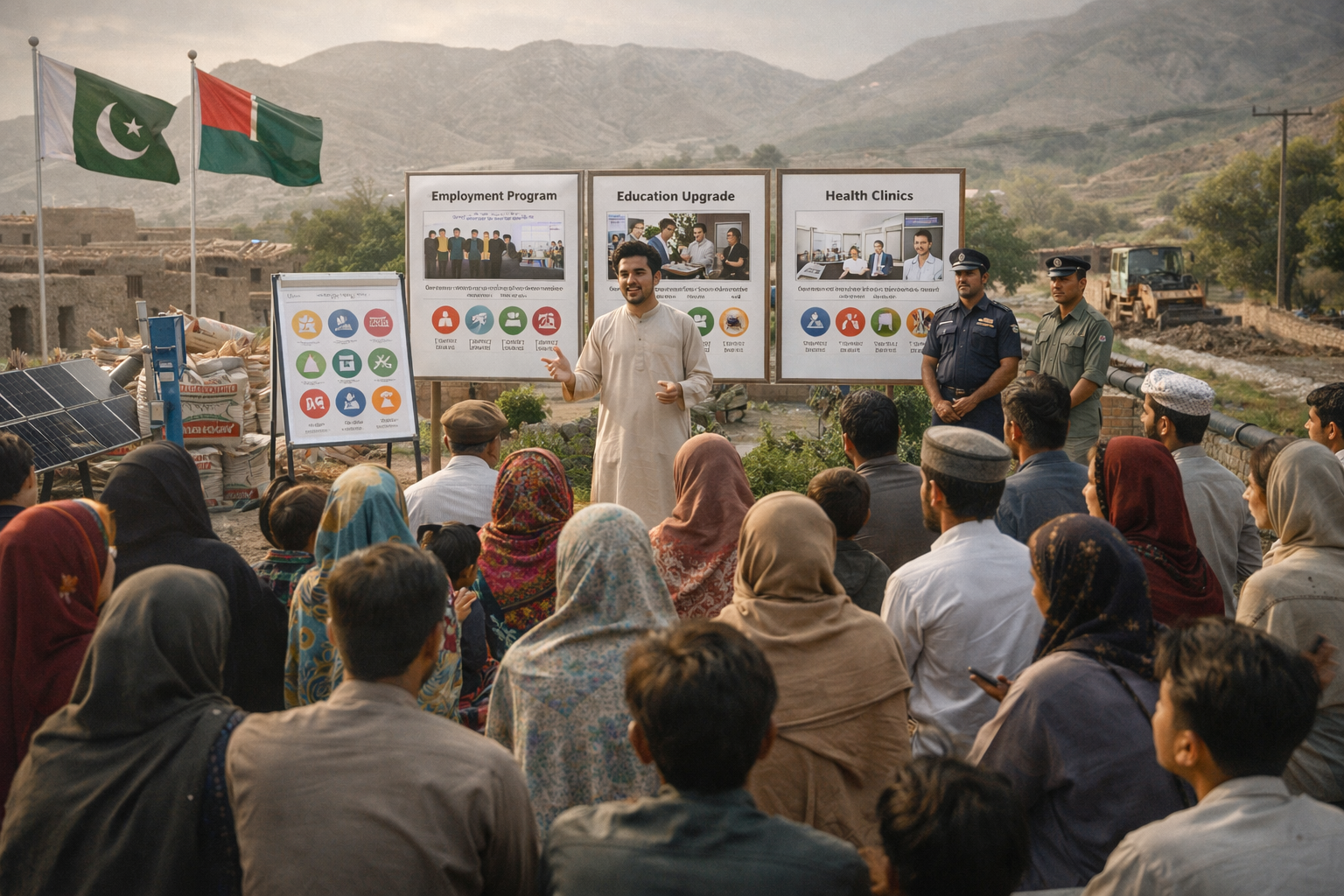
Let’s Build Balochistan Together
The Big Promise
Balochistan can move from “projects that come and go” to a disciplined, trusted delivery system that solves real problems in real places, starting now.
This CAP is designed to do three things at once:
Deliver fast, visible improvements within 14 days in daily life services.
Build a province-wide operating model that districts can actually run.
Create a credible pipeline for partners and funders to invest in outcomes, not slogans.
You will see a full governance model, operations design, budget logic, risk controls, and a weekly milestone plan to keep the work on track.
Community Snapshot and Asset Map
Balochistan is vast, diverse, and strategically positioned. It holds deep strengths: resilient communities, strong social networks, cultural pride, rich natural resources, coastline and trade routes, youth energy, and a growing ecosystem of universities, civil society, and local entrepreneurs.
At the same time, daily life is shaped by distance, arid climate, infrastructure gaps, insecurity in some areas, and a historic trust deficit between citizens and institutions. Many communities rely on informal solutions: shared water arrangements, local dispute resolution, small shops on thin margins, community teachers, volunteer health efforts, and remittances.
Asset map, in practical terms:
People assets: tribal and community leadership structures, women’s networks, youth groups, teachers, community health workers, religious leaders, business associations.
Place assets: solar and wind potential, mineral wealth, fisheries, border trade routes, agriculture pockets, ports and corridors, district hubs.
Institution assets: provincial departments, district administrations, BHUs and schools, universities, training institutes, NGOs, philanthropists, media.
Momentum assets: rising interest in renewable energy and micro-grids, nutrition and immunization programming, and global attention to climate resilience and water security. (World Bank)
Problem to Root Cause Translation
This CAP targets 10 major issues, challenges, needs, and wants. For each, we translate the visible problem into root causes you can actually design around.
Issue 1: Water scarcity and unsafe water
People experience: dry taps, expensive tanker water, disputes, sickness.
Root causes: groundwater depletion, weak regulation of extraction, limited recharge, poor storage, leakage, fragmented responsibility, and low-cost recovery. Studies of Quetta Valley report severe decline patterns, with some estimates of groundwater levels dropping multiple meters annually, signaling an emergency trajectory. (ScienceDirect)
Issue 2: Education exclusion and low learning
People experience: out-of-school children, teacher absenteeism, low literacy, limited girls’ access.
Root causes: distance, school facilities, safety, poverty, weak accountability, teacher support gaps. UNICEF highlights Balochistan as the most severe in proportional terms for exclusion, reporting millions of children out of school. (UNICEF)
Issue 3: Health access, maternal care, and child survival gaps
People experience: long travel to facilities, high out-of-pocket costs, preventable deaths.
Root causes: staffing shortages, weak referral and transport, facility readiness, trust barriers, and uneven service quality. PDHS-linked indicators show very low skilled birth attendance and institutional deliveries in Balochistan compared to other regions. (DHS Program)
Issue 4: Malnutrition and food insecurity
People experience: stunting, wasting, anemia, low productivity, school dropouts.
Root causes: poverty, diet diversity constraints, weak WASH, maternal nutrition gaps, and service reach. National Nutrition Survey key findings show Pakistan’s stunting around 40% and note higher than national average in provinces including Balochistan; provincial reporting also shows stunting in Balochistan at very high levels. (UNICEF)
Issue 5: Energy poverty and unreliable electricity
People experience: darkness, high bills, spoiled goods, limited study time, weak business growth.
Root causes: low grid reach, reliability problems, terrain and density challenges, weak last-mile investment. One policy analysis cites grid access in Balochistan far below full coverage, underlining the scale of the access gap. (SDPI)
Issue 6: Jobs, livelihoods, and youth opportunity
People experience: unemployment, informal work, migration, frustration, underemployment of educated youth.
Root causes: skills mismatch, weak local value chains, limited SME finance, procurement barriers, insecurity in some corridors, and low industrial diversification.
Issue 7: Roads, digital connectivity, and basic infrastructure
People experience: isolation, high transport cost, weak emergency response, poor market access.
Root causes: high capex needs, maintenance deficits, contractor performance issues, dispersed settlements, and weak monitoring.
Issue 8: Governance capacity and service delivery trust gap
People experience: slow services, unclear responsibility, corruption perceptions, weak grievance response.
Root causes: fragmented accountability, limited district delivery capacity, politicized postings, poor data, and low citizen voice in planning.
Issue 9: Security, justice access, and social cohesion
People experience: fear, disrupted schooling and markets, constrained mobility, trauma.
Root causes: local grievances, exclusion, weak conflict resolution pathways, limited youth opportunity, and inconsistent community-police trust.
Issue 10: Natural resource management, environment, and equitable benefit
People experience: “resources leave, locals stay poor,” environmental degradation, conflict around projects.
Root causes: weak benefit-sharing, limited local hiring and supplier development, inadequate environmental safeguards, and low transparency.
Interactive prompt: Which 3 of these 10 issues are most urgent in your district today, and which 1 is the best place to start for quick visible wins?
Stakeholder Map
This CAP assumes change must be co-owned, not “delivered to” communities.
Provincial and district public sector:
Planning and Development Department (P&DD), Finance, Local Government, Health, Education, Irrigation, Public Health Engineering, Energy, Livestock and Agriculture, Fisheries, Works and Communications, Social Welfare, PDMA.
Community leadership and voice:
Tribal and community elders, religious leaders, women-led community groups, youth groups, parent committees, water user groups, fisher associations, farmer clusters.
Frontline service workforce:
Teachers, head teachers, community health workers, vaccinators, midwives, BHU staff, sanitation workers, line supervisors.
Private sector and investors:
SMEs, transporters, cold chain providers, solar installers, telecoms, mining supply chain firms, fisheries value chain actors, chambers and associations.
Civil society and knowledge partners:
Local NGOs and CBOs, universities and research centers, media, legal aid groups, disability advocates.
Development partners and philanthropies:
UN agencies, World Bank and ADB ecosystem, bilateral donors, diaspora giving circles, corporate philanthropy.
Power and trust reality check: The plan includes formal government decision rights, but it also creates protected space for community oversight, because trust is rebuilt by performance plus transparency.
Vision, Goal, and SMART Objectives
Vision
A safer, healthier, more connected Balochistan where basic services work, opportunities expand for youth and women, and natural wealth translates into local wellbeing.
12-month Goal
Build a province-wide delivery system that produces measurable improvements across the 10 issues in at least 6 priority districts, while establishing scalable models and financing pathways for province-wide expansion.
SMART Objectives (12 months)
Water: Provide reliable safe water solutions for at least 150,000 people through repaired schemes, storage, filtration, and regulated tanker points, with monthly water quality checks in priority areas.
Out-of-school: Re-enroll and retain 25,000 out-of-school children, with at least 50% girls, using community enrollment drives plus transport and facility support aligned to local constraints. (UNICEF)
Learning: Improve foundational reading and numeracy by 15 percentage points in participating schools using teacher coaching, attendance accountability, and simple assessment.
Maternal and child health: Increase skilled birth attendance and institutional delivery utilization in target catchments by 10 percentage points, using referral transport, midwife support, and facility readiness. (DHS Program)
Nutrition: Reduce acute malnutrition caseload in targeted union councils by 10%, and improve minimum diet diversity and growth monitoring coverage through integrated nutrition plus WASH actions. (UNICEF)
Energy access: Deploy 10,000 household-level or community energy solutions (solar home systems, productive use kits, or micro-grids) with transparent tariff and maintenance models.
Jobs: Create 20,000 paid work opportunities (short-cycle public works, apprenticeships, and SME-linked jobs), with at least 30% women participation where culturally feasible and safe.
Strategy and Intervention Portfolio with Alternatives and Tradeoffs
This CAP uses a portfolio approach so progress is not hostage to one sector.
Portfolio A: Water Security and WASH
What we do: repair and protect water schemes, regulate tanker points, recharge and storage pilots, school and clinic WASH, water quality monitoring.
Tradeoff: infrastructure is slower but durable; tanker regulation is fast but politically sensitive.
Portfolio B: Education Recovery plus Skills
What we do: enrollment drives, girls’ access supports, teacher presence routines, catch-up learning, district learning labs, youth skill bootcamps tied to real jobs.
Tradeoff: enrollment without learning disappoints; learning without access leaves the hardest-to-reach behind.
Portfolio C: Primary Health, Maternal Care, Immunization
What we do: facility readiness, referral transport vouchers, staffing stabilization, outreach days, immunization trust campaigns, basic medicine availability tracking.
Tradeoff: outreach is fast but must link to functioning facilities or trust collapses.
Portfolio D: Nutrition plus Food and Livelihood Link
What we do: targeted CMAM support linkages, community nutrition sessions, kitchen gardens where viable, school meals pilots, WASH integration.
Tradeoff: food support alone can create dependency; combine with livelihoods and behavior change.
Portfolio E: Energy Access and Productive Use
What we do: solar micro-grids where grid is weak, productive-use bundles for SMEs, cold chain for fisheries and vaccines, local technician training.
Tradeoff: hardware without maintenance fails; prioritize service contracts and local technician pipelines. (World Bank)
Portfolio F: Local Economy and Resource Benefit
What we do: local procurement policies, supplier development for mining and public works, fisheries value chain upgrades, transparent community benefit frameworks.
Tradeoff: requires governance strength and transparency, but delivers legitimacy and jobs.
Portfolio G: Governance, Safety, and Social Cohesion
What we do: grievance redress, citizen scorecards, community-police engagement routines, legal aid referral, youth engagement through paid civic service.
Tradeoff: cannot be cosmetic; must protect neutrality and inclusion.
Theory of Change and practical logic model
If Balochistan builds a district-centered delivery system that combines quick wins with credible governance, then communities will re-engage, frontline workers will perform with support, and partners will invest with confidence.
Inputs become outcomes through a simple practical logic:
Inputs: financing, staff, community partners, data tools, procurement capacity.
Activities: water repairs, school recovery, health outreach, nutrition-WASH integration, energy deployments, job pathways, grievance handling.
Outputs: working schemes, re-enrolled kids, ready facilities, nutrition coverage, installed energy systems, apprenticeships placed, complaints resolved.
Outcomes: reduced water stress, higher attendance and learning, safer births, improved nutrition, higher incomes, increased trust.
Impact: stronger human development, stability through inclusion, and local prosperity linked to resources.
Assumptions we manage actively:
Communities will engage if they see fairness and results.
Frontline staff performance improves with coaching, tools, and accountability.
Security constraints require flexible delivery models, not rigid plans.
Community Engagement and Co Design Plan
This plan is action-first, but co-designed. Engagement is a delivery tool, not a ceremony.
6-step co-design routine (repeat in each district)
Listen fast, not forever
Run 5-day rapid listening: women, youth, elders, traders, teachers, health staff. Capture top barriers and where trust is broken.Map the service journey
Document the steps a mother takes for a safe delivery, or a child takes to reach school. Identify failure points and fixable choke points.Agree on 3 district priorities
Choose 3 priorities per district from the 10 issues. Publish them locally in simple language.Design the minimum viable package
Define exactly what will change in 30 days and who is responsible.Create community oversight
Form a Community Delivery Group with at least 40% women participation where feasible, plus youth seats, and a public complaint channel.Close the loop weekly
Publish “You said, we did, next” updates in mosques, markets, schools, radio, WhatsApp groups.
Inclusion safeguards: separate women’s sessions, disability access checks, language accessibility (Balochi, Brahui, Pashto, Urdu), and protection protocols for sensitive complaints.
Implementation and Operations Design
This CAP runs as a Delivery System, not a one-off project.
Operating model
Provincial Delivery Unit (PDU): small, high-skill team housed with P&DD for coordination, targets, dashboards, partner alignment, and bottleneck removal.
District Delivery Hubs (DDH): 6 initial districts, each with a coordinator, sector leads (water, education, health-nutrition, livelihoods-energy), MEAL officer, and community mobilizers.
Frontline Enablement: coaching, checklists, micro-procurement for small fixes, and rapid escalation routes for stuck issues.
Service Compacts: each district signs a 90-day compact: what will be delivered, where, by whom, and how it will be measured.
Fast Start Path (within 14 days)
This is the mandatory early win package, because momentum matters.
Fix 10 “always broken” points per district
Choose 10 quick repair items: a pump, a school toilet block, clinic power backup, medicine stock-out, a handwashing station.Launch a single grievance number and response promise
One phone and WhatsApp channel per district with a 72-hour acknowledgment rule.Run a 3-day enrollment and immunization push
Combine school re-enrollment with vaccination outreach and nutrition screening.Deploy a micro-contracting model
Local contractors paid on verified completion for small works in days, not months.
Governance and Coordination
Governance must match Balochistan’s realities: strong local legitimacy, clear decision rights, and transparency.
Three-layer governance
Provincial Steering Council (monthly)
Chaired by a designated provincial authority (typically P&DD leadership), with Finance, Local Government, Health, Education, Irrigation/PHE, Energy, PDMA, and district representation.
Approves targets, resolves cross-department blocks, endorses partner MOUs, and protects the CAP from fragmentation.
District Delivery Board (biweekly)
Deputy Commissioner or designated chair, with line departments, local government reps, community leaders, women and youth seats, and key NGOs.
Reviews dashboard, clears operational blocks, approves micro-project lists, and reviews grievance trends.
Community Delivery Groups (weekly)
Union council level groups verifying what is working, what is failing, and whether services are respectful and fair.
Decision rights and integrity rules
No spending without public posting of what is funded, where, and expected results.
Community verification required before completion is signed off for small works.
Conflict-of-interest declarations for procurement and hiring.
A protected mechanism for complaints about staff behavior and corruption.
Budget and Resourcing Logic as narrative
This CAP uses layered financing: quick wins, district operations, and scalable infrastructure.
Cost structure you should expect
Delivery backbone (people + systems): staffing the PDU and 6 DDHs, training, dashboards, travel, security planning, and communications.
Quick win micro-works fund: small repairs, WASH fixes, clinic readiness items, school facility repairs, minor water scheme rehabilitation.
Service quality inputs: essential medicines buffer, teacher coaching support, referral transport vouchers, nutrition screening supplies, water testing kits.
Energy and productive use deployments: solar home systems, micro-grid pilots, refrigeration for vaccines and fisheries, technician training, maintenance contracts.
Livelihood and skills: apprenticeship stipends, short-cycle public works, SME grants tied to outcomes, toolkits for trades, and job matching.
MEAL and safeguarding: surveys, audits, community scorecards, data protection, and third-party verification.
A realistic budgeting approach (without pretending one number fits all)
For a 90-day launch in 6 districts, budget typically clusters around: delivery backbone + quick wins + essential service inputs. The focus is speed and credibility.
For 12 months, costs shift toward deeper water works, energy scale, education recovery packages, and job creation instruments. Maintenance and operations must be funded from day one, not treated as an afterthought.
Rule: Every asset funded must have a named operator, a maintenance plan, and a funded spare-parts pathway. If those three are missing, do not buy it.
Funding and Partnership Strategy with clear asks
This CAP invites partners into clear lanes with measurable outputs.
The partnership offer (what we ask for)
Government departments: adopt the delivery compact model, release timely funds, share data, and empower district hubs to solve problems fast.
Donors and multilaterals: fund the delivery backbone plus performance-linked district packages, not just standalone sector projects.
Private sector and mining value chains: local supplier development commitments, apprenticeships, and community benefit transparency mechanisms.
NGOs and UN agencies: align outreach calendars, share frontline networks, and co-run integrated service days (education + health + nutrition + WASH).
Universities and research partners: district labs for monitoring, evaluation, and solution design, plus youth fellowships.
Partnership packaging you can hand to a funder
A one-page district compact
A costed package per portfolio
A quarterly results dashboard
A risk register and mitigation plan
A third-party verification mechanism
Measurement, Impact, and Learning System using MEAL thinking
MEAL means Measurement, Evaluation, Accountability, and Learning.
What we measure weekly
Water points functioning, water quality spot checks, tanker point compliance.
School attendance, teacher presence, re-enrollment numbers.
Facility readiness, outreach sessions, referral transport usage.
Nutrition screening coverage, SAM referrals completed.
Energy systems installed and functioning, maintenance response time.
Jobs created, apprentices placed, women participation where feasible.
Grievances received, acknowledged in 72 hours, resolved in 14 days.
How we learn and improve
Monthly “what failed and why” reviews at district boards.
Quarterly third-party verification on a sample of outputs.
Community scorecards to validate service experience, not just numbers.
Accountability built-in
A grievance system that responds, a public dashboard that tells the truth, and consequences for non-performance.
Risks and Mitigation
This CAP assumes risk and designs around it.
Top risks and what we do
Security disruptions: adopt flexible delivery routes, remote support tools, clustered service days, and district-level security protocols.
Political capture: transparent project selection rules, public postings, community verification, and multi-stakeholder boards.
Corruption and leakage: micro-contracting with verification, audits, conflict-of-interest controls, and complaint pathways.
Capacity gaps: coaching model, simplified checklists, and rapid troubleshooting support from PDU.
Community mistrust: fast wins, respectful engagement, publish “you said, we did,” and protect fairness across tribes and locations.
Maintenance failure: service contracts, local technician training, spare parts funds, and uptime KPIs.
Data quality issues: simple indicators first, verification sampling, and consistent definitions.
Gender exclusion: women-only sessions, female mobilizers, safe referral pathways, and culturally competent scheduling.
Climate shocks: integrate PDMA coordination, water storage, and climate-resilient infrastructure choices.
Partner fragmentation: one shared district compact, aligned calendars, and a single results dashboard.
90 Day Execution Plan with weekly milestones, plus next 12 months narrative
Below is a disciplined 13-week plan. It is designed so every week produces proof of progress.
Week 1: Stand up the delivery system
Appoint PDU lead, district hub leads, and MEAL leads.
Select 6 initial districts using readiness plus need.
Issue the CAP “delivery compact” template.
Week 2: Rapid listening and service journey maps
Run the 5-day listening sprint in each district.
Map two service journeys: water access and maternal care.
Week 3: Pick district priorities and publish them
Each district chooses 3 priorities from the 10 issues.
Publish commitments in local languages in public places.
Week 4: Fast Start repairs begin (14-day promise window)
Fix first 10 “always broken” points per district.
Launch grievance number and 72-hour acknowledgment rule.
Week 5: Integrated outreach week
Enrollment drive + immunization + nutrition screening in priority union councils.
Start teacher attendance and facility readiness routines.
Week 6: Micro-contracting scale up
Expand small works list with community verification rules.
Start water quality testing and public posting of results.
Week 7: Referral and access upgrades
Launch referral transport vouchers for maternal emergencies in target catchments.
Start clinic power continuity solutions where feasible.
Week 8: Learning recovery launch
Teacher coaching cycles start.
First simple reading and numeracy checks conducted.
Week 9: Livelihood and skills pipeline starts
Identify 1,000 apprenticeships across districts with local employers.
Start short-cycle public works linked to community priorities.
Week 10: Energy pilots go live
Deploy first micro-grids or productive-use solar bundles.
Train local technicians and set maintenance response standards.
Week 11: Resource benefit and local procurement actions
District procurement commitments for local SMEs.
Supplier development sessions for youth and small businesses.
Week 12: MEAL verification and trust review
Third-party sample verification begins.
Community scorecards collected and reviewed publicly.
Week 13: Reset and scale decision
Publish a 90-day results report: what worked, what failed, what changes next.
Decide scale path for the next 12 months based on evidence.
Next 12 months: the build phase
Months 4-6 focus on deeper water works, school facility upgrades, health staffing stabilization, and scaling energy access with maintenance systems. Months 7-9 expand jobs and local value chains, including fisheries cold chain and mining supplier development. Months 10-12 institutionalize the model: budget lines in government, district compacts as standard practice, and a partner financing platform tied to verified outcomes.
Reader Interactivity prompts
Pick one path now. Do not overthink it.
Pause and pick your path
Option 1: District First
Start in 2-3 districts with the strongest leadership and quickest wins, then expand.
Option 2: Water First
Treat water as the lead domino: stabilize water, reduce conflict, improve health, increase school attendance.
Option 3: Youth Jobs First
Launch paid civic service + apprenticeships to reduce frustration and build social cohesion.
Option 4: Mother and Child First
Make maternal care, immunization, and nutrition the moral center and organizing platform.
Now answer these three questions for yourself or your team:
Which option fits the political and operational reality in your area?
What is the first visible win people will feel in 14 days?
Who is the one accountable person per district who will not disappear?
Call to action to connect with Arbab
If you want this CAP turned into an implementable, partner-ready package with district compacts, draft MOUs, dashboard indicators, micro-contract templates, and a 6-district launch design, connect with Arbab Naseebullah Kasi and Feel Worldwide Foundation. The fastest way to start is to choose your 2-3 initial districts and commit to the 14-day Fast Start Path.
[Partnership & Collaboration Invitation (FWF)
If you are a government stakeholder, investor, operator, contractor, community leader, university, NGO, or donor, and you want a practical, measurable, integrity-first model for mining-led entrepreneurship and economic development in Balochistan, I welcome direct outreach. I am ready to share the playbooks, implementation templates, training architecture, MEAL tools, and partnership design options behind this concept, and to help convene serious stakeholders who want real outcomes.
Feel Worldwide Foundation Inc. welcomes collaboration with stakeholders who wish to explore, pilot, or scale the opportunities outlined above. Website: https://www.feelworldwidefoundation.org/
Contact: info@feelworldwidefoundation.org
Founder & CEO: Arbab Naseebullah Kasi - akasi@feelworldwidefoundation.org
An interactive, action-first concept article proposed by Arbab Naseebullah Kasi for discussion, learning, and partnership building.
This article is provided strictly for informational and discussion purposes only. It presents a conceptual idea and a potential proposed plan. It is not legal advice, financial advice, investment advice, tax advice, regulatory advice, or professional consulting advice, and it should not be relied upon as a basis for decisions, transactions, or actions.
All concepts, recommendations, and statements herein are proposed solely by Arbab Naseebullah Kasi in his personal capacity, informed by his professional knowledge, practical field experience across Balochistan and Pakistan, and more than two decades of involvement in U.S.-based projects and programs across multiple sectors and industries, as well as professional networks and stakeholder connections in both regions. These proposals remain conceptual and are not representations of any official position by any institution.
Nothing herein creates or implies any partnership, endorsement, affiliation, sponsorship, contract, commitment, obligation, or agency relationship with Feel Worldwide Foundation Inc. (FWF) or the University of Massachusetts Amherst (UMass Amherst), unless and until expressly confirmed through a separate written agreement signed by authorized representatives of the relevant parties.
To the fullest extent permitted by applicable law, Arbab Naseebullah Kasi, Feel Worldwide Foundation Inc. (FWF), and the University of Massachusetts Amherst (UMass Amherst) disclaim any and all responsibility and liability for any claims, demands, complaints, objections, losses, damages, costs, or expenses of any kind, whether direct or indirect, that may arise from or relate to this article or to any reliance on, use of, or action taken based on it. No claims or objections may be asserted against Arbab Naseebullah Kasi, FWF, or UMass Amherst based on this article or its contents.]
Share this article
For Instagram, Snapchat or another app, copy the link and paste it there.
