From Struggle to Opportunity:
From Struggle to Opportunity: Why Balochistan and Khyber Pakhtunkhwa Must Build Their Future Through Skills, Industry, and Entrepreneurial Ecosystems
By: Arbab Naseebullah Kasi
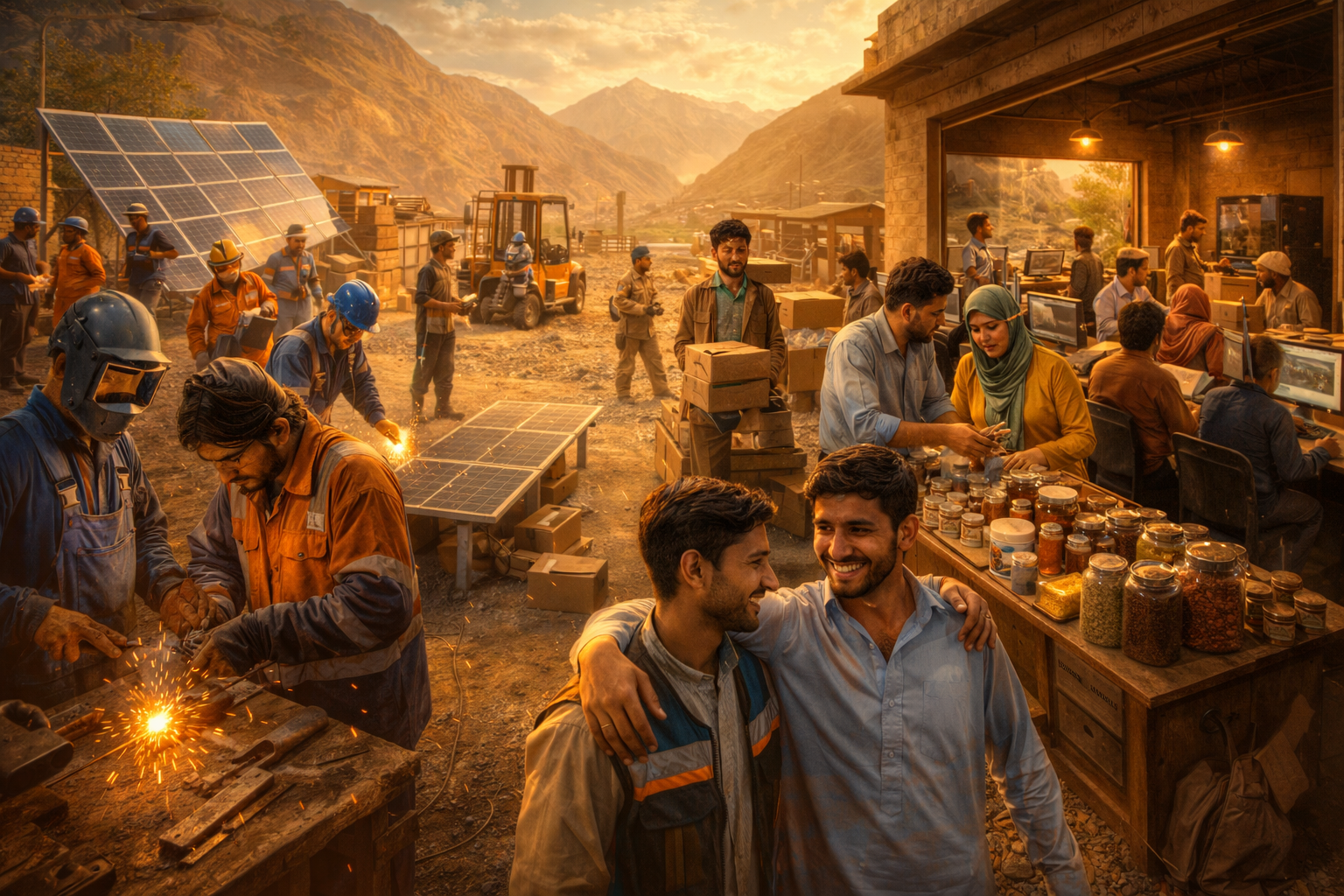
The future of Balochistan and KP will be built where skills, dignity, jobs, and enterprise finally connect.
The most important business opportunity in Balochistan and Khyber Pakhtunkhwa is not a single startup, a single grant, or a single training center. It is the chance to build a new economic ladder for people who have talent, energy, and ambition but too few reliable pathways into dignified work. For entrepreneurs in these provinces, this is the real frontier: not merely launching businesses, but designing systems that turn exclusion into capability, capability into employment, and employment into enterprise.
That matters because the structural gap is enormous. Pakistan faces a deep education and skills crisis, with an estimated 25.1 million children aged 5–16 out of school. In Khyber Pakhtunkhwa, UNICEF estimates 4.5 million children in that age group are out of school, while Balochistan faces the most severe exclusion proportionally, with 3.5 million out of school children, nearly 69 percent of its school-age population. At the same time, Pakistan’s skills system has long struggled with weak foundational learning, limited quality TVET reach, and a supply-driven model that does not consistently connect training to real jobs.
That is why your idea is important. It refuses to treat training as a ceremonial activity. Instead, it imagines a workforce-to-enterprise accelerator that links labor mapping, employer-designed courses, English and digital integration, internships, placements, and replication through public systems. In other words, it treats employability as infrastructure. That is exactly the right move for Balochistan and KP, and it is the reason this concept has more power than a typical development note.
The Real Problem Is Not a Lack of Potential. It Is a Broken Ladder.
Too many development conversations in fragile or underserved regions make the same mistake: they assume the main challenge is motivation. It is not. The challenge is architecture. Young people may be willing to work, learn, and build, but willingness alone does not create a livelihood. Without foundational skills, market information, employer trust, placement support, and pathways for advancement, talent remains trapped at the edge of the economy. The World Bank’s Pakistan skills assessment makes this plain: the country needs stronger foundational, cognitive, socio-behavioral, and technical skills, better job placement and career guidance, and much tighter links between skills policy and industry demand.
That lesson is even more urgent in places where instability, remoteness, and weak public infrastructure have interrupted ordinary economic life. The World Bank has explicitly argued that productive jobs strengthen skills, competitiveness, and social cohesion, especially in conflict-stricken contexts. In post-crisis KP, it also noted that unemployment and chronic socioeconomic distress intensified instability and that stimulating employment and livelihoods was seen as critical for regional stability. This is not just an economic issue. It is a societal one.
So the article’s core argument should be simple and strong: Balochistan and KP do not just need more entrepreneurship rhetoric. They need real ladders into the formal and productive economy.
Why Balochistan Matters So Much Right Now
Balochistan is too often discussed only through the language of distance, deprivation, and missed promise. That frame is incomplete. Yes, the province faces severe exclusion, thin infrastructure, and high delivery costs in far-flung areas. The World Bank’s Balochistan Livelihoods and Entrepreneurship Project was built specifically around these realities, and its development objective is telling: create employment opportunities for rural communities and improve the sustainability of enterprises. That combination matters. It recognizes that jobs and enterprise survival must be built together, not separately.
For entrepreneurs, the real question is not whether Balochistan has opportunity. It is whether people are willing to build business models that match the province’s actual structure. Balochistan’s opening is not limited to headline investment stories. Its deeper opportunity lies in mining-adjacent services, remote operations support, equipment maintenance, logistics, industrial safety, power systems, water systems, warehousing, light manufacturing, and local supplier development. That is where social entrepreneurs and corporate entrepreneurs can meet: one side building inclusion and readiness, the other building supply chains, contracts, and scalable demand. This is also why your concept note is strategically strong in emphasizing mining and minerals as an anchor without reducing the whole vision to extraction alone.
Balochistan does not need another generation told to “think big” while the economy offers them only informal survival. It needs pathways into real work close to real sectors. When a province has high exclusion, a scattered geography, and rising strategic interest in industrial development, entrepreneurship must become practical before it becomes glamorous.
Why Khyber Pakhtunkhwa Needs a Different, Equally Serious Response
Khyber Pakhtunkhwa should not be treated as a duplicate of Balochistan. Its opportunity set is different, and so is the design challenge. The strongest need in KP is not only technical skills. It is bridge-building. The province needs more systems that can move young people from educational or social isolation into the grammar of the modern labor market: workplace English, digital literacy, office discipline, employer exposure, internship pathways, and apprenticeship readiness. Pakistan’s skills diagnosis stresses that combinations of skills matter more, not less, in a changing economy, and that weak matching mechanisms and poor placement systems remain a serious problem.
That is why your emphasis on English integration is far more important than it may first appear. English, in this context, is not decoration. It is labor-market access. It is the difference between a technically capable young person and one who can read a safety manual, write an email, document an inventory record, understand basic compliance instructions, and interact with formal-sector systems. When English is taught as a work tool rather than as an abstract academic subject, it becomes one of the most powerful employability multipliers available.
And because KP has also been a major site of reconstruction, livelihood recovery, and skills-focused programming, the lesson is already visible: employment pathways must be embedded in broader economic recovery, not left as standalone classroom exercises. The same logic that drove post-crisis revitalization efforts in the region still applies now. Training that does not connect to the market will not change the trajectory of the province.
The Most Powerful Idea in This Entire Concept: Training Must Feed Enterprise
This is where your idea becomes more than a project. It becomes a doctrine.
The strongest model for both provinces is not “train people, then hope.” It is “map demand, build skills to demand, place into demand, then grow local enterprises around demand.” That sequence changes everything. It means a training program is no longer judged only by attendance or certificates. It is judged by internships secured, jobs started, vendors created, contracts won, retention achieved, and local economic circulation expanded. That is the right standard.
For social entrepreneurs, this means designing bridges where the market fails: foundational upskilling, women’s access pathways, employer mediation, local trust-building, mobile delivery, and post-training support. For corporate entrepreneurs, it means doing the harder but more meaningful work of building local vendor ecosystems, apprenticeship pipelines, compliant subcontractor networks, and entry-level role ladders that bring new workers into formal systems. One side expands inclusion. The other expands productive demand. The breakthrough comes when both happen together.
The Business Pathways That Deserve Priority
The first big pathway is mining-support and industrial-support services, especially in Balochistan. Not every young person will become an engineer, and that should not be the benchmark. Entry-level roles such as site assistants, logistics clerks, sample handlers, safety marshals, warehouse assistants, maintenance helpers, and documentation staff can become the first rung into a larger value chain. These roles are more accessible, more scalable, and more immediately linked to local economic participation than elite technical jobs. Your concept is right to see this as a gateway to local supplier ecosystems rather than as a narrow employment scheme.
The second pathway is welding, fabrication, industrial repair, and mechanical support. These are the kinds of skills that travel well across provinces, across sectors, and across economic cycles. A trained welder or fabrication technician does not only serve a mine. He or she can serve transport fleets, workshops, construction contractors, storage facilities, processing sites, and local manufacturing needs. That is exactly the kind of practical entrepreneurship both provinces need: trades that create wage jobs immediately and business ownership over time. Pakistan’s own TVET architecture, including NAVTTC and federal youth skill programs, is already oriented toward market-driven conventional and high-tech skills, apprenticeship, and industry linkage; the challenge is to make those systems work with provincial specificity and consistent employer buy-in.
The third pathway is solar, power, pump, and water-system services. In underserved or remote environments, energy reliability and water functionality are not side issues. They are economic enablers. A young person trained to install or maintain solar systems, pumps, basic electrical controls, and water-support infrastructure can serve industrial sites, schools, clinics, farms, small businesses, and households. This is one of the few pathways that produces business value and community value at the same time. It is therefore especially attractive for social entrepreneurs who want both livelihood impact and visible local benefit. Pakistan’s renewable energy skills mapping work underscores the need to connect sector growth with workforce readiness, which strengthens the case for province-specific technical pathways of this kind.
The fourth pathway is English-plus-digital workplace services, especially in KP but increasingly in Balochistan as well. This means training young people not merely to “use computers,” but to function in the everyday operating systems of modern work: email, spreadsheets, inventory logs, documentation, translation support, digital reporting, client communication, and basic back-office services. In a labor market where nonroutine cognitive and interactive skills are rising in value, these are not secondary skills. They are part of employability itself. For many young people, especially those outside mainstream academic channels, this can become the bridge from exclusion into formal work.
The fifth pathway is apprenticeship brokerage and job-matching infrastructure. This may sound less exciting than opening a workshop, but in fragile economies it can be more transformative. One of Pakistan’s recurring problems is not only low skills but weak matching. The World Bank’s skills assessment explicitly points to poor placement support and weak career guidance as causes of skills gaps, and NAVTTC’s own current architecture emphasizes apprenticeship and industry linkage. A serious local placement engine that tracks skills profiles, employer needs, interviews, retention, and alumni progression can be one of the most valuable enterprises in the whole ecosystem.
The sixth pathway is health, safety, environment, and compliance support. Industrial economies do not grow sustainably without safety culture, documentation, PPE management, incident reporting, and entry-level compliance roles. These are exactly the kinds of jobs that help local communities see industry not as a distant machine, but as a professional ecosystem with standards, accountability, and room for local talent. They also give young people a route into formal labor systems that reward reliability, discipline, and process awareness. That matters deeply in both provinces.
The seventh pathway is local supplier incubation. This is where entrepreneurship becomes truly regional. Instead of imagining only venture-backed startups or urban tech plays, local supplier incubation asks a more grounded question: what do institutions, employers, industrial sites, and growth sectors buy repeatedly, and why should those goods and services not be produced locally? Uniforms, signage, storage systems, basic consumables, cleaning materials, office supplies, fabricated items, transport support, and maintenance services may sound unromantic. They are also the backbone of real local business participation. When local people supply what local growth requires, resentment declines and ownership rises.
The eighth pathway is mobile and distributed training delivery. This is not optional. In provinces where geography, insecurity, transport costs, and weak institutional infrastructure all limit access, the old fixed-campus model cannot be the entire answer. The World Bank’s Balochistan project directly recognizes the constraints created by low population density and high delivery costs in far-flung areas. So the right response is not to wait for perfect infrastructure. It is to move capability outward through hub-and-spoke models, traveling trainers, temporary labs, blended delivery, and local trainer pipelines. That is how inclusion becomes operational rather than rhetorical.
What Most People Still Get Wrong
The first mistake is treating entrepreneurship as if it means only startup creation. In places like Balochistan and KP, entrepreneurship often begins earlier: in workforce intermediation, supplier development, industrial service provision, and capability-building. A placement platform, a welding cluster, a safety documentation service, or a mobile training enterprise may create more durable value than a fashionable app with no local market.
The second mistake is teaching technical skills without foundation skills. Pakistan’s skills diagnosis is clear that foundational literacy, numeracy, cognitive ability, and socio-behavioral skills are not optional extras. They are the base on which TVET and higher-order labor-market performance depend. If programs ignore those basics, they will keep producing certificates that do not convert into livelihoods.
The third mistake is designing one generic model for both provinces. Balochistan needs stronger alignment with mining-adjacent opportunity, remote operations, local supplier development, and infrastructure-linked trades. KP needs stronger bridge pathways into formal employability, apprenticeships, digital service roles, and market-facing language and workplace readiness. A smart strategy respects both overlap and difference.
The fourth mistake is excluding women, whether directly or through lazy design. Pakistan’s human capital and skills constraints are made worse by weak economic integration of women, and any entrepreneurship strategy that ignores women’s mobility, safety, access, scheduling, and participation is leaving growth on the table before the work even begins. In both provinces, the future will be smaller than it should be unless women are built into the economic architecture from day one.
What Entrepreneurs Should Build Now
The entrepreneurs who matter most in the next decade will be those who stop asking, “What business can I start?” and start asking, “What economic system can I strengthen?” In Balochistan, that may mean becoming the trusted local supplier, training partner, maintenance provider, logistics service, or compliance support firm that larger sectors need. In KP, it may mean becoming the bridge-builder who translates hidden talent into workplace readiness, apprenticeships, and digital or operational service capacity. In both places, the opportunity belongs to those who can connect people to markets with discipline and credibility.
The strongest immediate plan is not complicated. First, map demand before designing curriculum. Second, secure employer commitments before recruiting cohorts. Third, integrate English, digital skills, and workplace behavior into every technical stream instead of isolating them. Fourth, build placement and retention systems, not just graduation ceremonies. Fifth, identify the skill streams most likely to convert into supplier businesses and support those enterprises beyond the classroom. Sixth, design for replication from the beginning by aligning with public TVET systems, accreditation logic, and provincial institutions. That is how a project becomes an ecosystem.
The Deeper Truth
The future of Balochistan and Khyber Pakhtunkhwa will not be secured by speeches about youth potential. It will be secured when talent can move through a visible ladder: from learning to earning, from earning to enterprise, from enterprise to local economic dignity.
That is why this idea matters so much. It understands that jobs are not the end of the story and startups are not the beginning of it. The real work is building the bridge between the two. Where that bridge exists, frustration begins to lose power. Where it does not, even the most gifted people are forced to live smaller than they should.
For Balochistan and KP, the most powerful entrepreneurship strategy is not to copy someone else’s model. It is to build a regional economy from the strengths these provinces already hold: resilience, ambition, strategic location, untapped talent, and sectors that need local participation. The goal is not charity. The goal is capability. The goal is not dependence. The goal is circulation. And the goal is not merely to train people for today’s jobs, but to prepare them to build tomorrow’s enterprises.
That is the article’s real conclusion, and it is also its challenge: stop treating western Pakistan as a problem to be managed. Start treating it as an economy to be built.
For organizations, institutions, companies, philanthropies, and development partners looking to create meaningful and measurable impact in Pakistan and beyond, Feel Worldwide Foundation Inc., a U.S.-registered 501(c)(3) nonprofit, is a uniquely strong partner because we combine mission, credibility, and access. Through our deep relationships across the United States and Pakistan, including connections with universities, nonprofit organizations, community leaders, entrepreneurs, alumni networks, industry stakeholders, and public-sector institutions, we are able to convene the right people, design practical programs, and turn ideas into real outcomes in entrepreneurship, education, leadership, livelihoods, humanitarian support, and community development. What makes us especially valuable as a partner is not only our cross-sector reach, but our ability to work with cultural intelligence, strategic clarity, and a genuine commitment to long-term impact, making Feel Worldwide Foundation Inc. an ideal platform for those who want trusted, capable, and well-connected partners to build ethical, effective, and scalable collaborations in both the USA and Pakistan.
Share this article
For Instagram, Snapchat or another app, copy the link and paste it there.