

A Texas Power-Washing Business Needs a City Plan Before It Needs a Bigger Machine
Compare Houston and Fort Worth through runoff rules, route economics, customer access, and a low-cost demand test before buying equipment.
By Arbab Naseebullah Kasi, Chief Executive Officer - CEO, Feel Worldwide Foundation Inc.
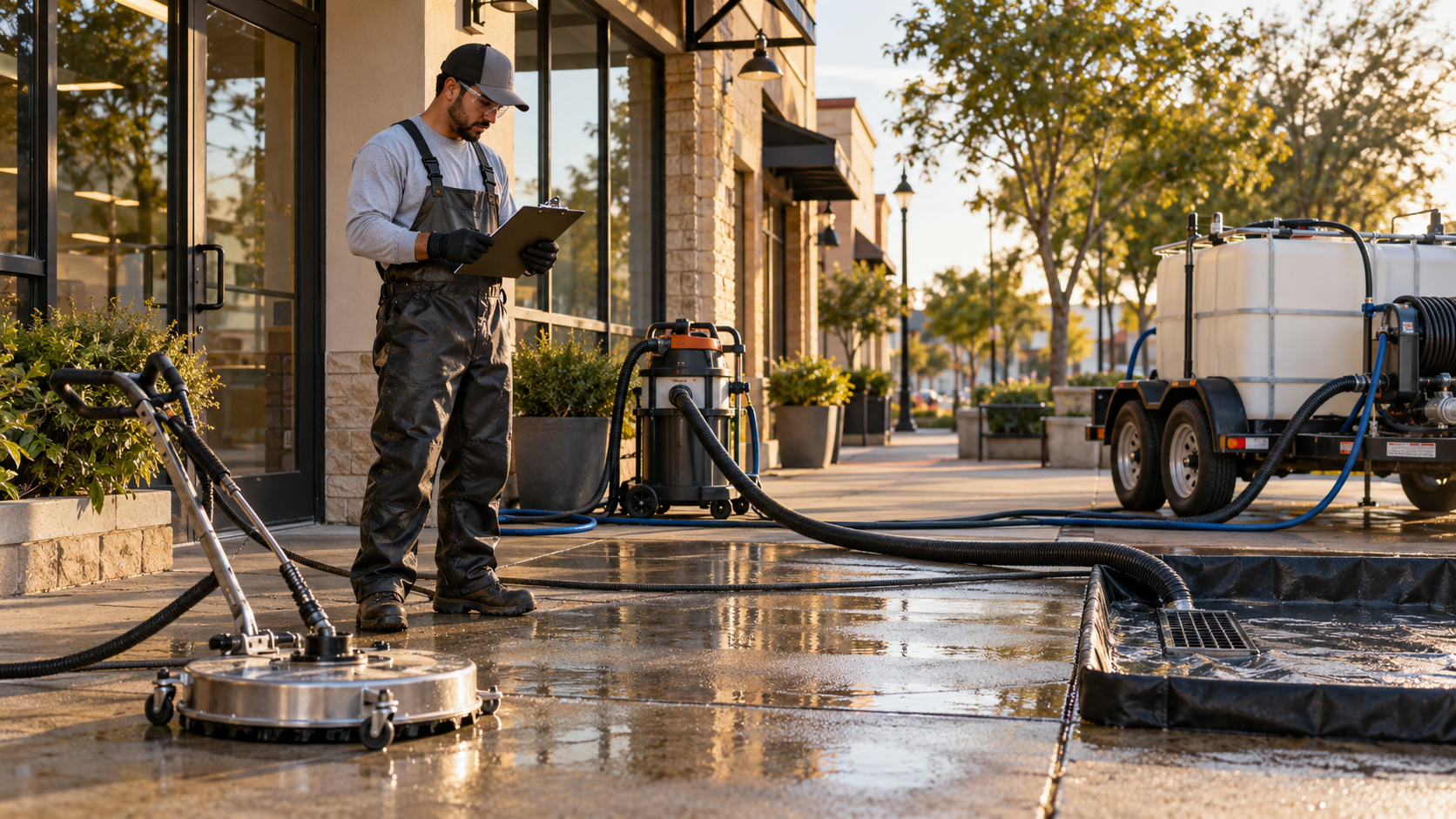
Illustration of a mobile exterior-cleaning entrepreneur preparing a storefront job with runoff-control equipment.
This guide is for a Texas resident considering a small, owner-operated mobile exterior-cleaning service in Houston or Fort Worth. It is not a promise that demand exists, and it is not personal legal, tax, immigration, insurance, or investment advice. It is a way to make the decision in the right order.
The tempting first step is to compare pressure washers. The more important first step is to compare operating conditions. A machine that looks affordable can become the least important cost if a job requires wastewater capture, a disposal route, city registration, commercial vehicle coverage, travel across a wide service area, or work at hours when customers are closed. The useful question is not, “Which machine can I buy?” It is, “Which customer problem can I solve safely, lawfully, and repeatedly inside one compact route?”
The same service can become a different business in another city
Fort Worth has a named permit program for mobile commercial cosmetic cleaners. The city says any person or business doing this work must hold a business permit. The current published fee is $25 for the permit and $25 for each registered wash unit, and the permit lasts one year. The city also requires driver’s-license copies for vehicle operators, proof of insurance for vehicles or trailers, visible registration numbers, and registration certificates. Its definition includes commercial power washing, steam cleaning, and other mobile cleaning of vehicles or exterior surfaces. See the City of Fort Worth’s current permit page.
The operational point is bigger than the fee. Fort Worth says wash water that does not qualify for an exemption must be collected before it leaves the property. It describes containment, pumping or vacuum recovery, approved disposal locations, and controls that keep oil, debris, detergent, and other pollutants out of storm drains. A founder therefore needs a water plan for every quote, not just a washing plan.
Houston publishes its own municipal stormwater, wastewater, and permitting resources. Its Municipal Separate Storm Sewer System program is designed to reduce pollutant discharges, while the city’s Stormwater Section issues stormwater-quality permits for covered activities and answers stormwater inquiries. The correct requirement depends on the activity, site, discharge, and disposal method, so a founder should describe the planned operation to Houston Public Works before quoting work. Start with the Houston MS4 program, the Stormwater Section, and the Houston Permitting Center.
This comparison does not mean one city is “easy” and the other is “hard.” It means a business model must fit the place where the work will actually happen. A Fort Worth permit does not settle a Houston job, and a Houston answer does not settle a job in an unincorporated area or another municipality.
Begin with a narrow customer problem
“Power washing for everyone” is not yet an offer. A testable offer names the buyer, surface, timing, and result. Plausible starting hypotheses include storefront walkway cleaning before opening time, small fleet exterior washing at a customer-approved site, trash-pad or loading-area cleaning with a documented recovery plan, and recurring exterior cleaning for a compact group of small commercial properties.
Each idea changes the job. A storefront manager may care about slip risk and opening time. A fleet manager may care about vehicle downtime. A property manager may require a certificate of insurance, vendor onboarding, or written disposal procedures. Grease, paint, chemicals, or heavy oil can make the wastewater question more difficult. These are hypotheses to investigate, not guaranteed opportunities.
The U.S. Small Business Administration explains that market research helps a founder find customers and competitive analysis helps the business become distinct. Its guidance suggests studying demand, market size, location, saturation, and the prices customers already pay. That makes a short buyer conversation more valuable than a long equipment wish list. Review the SBA’s market-research guidance.
Run a two-zone demand test before buying a rig
Choose one compact zone in Houston and one in Fort Worth, or two compact zones within the city where you actually plan to operate. Do not treat an entire metropolitan area as a route. Identify eight potential buyers in each zone, such as independently managed storefronts, small property managers, worship facilities, or fleet operators whose sites appear compatible with the proposed service.
Ask the same five questions:
Which exterior surface creates a recurring problem, and how is it handled now?
Who approves a vendor and what proof, insurance, or site rules are required?
Where may wash water go, and who confirms that disposal route?
What work window avoids customers, vehicles, pedestrians, and deliveries?
Would the buyer consider a small paid pilot with a written scope and cleanup standard?
Record the answer, current alternative, decision-maker, work window, site constraint, and next step. A “yes” from someone who cannot approve the work is not validated demand. A paid pilot should happen only after the property owner, city, insurance, tax, safety, and wastewater questions are resolved.
Build the startup budget around containment and cash flow
A realistic startup worksheet should separate one-time, per-job, and monthly costs. One-time or occasional items may include a pressure washer, surface cleaner, hoses, personal protective equipment, cones, drain covers or berms, a wet vacuum or recovery system, a recovery tank, vehicle or trailer setup, and training. Per-job costs may include labor time, fuel, water, detergent when allowed, absorbent materials, disposal, parking, and travel. Monthly or annual costs may include insurance, phone service, bookkeeping, marketing, equipment maintenance, permits, and registrations.
If the founder chooses a Texas limited liability company, the Secretary of State’s current Form 205 lists a $300 filing fee. An LLC is not the only possible structure, and the filing does not replace city permits, tax registration, contracts, insurance, or safety duties. Review Texas Secretary of State Form 205 and choose the structure with qualified advice when needed.
Texas also treats many cleaning activities as taxable services. The Comptroller says businesses selling taxable services in Texas must obtain a sales and use tax permit. The permit itself has no fee, although a security bond may sometimes be required, and permit holders must collect applicable tax, file returns, keep records, and continue filing even for a period with no taxable sales. Confirm the classification of the exact service with the Texas Comptroller’s permit guidance and taxable-services guidance.
Price the job you can actually deliver
A price should cover more than minutes spent spraying. It should reflect site inspection, setup, pedestrian control, surface testing, water capture, disposal, travel, tax administration, payment delay, equipment wear, and the possibility of a return visit. A low headline price can produce negative cash flow when the founder ignores two hours of travel and setup for one short wash.
Fictional teaching example: A founder estimates a storefront pilot will require 45 minutes of travel and loading, 30 minutes of setup and containment, 75 minutes of cleaning, 30 minutes of recovery and cleanup, plus fuel, consumables, disposal, and payment-processing costs. If the proposed price covers only the 75 minutes of visible cleaning, the job may lose money even when the customer pays in full. The founder should calculate a floor price from the complete job, then compare it with buyer feedback and competing alternatives. If buyers will not pay enough to cover compliant delivery, that is useful evidence to change the customer, route, scope, or business idea.
Safety and access belong in the operating plan
Pressure washers can cause severe injuries that initially look minor. The Centers for Disease Control and Prevention warns that high-pressure spray can cause serious wounds, flying objects can injure nearby people, improper use can create electric-shock risk, and gasoline-powered machines can cause carbon-monoxide poisoning. Read the CDC pressure-washer safety guidance, follow the manufacturer’s instructions, keep people outside the work zone, and never use a gasoline-powered unit in an enclosed space.
Access also affects whether the work is truly feasible. A founder may need an accessible way to inspect sites, translated or plain-language proposals, a helper for lifting, or a service scope that avoids unsafe physical demands. Noncitizen founders should separate business formation from permission to work. USCIS publishes options for noncitizen entrepreneurs, and immigration status or circumstances determine whether a person is authorized to work. Creating an entity is not, by itself, an employment authorization decision.
Use one page to make the decision
Create a two-column decision sheet, one column for each proposed zone. Write down the customer type, recurring problem, decision-maker, paid-pilot interest, average travel time, work window, wastewater route, city contact or permit, insurance requirement, equipment gap, complete pilot cost, proposed price, and greatest unresolved risk. Do not award points for enthusiasm. Award points for verified facts.
The next action is simple: choose one zone and conduct three buyer interviews before requesting equipment quotes. If the interviews reveal a real problem, an authorized buyer, a workable water plan, and a price that covers the complete job, continue the test. If one of those pieces is missing, adjust the model before money is committed.
Feel Worldwide Foundation’s Skills, Work & Entrepreneurship pathway connects practical learning with responsible enterprise development. Readers who want to share a learning need or partnership idea can use the foundation’s official contact page.
Reviewed October 6, 2026. Geographic scope: Houston and Fort Worth, Texas, United States. Currency: USD. City rules, fees, tax treatment, insurance requirements, and immigration circumstances can change. Verify the current requirements for the exact address, activity, customer, vehicle, discharge, and disposal method before operating.
Share this article
For Instagram, Snapchat or another app, copy the link and paste it there.
