

Compare one essential tool over the same period, then check what happens if your plans change.
By Arbab Naseebullah Kasi, Chief Executive Officer - CEO, Feel Worldwide Foundation Inc.
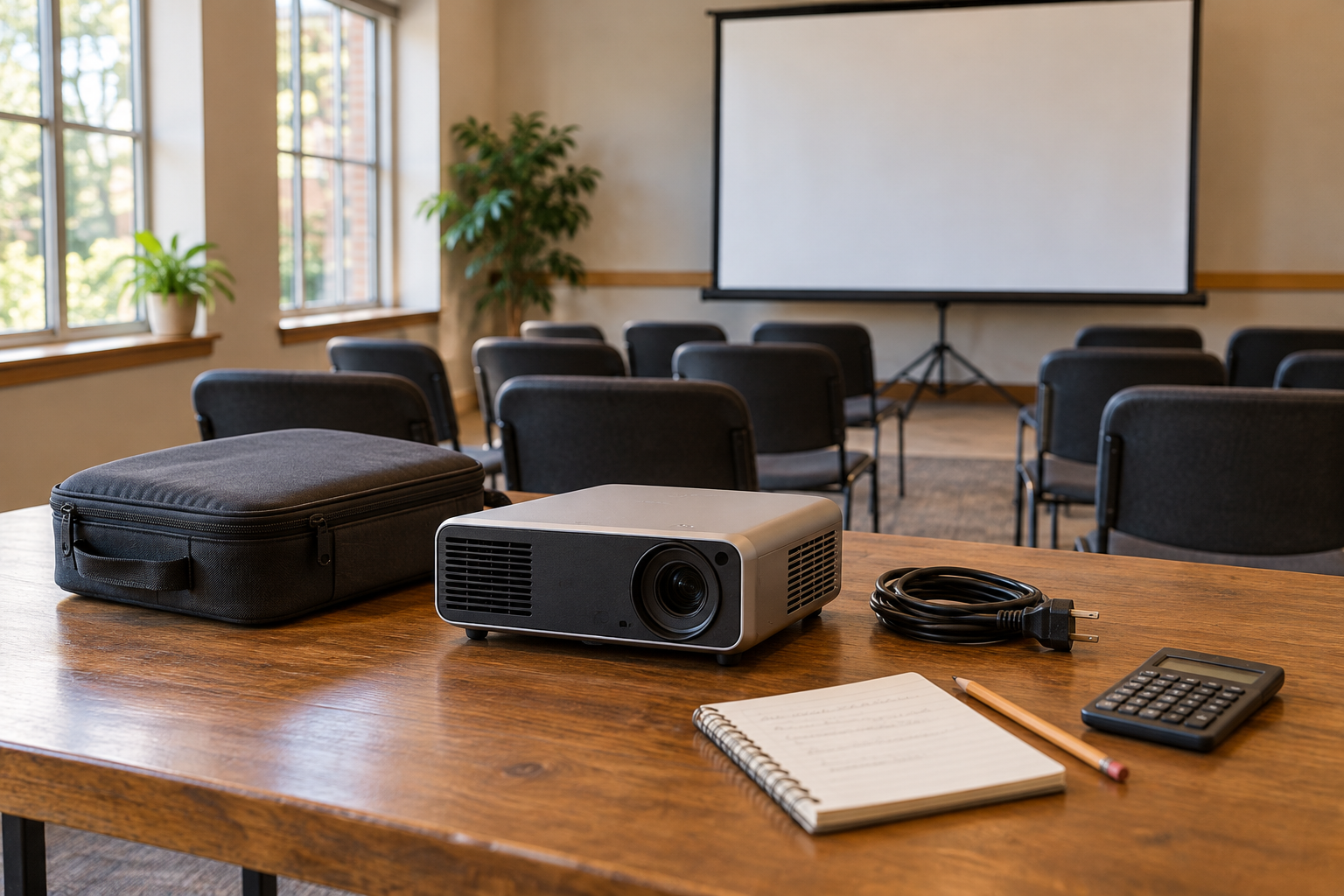
Equipment and planning materials arranged before a fictional workshop.
A tool can be affordable on the day you obtain it and expensive over the months you barely use it. The reverse is also possible: a higher purchase price may work out well for equipment that earns its place every week. For a small business or independent service provider, the useful question is not simply whether a monthly payment looks manageable. It is which arrangement gives you reliable access for the work you can reasonably expect to do.
Start with one essential item, not an entire wish list. This article offers a planning exercise for comparing short-term rental, a fixed-term lease and outright purchase. It does not recommend a particular product, lender or contract. Sources were reviewed on October 16, 2026. The example uses fictional U.S. dollar amounts, not market quotations, and excludes tax treatment and financing advice.
Describe the job before choosing the machine
Write a short requirement in everyday language: what must the tool accomplish, where will it operate, and what would make it unsuitable? An independent workshop facilitator might need a portable projector that produces readable slides in a moderately bright room, connects to an existing laptop and can be carried without difficulty. A cheaper unit that fails these requirements is not a comparable alternative.
Check the setting as carefully as the specification. Can the venue already supply suitable equipment? Is there a secure place to store it? Can you transport and set it up safely? Will everyone be able to use the output, including participants who need large print or a non-screen format? Access to equipment should improve the service, not make attendance depend on a participant's eyesight, device or technical confidence.
The U.S. Small Business Administration's equipment guide starts with identifying the assets the business needs before deciding how to acquire them. It also notes that lease structures vary. Treat a label such as “flexible lease” as an invitation to read the offer, not proof that you can leave whenever you want.
Put every offer on the same calendar
Choose a realistic comparison period, perhaps the next twelve months, and estimate actual working days within it. Separate confirmed work from possible work. Six booked sessions and twelve hopeful conversations are not eighteen bookings. A low-use and a higher-use scenario will tell you more than one optimistic forecast.
There is a useful precedent in the U.S. government's equipment-acquisition rules: agencies compare duration and extent of use, cumulative payments, purchase price, transport, storage, maintenance and other factors. These are federal procurement rules, not legal requirements for an ordinary small business. The transferable planning lesson is to compare equivalent service over an equivalent period, rather than one attractive price.
For each option, request a written, itemized quotation. Include required accessories, delivery or collection, setup, insurance or damage charges, servicing, return costs and any unavoidable final payment. Mark each item as included, extra or still unknown. An unknown is a question to resolve, not a zero. Keep refundable deposits separate: they may not be a final expense, but they still tie up cash while held.
A fictional projector comparison
Consider Maya, a fictional independent facilitator planning eight workshop days over one year. Assume all three offers provide equivalent equipment and accessories. For this teaching example only, short-term rental costs $75 per workshop day, including collection and return costs. A twelve-month lease costs $65 per month plus a $60 setup charge, with no ownership or buyout at the end. Buying costs $900, with a $100 allowance for ownership-related expenses and an estimated $300 net resale value after one year.
At eight days, rental totals $600. The lease totals $840: twelve payments of $65 plus $60. The purchase comparison is $700: $900 plus $100, less the assumed $300 recovered from resale. Those totals produce estimated costs per workshop day of $75, $105 and $87.50 respectively. These are equipment-access costs only, not the cost of delivering the workshop or a proposed customer price.
Now change only the use estimate. At sixteen days, rental becomes $1,200, while the simplified lease and ownership totals remain $840 and $700. Their per-day costs become $52.50 and $43.75. In this example the cost ranking changes because use changes. The fixed totals stay unchanged only because we assumed no extra wear, servicing or usage charges. A real comparison must test whether those assumptions hold.
Resale is a second uncertainty. If Maya receives only $100 net instead of $300, the ownership total becomes $900. If she keeps the projector, there is no resale receipt that year, even though it may retain value. Do not put a future sale into today's available cash. Check several plausible resale outcomes and the effort needed to find a buyer; do not make the purchase work only through the most generous estimate.
Compare the exit as carefully as the entry
Suppose two workshops are cancelled. A rental reservation may or may not be cancellable without charge. A lease may continue to require payments even when the projector is idle. Ownership leaves the facilitator with a tool to store, maintain, use elsewhere or sell. None of these arrangements is automatically best. Their value depends partly on how much uncertainty the business can absorb.
The Australian government's equipment comparison guide highlights this distinction: an equipment lease may require payments for its full term even when the equipment is no longer needed, whereas owned equipment can be sold to recover some cost. That is a useful question to investigate in any offer, not a statement about your local legal rights. Confirm the actual contract and applicable rules before relying on an exit route.
Ask the supplier to explain the end of the agreement in writing. Does the equipment go back, renew automatically or become available to buy? What notice is required? What counts as damage rather than ordinary wear? Who pays for return transport? If a term is unclear or the commitment is substantial, obtain qualified local advice before signing. A friendly sales explanation should not replace the written terms.
Reliability and cash can change the answer
The cheapest total does not help if the tool is unavailable on the day of paid work. Ask what happens after a breakdown, how quickly a replacement can arrive and whether support operates when you work. For Maya, a rental company with a dependable replacement process might justify a higher price. Equally, a venue's tested projector might remove the need to acquire one at all.
Run a short trial where possible. Test the actual laptop connection, transport weight, setup time, room lighting and readable output before committing to a longer arrangement. Plan an accessible fallback, such as printed material and a session that can proceed without projection. A fallback should preserve the purpose of the workshop, not merely satisfy a technical checklist.
Keep a separate cash calendar beside the total-cost comparison. Maya's purchase requires $900 at the beginning, while the lease spreads payments but creates a continuing commitment. The SBA warns that cash purchases leave less available for operating expenses. List what must still be paid before customer receipts arrive. A lower estimated annual cost can be the wrong choice if the initial payment leaves essential obligations uncovered.
This simple exercise deliberately leaves out loan interest, taxes and accounting treatment. If borrowing is involved, add the complete repayment schedule and fees rather than substituting the advertised monthly amount. For a large or multi-year decision, a qualified adviser can help compare cash timing, financing and tax consequences. Do not count an assumed tax saving as the reason to acquire an item the business does not need.
Make a decision you can revisit
Create a one-page comparison with the same required specification, time period and low-use scenario for every option. Record the total expected cost, upfront cash, cancellation obligations, repair arrangements and assumptions still needing evidence. Write a short decision sentence: “For the next three confirmed sessions, we will rent, then reconsider ownership once we have actual usage and support experience.” This is an example of a review rule, not a universal threshold.
Practical judgment like this connects with FWF's Skills, Work and Entrepreneurship pathway. Readers can explore the foundation's public priorities or contact FWF with a relevant question, without assuming that equipment finance or individual purchasing advice is available.
Your next step is small: choose one tool you are considering and ask for two comparable written offers. Then calculate the cost at your lowest plausible use level and read the exit terms. You do not need to predict the entire future. You need a decision that still makes sense when the calendar is quieter than you hoped.
Explore Resources for Your Next Step
This section contains affiliate and referral links. Qualifying purchases or sign-ups may generate a commission. Arbab Naseebullah Kasi will donate all commissions he receives through these links to Feel Worldwide Foundation Inc. to support its programs and operations.
These optional resources cover different kinds of business and learning work. They are not equipment quotations or a reason to add spending to your plan. Start with the tools you already have, and check current features, pricing and terms against a specific need before signing up.
For creative production, explore ElevenLabs, Synthesia or Pictory. For reading and communication, consider Bookshop or beehiiv. For business software, hosting or freelance services, explore Zoho, SiteGround or Fiverr. If travel is already part of your plans, Expedia and Viator offer travel-related resources.
